



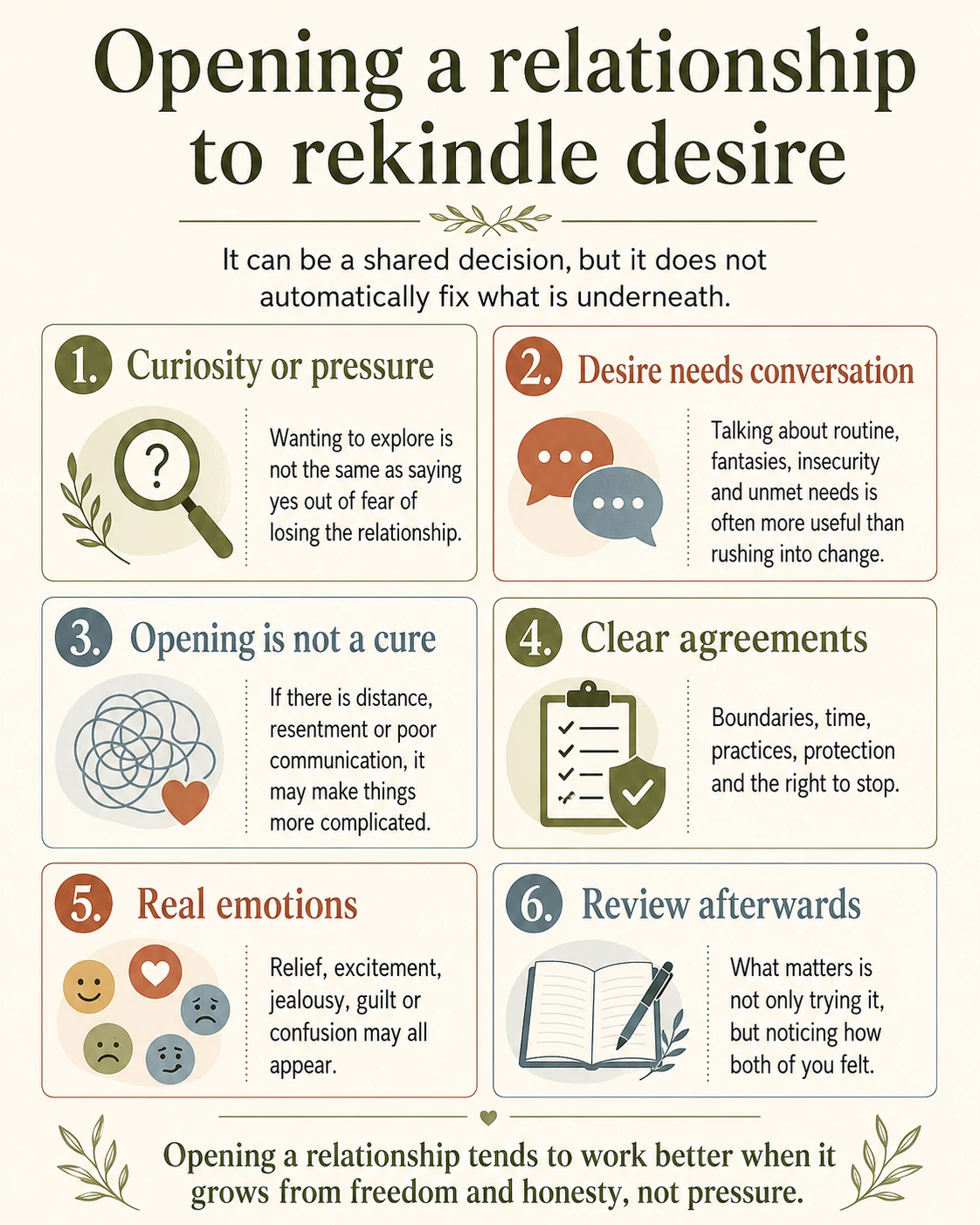
Opening a relationship may introduce novelty, but it is not an automatic treatment for low desire. If openness is used to avoid pain, resentment, sexual pressure or an unspoken incompatibility, it may intensify the problem. Before changing the relationship agreement, understand what is dampening desire and make sure both partners can say yes, no or not yet without punishment.
When desire declines, couples sometimes wonder whether meeting other people could bring back the spark. The fantasy may offer novelty, freedom or permission to explore parts of sexuality that routine has crowded out. It can also become a rapid solution to distress that needs a different kind of attention.
This guide does not try to persuade you towards openness or monogamy. It helps distinguish personal desire, shared curiosity and pressure; review physical and relational factors; and make a decision with realistic expectations.
Desire is not a switch or always one partner’s problem
Desire discrepancy means that people in a relationship want sexual activity at different frequencies, intensities or in different forms. It is common and changes over time. The challenge is not failing to have identical desire, but how the difference is interpreted and managed.
Sleep, stress, health, medication, pain, hormones, body image, novelty, emotional safety, care work, resentment and the quality of sexual experiences can all affect desire. Labelling somebody the low-desire partner may hide the fact that their desire appears in different conditions or that sex has become associated with obligation.
Can opening a relationship increase desire?
It can. Anticipation, novelty, feeling desired by somebody new or discovering fantasies may increase arousal. For some couples, external experiences also prompt erotic energy or more honest conversation within their relationship.
An initial increase does not prove that the model is sustainable or that the cause has been repaired. Desire may be directed towards new people without returning to the established relationship; comparison, jealousy, tiredness or time pressure may develop. Opening is a change in agreements and connections, not an isolated sexual technique.
Research does not show that monogamy or non-monogamy guarantees greater satisfaction. Autonomous motivation, consent, comfort, communication and genuine fit between structure and participants matter.

What opening cannot resolve by itself
Pain or medical factors
Pain, erectile difficulties, hormonal changes or medication effects need appropriate assessment, not pressure to add sexual partners.
Sex experienced as obligation
If saying no already leads to anger or withdrawal, openness may reproduce or multiply the same dynamic.
Accumulated resentment
Unequal care work, contempt and unrepaired injuries remain after the relationship opens.
Emotional disconnection
More experiences do not replace feeling seen, safe and supported in the relationship.
Structural incompatibility
One person may need monogamy while the other needs non-monogamy. Rules cannot always erase that difference.
An acute relationship crisis
Openness adds decisions, time and emotion; it rarely simplifies a crisis that already overwhelms the couple.
First explore what is affecting desire
For two or three weeks, each partner can privately note moments of connection, desire or lack of it, tiredness, stress, pleasant touch, pressure, pain and conditions that support arousal. The purpose is not to prove who is right but to identify patterns.
Ask what kind of desire is missing. There may be little spontaneous initiation but positive responsive desire once intimacy begins safely; individual desire without partnered desire; affection without eroticism; or desire blocked by fear, pain or conflict.

Motives worth naming honestly
- shared curiosity and a wish to explore;
- interest in non-monogamy beyond the present sexual difficulty;
- different preferred practices, frequencies or orientations;
- a search for validation, novelty or autonomy;
- fear of losing a partner or of an affair;
- hope that openness will prevent a break-up or difficult conversation;
- interest in a specific person who is already present.
Motives can be mixed. Naming the uncomfortable ones matters. Decisions driven mainly by guilt, threat or fear of abandonment have a more fragile basis than choices aligned with both partners’ values.

Questions to ask before opening
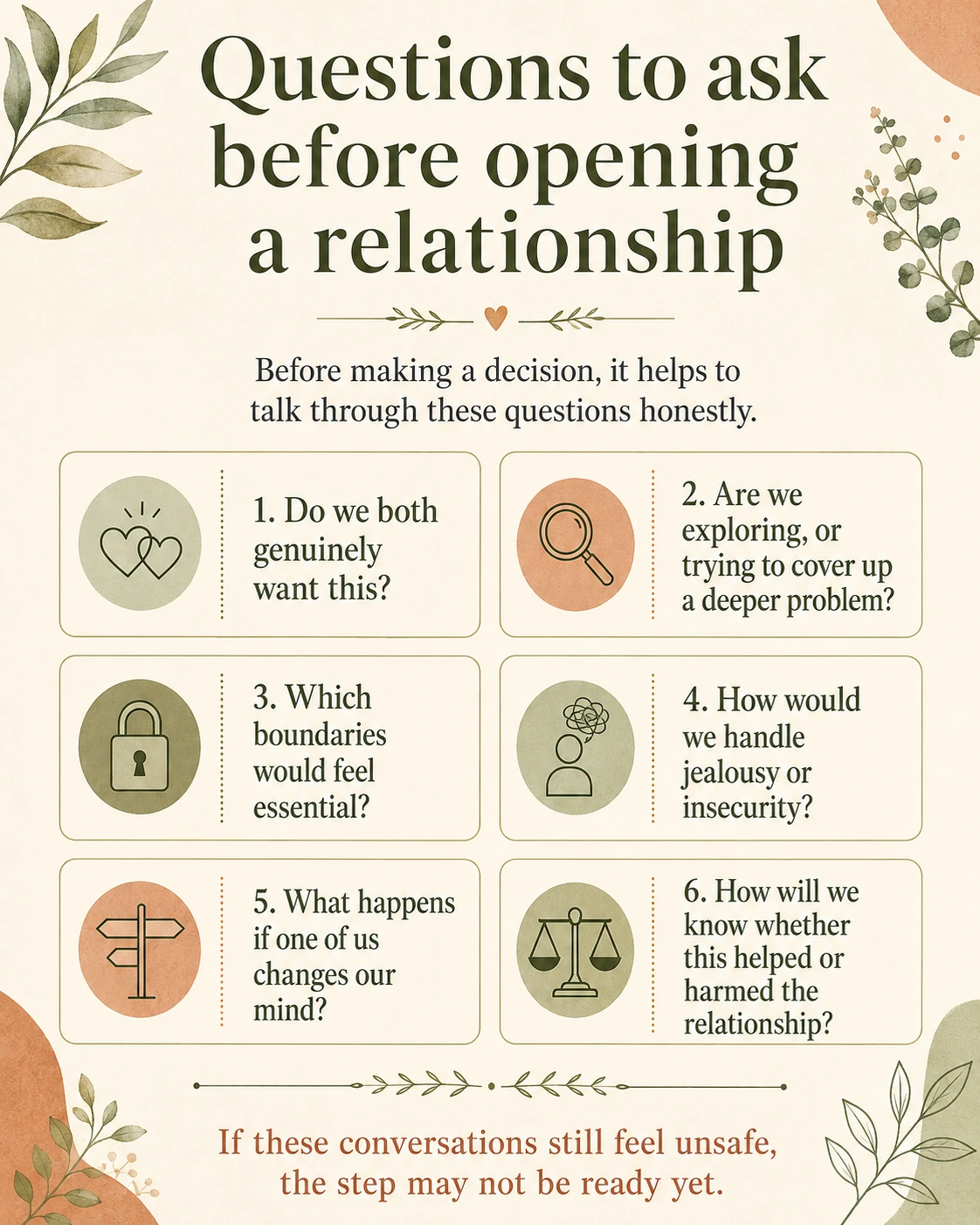
Would we open if our sex life felt satisfying?
This helps distinguish a relationship orientation from a temporary intervention for a symptom.
Can both of us say no?
A yes produced by threats, repeated pressure or guilt is not safe consent.
What exactly do we expect to change?
Turn “bring back the spark” into observable aims such as less pressure, more conversation or space to explore a fantasy.
What would stopping mean?
Plan how either partner can pause and how existing outside connections will be treated as people with feelings and rights.
How will we manage health, time and privacy?
Include barriers, testing, calendars, costs, personal data and communication of relevant changes.
If you explore, begin with the agreement rather than a date
Exploration might begin with reading, talking, sharing fantasies or attending a social space without participating. Every step needs fresh consent. Agreeing to talk, create a profile or attend a venue does not authorise the next step.
Discuss practices, people, follow-up contact, disclosure, sexual health, time and whether experiences are shared or separate. No rule should treat other people as disposable. If a connection develops, that person’s boundaries and feelings also matter.

Ways to work with desire without opening
These are not compulsory tests before openness, but they can reveal whether the couple is seeking novelty, relief from pressure or a different relationship structure:
- broaden intimacy and temporarily remove the requirement to reach a specific sexual act;
- protect erotic time from domestic work and screens;
- share fantasies with a clear right not to enact them;
- explore sensual touch, solo or mutual masturbation and new ways to initiate;
- review pain, sleep, stress, medication and sexual health with appropriate professionals;
- address resentment, workload and emotional safety;
- seek affirmative, non-moralising sex or couples therapy.

If one partner wants openness and the other does not
There is no compromise that turns no into yes. A partner can listen to what the proposal means, discuss fantasies or request time without agreeing to open. The interested partner may express a need but cannot turn it into a debt.
If monogamy is central for one partner and non-monogamy central for the other, there may be a genuine incompatibility. Recognising it is painful but more honest than beginning an arrangement sustained by fear.
When might sex or couples therapy help?
Therapy may help map desire, distinguish consent from resignation, discuss fantasies, review agreements or repair harm after an experience. Competent therapy neither prescribes nor pathologises openness.
Ocnos provides sex therapy and couples therapy in Palmones and online. You may also find our guides to open relationships and consensual non-monogamy useful.
Frequently asked questions
Does opening a relationship always rekindle desire?
No. Novelty may create excitement, but it does not automatically resolve exhaustion, pain, resentment, sexual pressure, medical factors or disconnection. Outcomes depend on what is affecting desire and how the decision is made.
Can we open our relationship for a trial period?
Yes, if both partners choose it and define what the trial means, how it can stop and what happens afterwards. A trial never removes either person’s right to change their mind during the process.
Do we both need exactly the same level of enthusiasm?
Enthusiasm need not be identical, but there must be a free and sufficient yes. Agreeing through fear, exhaustion or threat is not enthusiastic consent or a safe basis for opening.
Do jealousy and insecurity mean it cannot work?
Not necessarily. Jealousy may reveal fear, comparison or unmet needs. What matters is being able to discuss it, pause and revise agreements without punishment.
Is an open relationship the same as having an affair?
No. Open relationships involve knowledge, consent and agreements. Secrecy, deception or exploiting ambiguous permission may still breach trust.
When might therapy help?
Before opening when desire or certainty differs, and after opening if there is pressure, intense jealousy, broken agreements or difficulty reconnecting. Therapy should not impose either monogamy or openness.
Discuss desire without turning it into a threat
If you are considering opening your relationship, experiencing mismatched desire or already feel fear and pressure around the conversation, we can help you clarify needs and boundaries without imposing an outcome. Appointments are available in Palmones, Campo de Gibraltar, and online.
Scientific sources consulted
- Vowels, L. M. and Mark, K. P. (2020). Strategies couples use to manage sexual desire discrepancy. Archives of Sexual Behavior.
- de Oliveira, L. et al. (2020). European position statement on sexual desire discrepancy and clinical recommendations. Sexual Medicine.
- Wood, J. et al. (2018). Sexual motivation and relational outcomes among monogamous and consensually non-monogamous people. Journal of Social and Personal Relationships.
- Hangen, F. et al. (2020). Consent, comfort and communication in distinguishing consensual non-monogamy from infidelity. The Journal of Sex Research.
- Anderson, J. R. et al. (2026). Meta-analysis of relationship and sexual satisfaction by relationship orientation. The Journal of Sex Research.
Clinical note: this information does not replace individual psychological or medical assessment. If there is abuse, coercion or fear, seek safe individual support.