



You can withdraw consent for future experiences even if you previously agreed to open the relationship. Regret is not failure and does not oblige you to endure the arrangement for consistency. Closing cannot erase the past or make people in existing connections disposable. Pause, understand, communicate and decide responsibly.
You may have agreed enthusiastically and found reality very different. Perhaps intense jealousy appeared, an agreement was broken or you recognised that your yes came from fear. Your partner may also have formed a bond you cannot currently integrate.
Urgency may make you demand that everything returns to how it was. First pause new decisions, protect health and identify what “I regret this” actually means.

What to do during the first 24–48 hours
Pause new actions
Request no new dates or expanded agreements while you talk. A pause does not automatically resolve existing relationships.
Attend to sexual health
If a barrier failed or information was incomplete, communicate and seek healthcare advice promptly.
Avoid peak decisions
Do not demand unnecessary details, contact others impulsively or promise to continue simply to calm somebody.
Arrange a conversation
Agree when to talk and which questions matter. If fear is present, seek individual support first.
What exactly do you regret?
The structure
You discover that you cannot freely choose non-monogamy.
The pace
You wanted to explore, but events moved too quickly or intensely.
An agreement
A specific rule failed to protect what you expected or proved unworkable.
An experience
An encounter was unpleasant, unsafe or failed to respect consent.
Giving in
You recognise that you agreed to avoid conflict, abandonment or infidelity.
Unexpected impact
Reality triggered jealousy, grief or comparison that fantasy did not predict.

Withdrawing future consent is valid
Consent to a structure or encounter is not a permanent contract. You may say “I do not want new dates”, “I need a pause” or “I cannot continue in an open relationship”. You need not prove extreme harm.
Your boundary cannot force your partner to desire monogamy. They may agree to close, request time to handle connections or acknowledge a need for non-monogamy. If no structure can be freely chosen by both, there may be incompatibility.
Continuing because you fear a break-up, threats, anger, punishment or humiliation does not make openness consensual. If you cannot safely say no, seek individual support.
Other people are not collateral damage
If contact was casual, pausing may be straightforward. If an emotional relationship exists, demanding disappearance within minutes may harm somebody who participated in good faith. That person did not single-handedly create the couple’s difficulty.
This does not mean tolerating an unconsented structure indefinitely. It means that leaving requires honest communication, clear boundaries and proportionate timescales, unless risk, abuse or deception requires immediate no contact for safety.

Discussing regret without turning it into blame
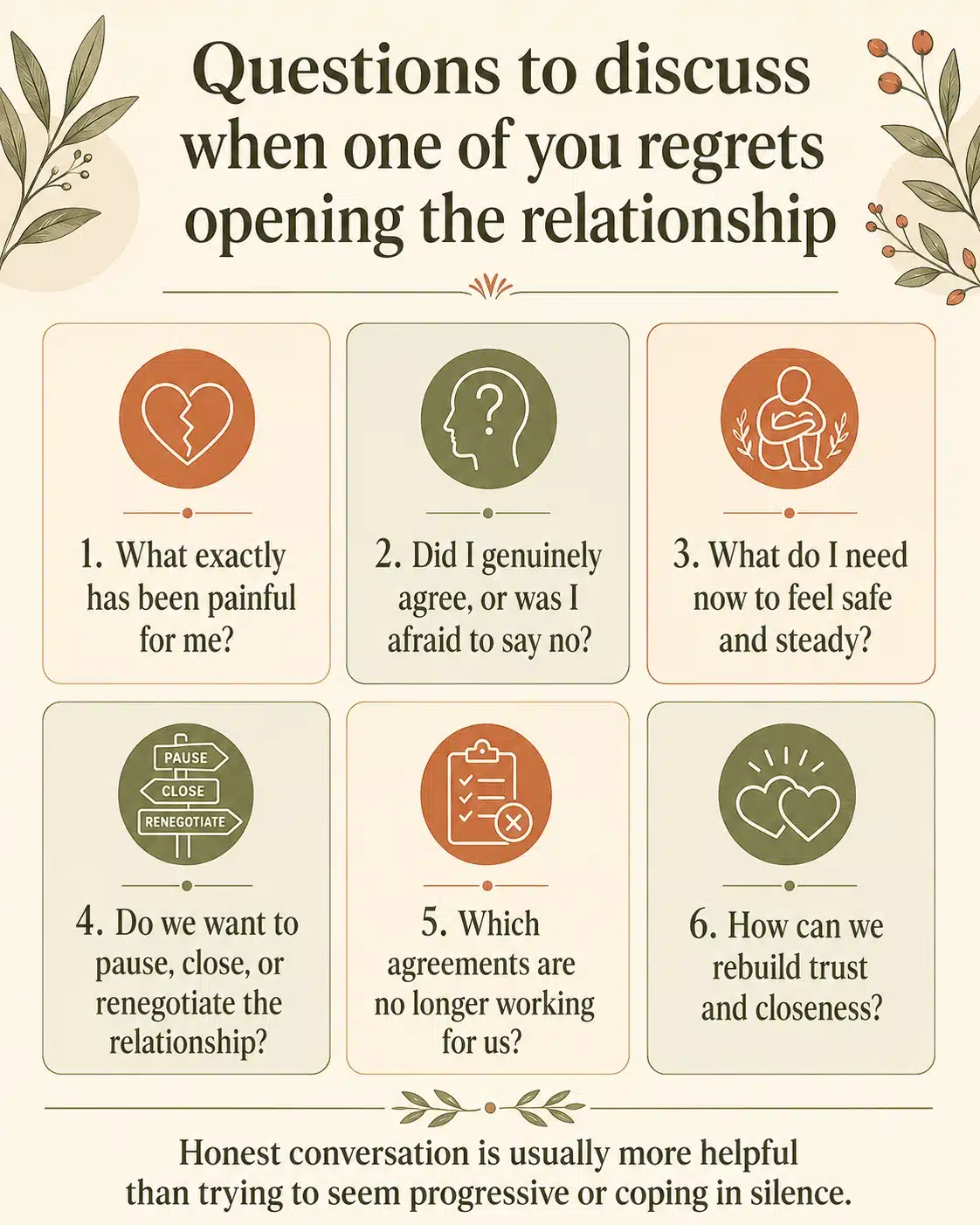
Use precise language: “I agreed, but now know I cannot continue”, “the agreement was broken and I need repair” or “I want to explore, but not at this pace”. Avoid “you forced me” when there was no pressure, and do not dismiss genuine pressure by saying “you agreed too”.
- Which part of the experience created regret?
- Was consent free, informed and genuinely stoppable?
- What needs to pause from today?
- Which outside connections exist and what commitments were communicated?
- What repair does the established relationship need?
- Is there any structure both people can choose without resignation?

Pause, close, reconfigure or separate
Pause
Stop new dates for a defined period to regulate, gather information and review agreements.
Reconfigure
Change pace, practices, autonomy, information or connection type when both still want to explore.
Close
Return to exclusivity by mutual choice while handling existing outside relationships ethically.
Separate
Recognise incompatible needs or that the harm prevents continuation.
No option guarantees immediate relief. Closing may bring calm alongside grief, resentment or distrust. Continuing may be possible at a much slower pace. Separation may be the most caring decision when no shared agreement exists.
If your partner does not want to close
Your partner may have feelings, values or bonds that do not disappear because of your regret. Listening does not oblige you to accept. Ask whether they can pause while you decide and what remaining open means to them.
Do not negotiate through repeated ultimatums. If one can remain only with exclusivity and the other only with openness, therapy may help recognise reality rather than manufacture an impossible solution.

Repair after pressure or a broken agreement
Repair means naming what happened without hiding behind the label open relationship. Where there was deception, pressure or a breach, accountability includes disclosure, stopping harmful behaviour, attending to sexual health and accepting that trust takes time.
The hurt partner may request agreed transparency, not unlimited surveillance. The responsible partner can answer relevant questions without providing minute sexual detail that fuels intrusive imagery. Set observable actions and a review date.

Returning to monogamy is not returning to the past
The relationship has learnt something about desire, boundaries and vulnerability. Pretending nothing happened may leave the subject ready to return. If you close, redefine exclusivity, contact with known people, sexual health and how future doubts will be discussed.
You may retain useful learning: explicit communication, autonomy, discussion of fantasy and fairer use of time. Closing a structure need not close conversation.
When therapy may help
Therapy may help when one person regrets opening and the other wants to continue, harm followed breaches, jealousy overwhelms or outside relationships are difficult to handle. A professional should not use therapy to persuade anybody to open or close.
Ocnos provides couples therapy and sex therapy in Palmones and online. You may also read about jealousy in an open relationship, open relationships and when one partner wants openness and the other does not.
Frequently asked questions
Can I withdraw consent after opening the relationship?
Yes for future experiences. Consenting once creates no permanent obligation. Withdrawal does not automatically erase existing connections, which require honest and careful handling.
Must my partner immediately end the other relationship?
You may agree an immediate pause on new dates, but an existing bond involves another person. Safety comes first, and ending or changing that bond requires accountability, communication and clear timescales.
Does regret mean opening was a mistake?
Not always. It may reflect initial activation, inadequate agreements, a need for a different pace or incompatibility with non-monogamy. Identify which part you regret.
Can we return to monogamy?
Yes, if both partners choose it and outside relationships are handled ethically. Closing again does not automatically restore trust; grief, repair and new agreements may be needed.
What if my partner wants to remain open?
You cannot force them to prefer monogamy, but you are not obliged to remain in a structure you do not consent to. The difference may be an incompatibility requiring painful decisions.
Can therapy help us close the relationship?
Therapy can support conversation, repair and decision-making, but should not promise that the couple stays together or impose closing or openness. Individual support may be appropriate where pressure or fear exists.
Regret deserves a safe conversation
If opening has led to regret, pressure or broken trust, we can help you pause, understand and decide without imposing a model. Appointments are available in Palmones, Campo de Gibraltar, and online.
Scientific sources consulted
- Hangen, F. et al. (2020). Consent, comfort and communication in distinguishing consensual non-monogamy from infidelity. The Journal of Sex Research.
- Wood, J. et al. (2018). Autonomous motivation and relational satisfaction in monogamous and consensually non-monogamous relationships. Journal of Social and Personal Relationships.
- Schechinger, H. A., Sakaluk, J. K. and Moors, A. C. (2018). Helpful and harmful therapy experiences reported by consensually non-monogamous clients. Journal of Consulting and Clinical Psychology.
- Mogilski, J. K. et al. (2026). International development and validation of a multiple-relationships maintenance measure. Archives of Sexual Behavior.
- Anderson, J. R. et al. (2026). Meta-analysis of relationship and sexual satisfaction by relationship orientation. The Journal of Sex Research.
Clinical note: this information does not replace psychological or medical assessment. If there is abuse, coercion or fear, seek safe individual support before considering joint therapy.