



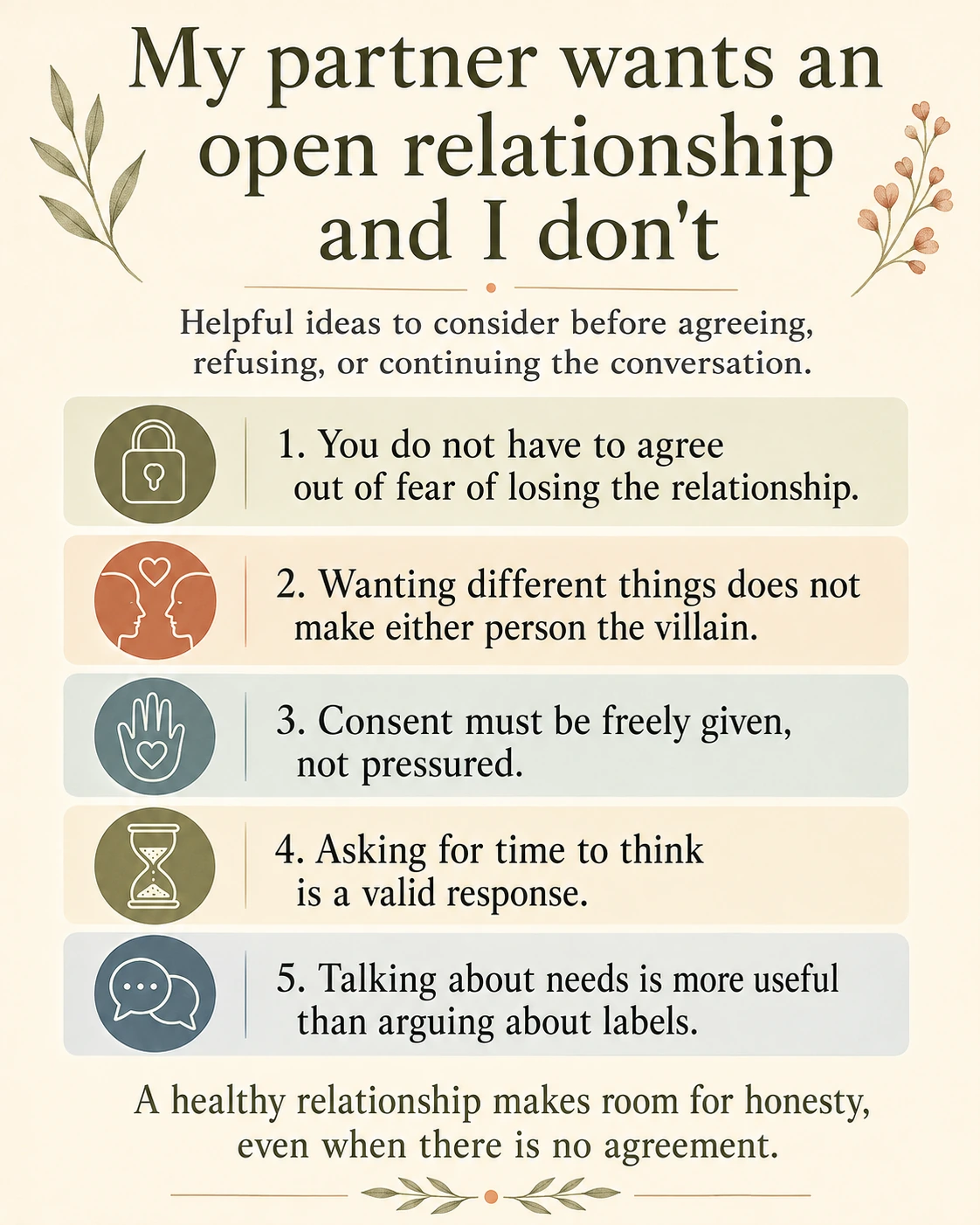
Your partner suggesting an open relationship does not oblige you to try it, defend monogamy or decide immediately. You can listen to what openness means to them and maintain your no. Changing a relationship agreement requires genuine freedom; agreeing to prevent anger, pressure or a break-up does not make openness consensual.
Hearing “I want an open relationship” may trigger fear, comparison, anger, curiosity or a sense that your shared history has changed meaning. It can also create urgency: answer now, prove that you are open-minded or compete with someone you may not even know.
You do not need to resolve this in the first conversation. This guide helps you regain choice, understand the proposal and distinguish a negotiable difference from incompatibility or pressure.
What to do during the first conversation
Request a pause
“I need time to understand how I feel. I will not decide today” is a complete response.
Separate listening from agreement
You can ask what the proposal means without consenting to a profile, date, practice or outside contact.
Protect the current agreement
Until a new agreement exists, the previous one remains. Requesting openness does not authorise acting as though it has been granted.
Regulate before going deeper
If either of you is frozen, shouting or panicking, pause and arrange a specific time to continue more safely.
The proposal may mean different things
It may express curiosity, fantasy, a wish for variety, a non-monogamous identity, feelings for somebody else, sexual dissatisfaction or a need to renegotiate the relationship. It may also disclose that something has already happened. Avoid assuming either the most reassuring or most catastrophic explanation.
Ask concrete questions: “Is this a fantasy or a need?”, “Is there a specific person?”, “Has anything happened that I need to know?”, “What do you imagine would change?” and “Could you continue in monogamy without resentment?”.
Fear, jealousy and sadness are not defective arguments
Your first reaction does not determine your final decision, but it deserves respect. You may fear losing exclusivity, time, safety, shared plans or your picture of the future. Curiosity and rejection may also coexist.
You do not have to prove that your boundary is scientifically superior. Monogamy and consensual non-monogamy can both support satisfying relationships. The question is which structure you can choose without abandoning yourself.

Distinguishing a boundary from a fear you want to explore
Boundary
“I cannot freely participate in a relationship with outside connections.” It does not require an expiry date.
Uncertainty
“I do not know what I want and need information, time or support.” The current answer is still not yet.
Explorable fear
“The idea interests me, but I fear jealousy or losing time.” Exploring fear does not oblige you to open.
Agreement under pressure
“I do not want this, but I will agree so they do not leave.” This is not a safe basis for consent.
A boundary describes what you can participate in; it does not control the other person’s life. Your partner may decide they need non-monogamy, and you may decide you cannot remain in that relationship. Both freedoms can reveal a painful incompatibility.
A framework for discussing needs and boundaries
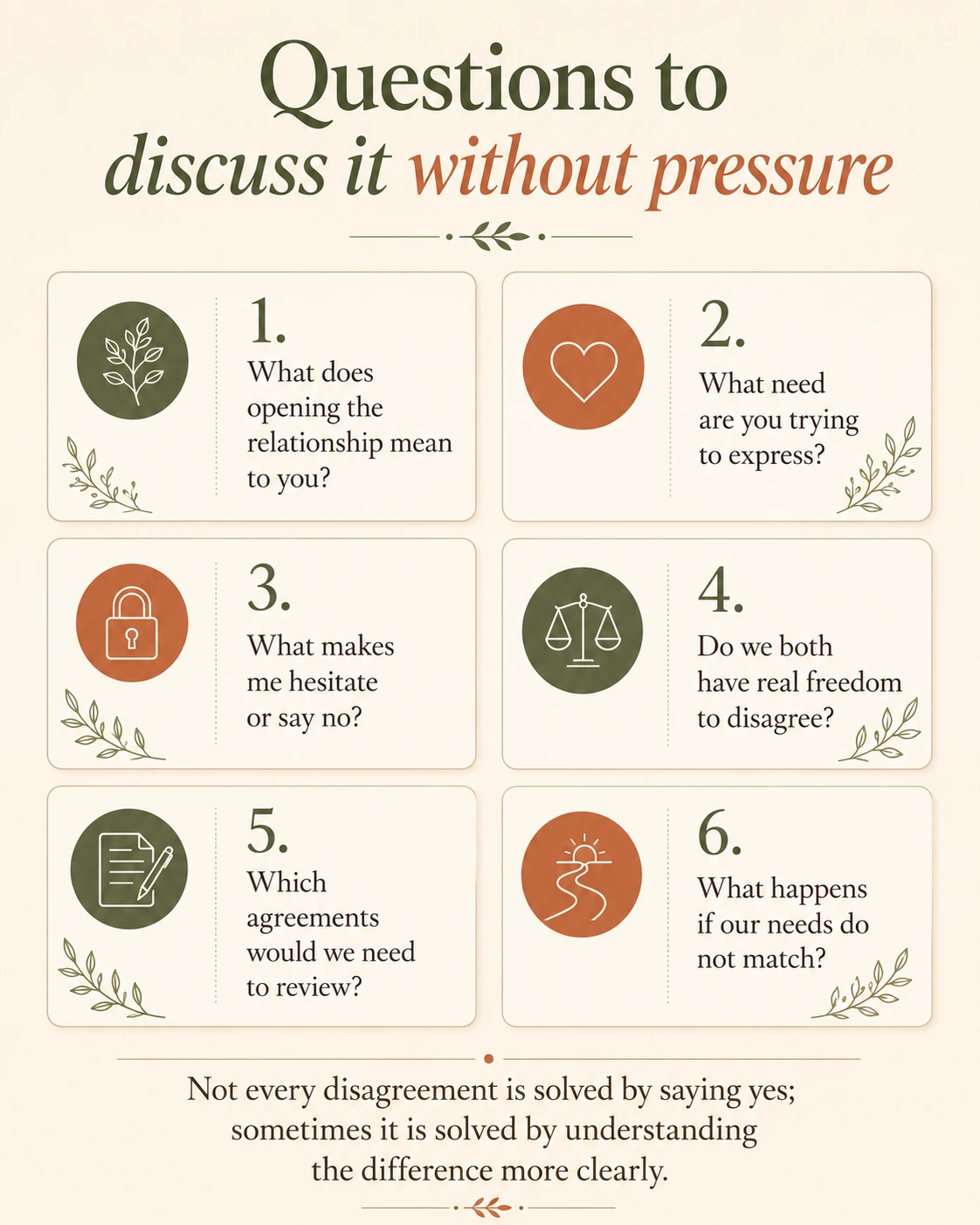
- Describe: “When I heard the proposal, I felt…” without turning emotion into accusation.
- Clarify: what open relationship means to each person; you may imagine very different structures.
- Name needs: variety, autonomy, safety, exclusivity, desire, honesty or belonging.
- Express boundaries: what you cannot freely choose now, without threats or ridicule.
- Choose the next step: pause, more information, therapy or acknowledgement of incompatibility.
You might agree a period without repeated requests — perhaps two weeks to reflect before a planned conversation. This time must not become a daily persuasion campaign.

Signs of pressure or coercion
- “If you loved me, you would try” or “otherwise I will cheat”;
- repeating the request until a partner agrees through exhaustion;
- calling someone insecure, old-fashioned or controlling for saying no;
- creating profiles, flirting or arranging dates before agreement;
- concealing a specific person or an outside relationship already begun;
- using therapy, friends or reading material to form a pressure campaign;
- punishing a boundary with silence, affection withdrawal, humiliation or threats.
Non-monogamy is consensual when there is knowledge, sufficient comfort and communication — not merely when somebody eventually says “fine”. If fear or control is present, seek safe individual support.
What tends to make the situation worse
- opening immediately to see whether you can tolerate it;
- requesting sexual details to compare or punish yourself;
- promising future openness simply to end the conversation;
- monitoring devices or locations rather than requesting honesty;
- involving a third person as a test or rescue;
- turning every intimate moment into negotiation about opening;
- having sex to prove that the relationship still works.

Your options are not limited to opening or breaking up today
Maintain monogamy
If both partners can choose it without resentment and want to address the needs behind the proposal.
Explore without opening
Discuss fantasies, broaden intimacy or learn about relationship structures while keeping the current agreement.
Negotiate openness
Only with a free and sufficient yes from both partners, revisable agreements and respect for others.
Acknowledge incompatibility
When a structure essential to one person violates a central boundary of the other.
A break-up does not prove that your boundary was wrong. Sometimes two people love one another but cannot build a shared structure without one permanently surrendering something essential.

If your partner acted before you agreed
The conversation has changed. It is no longer only a proposal but a possible breach of the existing agreement. You do not have to accept openness to redefine what happened retrospectively as consensual.
Request information needed for sexual health and trust without forcing yourself to hear details that cause further harm. You may ask for testing, a pause and individual support. Repair requires accountability, honesty and respect for your ability to decide.
How therapy can help
Therapy can create a space where the partner proposing openness is heard without turning desire into a command, and the partner saying no is heard without being labelled insecure. It can also clarify whether shared room exists or the difference is incompatible.
Ocnos provides couples therapy and sex therapy in Palmones and online. To understand the model, read our guide to open relationships and our article on opening a relationship to rekindle desire.
Frequently asked questions
Do I have to accept an open relationship to avoid losing my partner?
No. Staying in the relationship does not oblige you to accept practices or structures you do not want. You can listen to the proposal and still say no.
Does asking for time mean I will eventually agree?
No. Time is for understanding and deciding, not wearing down a boundary. You may set a pressure-free period and conclude that you do not want openness.
Does my partner no longer love me if they want openness?
Not necessarily. The proposal may reflect curiosity, identity, a wish for variety or dissatisfaction, among other possibilities. Only an honest conversation can clarify its meaning.
Can we find a compromise?
You may explore fantasies or redefine intimacy without opening, but there is no valid middle ground if it requires somebody to tolerate outside relationships against their will.
What if we are incompatible?
A structural incompatibility may require painful choices between important needs. It does not make either partner guilty, but it should not be managed through pressure or permanent resignation.
Can couples therapy persuade one of us?
That should not be the aim. Therapy can support safety, clarity and informed decisions; it should not be used to recruit one partner into the other’s preferred outcome.
Your no deserves to be heard without punishment
If the request to open your relationship has left you stuck, pressure is present or you do not know whether your needs are compatible, we can help you talk with greater safety and clarity. Appointments are available in Palmones, Campo de Gibraltar, and online.
Scientific sources consulted
- Hangen, F. et al. (2020). Consent, comfort and communication in consensual non-monogamy. The Journal of Sex Research.
- Wood, J. et al. (2018). Autonomous motivation and satisfaction in monogamous and consensually non-monogamous relationships. Journal of Social and Personal Relationships.
- Anderson, J. R. et al. (2026). Meta-analysis of relationship and sexual satisfaction by relationship orientation. The Journal of Sex Research.
- Schechinger, H. A., Sakaluk, J. K. and Moors, A. C. (2018). Helpful and harmful therapy practices reported by consensually non-monogamous clients. Journal of Consulting and Clinical Psychology.
- Vowels, L. M. and Mark, K. P. (2020). Partnered strategies for sexual desire discrepancy. Archives of Sexual Behavior.
Clinical note: this information does not replace individual psychological assessment. If there is abuse, coercion, surveillance or fear, seek safe individual support before considering joint therapy.