



A quad is a consensual relationship structure involving four people, but it does not require all six possible two-person relationships to be romantic, sexual or equally close. It might involve four mutually connected people, two connected couples or a differently shaped network. Its health depends on freedom of choice, clear agreements and care for each person, not on the group appearing perfectly symmetrical.
A four-person relationship can bring to mind one very specific picture: four people who love one another in the same way, do everything together and make every decision as a single unit. Real quad relationships can be far more varied and much less symmetrical.
This guide explains what a quad relationship is, how it may be organised, which particular difficulties can arise and which conversations help prevent alliances, exclusion and overload. The aim is not to present this model as better or worse than monogamy, but to offer criteria for approaching it with consent, responsibility and realism.
What is a quad or four-person relationship?
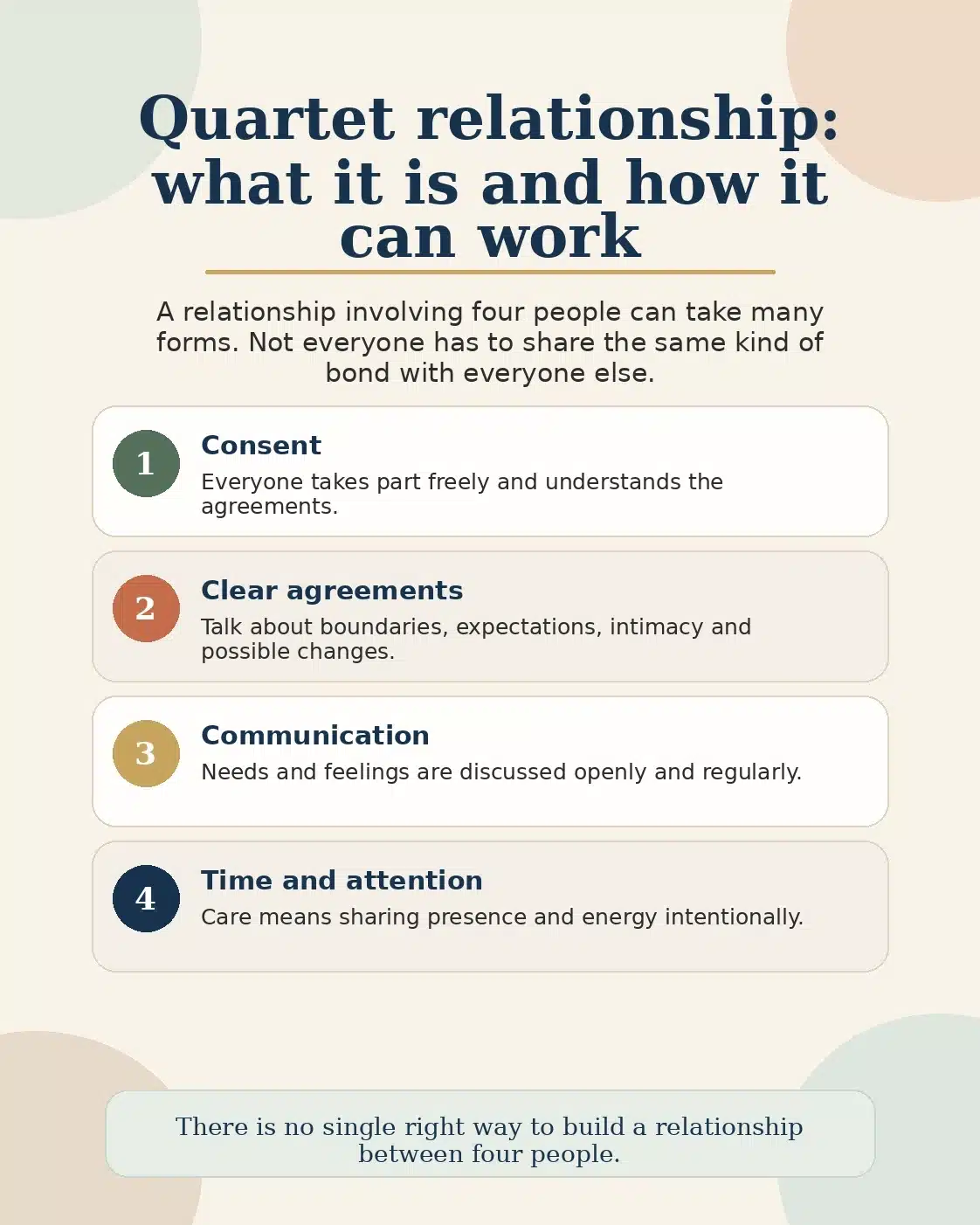
Within consensual non-monogamy, a quad is an intimate network involving four people. Sometimes all four consider themselves partners with one another. In other configurations, only some bonds are romantic, whilst the others involve friendship, shared home life, companionship or simply mutual respect.
If every person were romantically connected to every other member, there would be six two-person relationships: A–B, A–C, A–D, B–C, B–D and C–D, as well as the group dynamic. That mathematical possibility does not create an emotional obligation. Nobody has to fall in love, feel desire or develop intimacy with everybody else to make the network valid.
A quad is not defined by doing everything as four. It is defined by each person knowing the structure, being able to consent to it and understanding which relationships exist and which decisions affect them.
A quad is not the same as sex between four people
A sexual experience involving four people describes an activity, not a relationship structure. It may be a one-off event with no commitment afterwards. An intimate quad involves continuity, recognition and some degree of relational responsibility, even when group sex is not part of it.
The members’ sexual orientations cannot be inferred from the structure either. A quad may include four men, four women, non-binary people or different combinations of gender. It may be closed or allow relationships outside the group. The number of people does not automatically answer any of these questions.
How can a four-person relationship be structured?
Fully connected quad
All four people have some form of romantic relationship with one another. Even here, each bond may have a different intensity and expression.
Two connected couples
Two couples develop cross-connections, shared experiences or home life. Group sexuality may exist without everybody being romantic partners.
Asymmetrical network
One person may have several relationships whilst others have only one. The shape is less symmetrical but can still be consensual and clear.
Four-person polycule
All four belong to the same network without forming one group relationship. Polycule describes the wider network and does not mean everybody dates one another.
These structures can change. Two couples may grow closer, one relationship may end without dissolving the whole network, or a closed quad may reconsider its boundaries. Labels offer orientation; specific agreements explain how the relationship actually works.

Quad, throuple, polyamory and open relationship: the differences
Polyamory is the wider framework: it allows for several known and consensual romantic or emotionally intimate relationships. A quad is one possible configuration within that framework. A throuple involves three people, whilst an open relationship usually retains a central couple and permits certain outside experiences.
The categories may overlap. Two couples could describe themselves as a quad, an open relationship or a small polycule depending on how they experience the connections. There is no need to find a perfect term, but using the same term for incompatible expectations can create avoidable harm.
Can a four-person relationship work?
There is no evidence that consensually non-monogamous relationships are inherently less satisfying. A meta-analysis of 35 studies involving 24,489 participants found no overall difference in relationship or sexual satisfaction between monogamous and non-monogamous people. This does not guarantee the wellbeing of any particular quad; it helps separate the structure from the processes taking place inside it.
Evidence focused specifically on quads is scarce. Much research combines different forms of polyamory and non-monogamy, uses convenience samples and is cross-sectional. It cannot show that one configuration is superior or predict the future of a particular group.
Recent international research into maintaining multiple relationships identifies areas such as talking openly about jealousy, thoughtful resource distribution, sexual health, visibility and agreements about hierarchy. These are processes people can observe and revise without promising a perfect outcome.

More people does not mean dividing love: it means more relationships to care for
A fully connected quad may contain six two-person bonds, different groups of three and a shared group of four. Each conversation, change or conflict can affect more than one level. This complexity does not make the relationship impossible, but it does require time, energy and coordination.
The idea that love is unlimited may feel inspiring, but calendars, sleep, money and attention do have limits. Acknowledging them allows practical boundaries to be negotiated without treating every limit as a lack of love.
Each person can draw the network and write what they need in each bond: time, intimacy, information, independence, future plans or support. Compare the maps afterwards. Differences are not mistakes; they show where conversation is needed.
Nine essential conversations for a quad
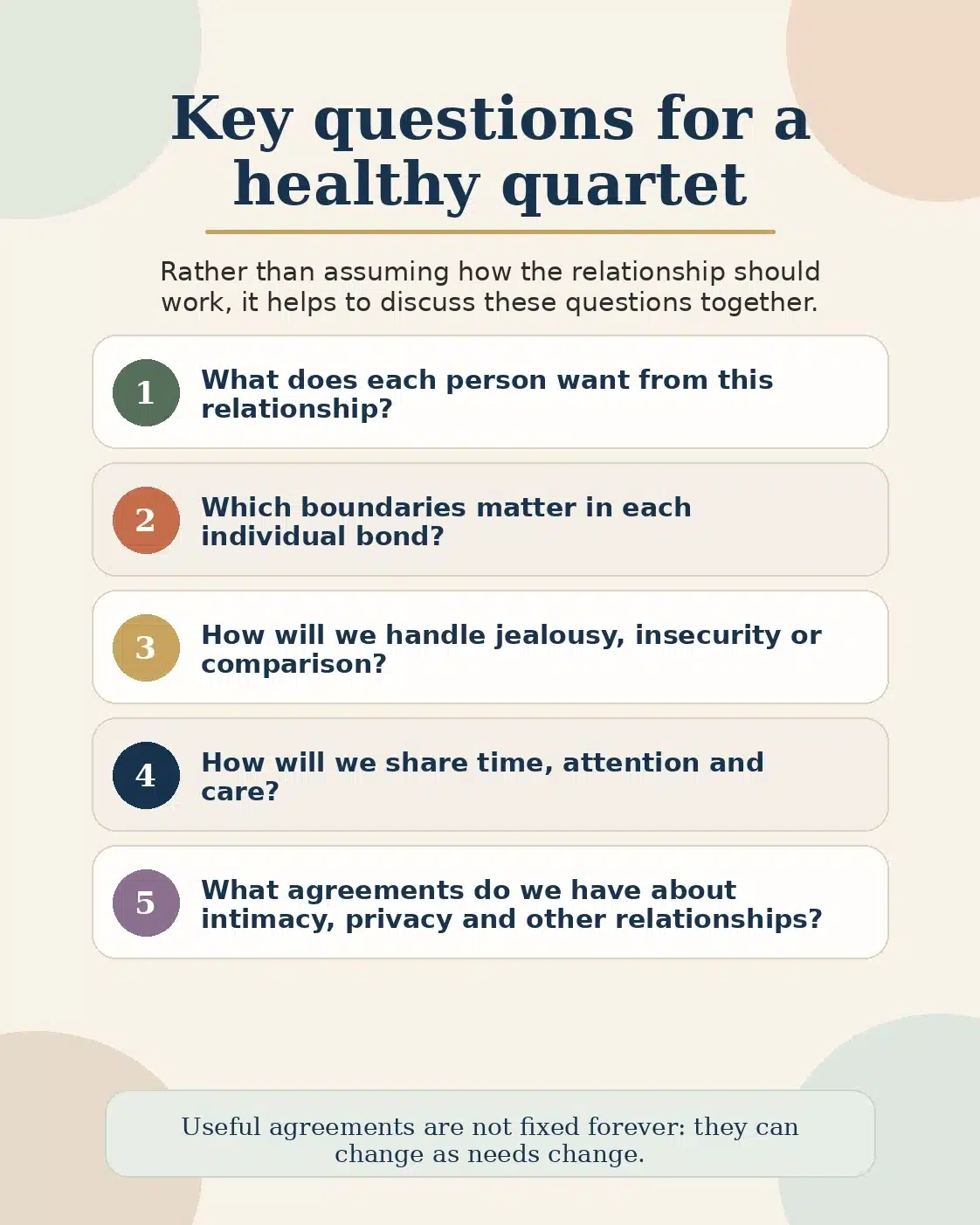
Which relationships exist?
Name who has a romantic, sexual, domestic or friendship connection with whom, without expecting every bond to develop in the same direction.
What does commitment mean?
Clarify whether this is an exploratory relationship, a stable network, a shared-home plan or something else. Do not assume everybody imagines the same future.
How will time be shared?
Include individual time, time for each relationship, time in smaller groups and time as four. Fair does not always mean identical.
How will decisions be made?
Separate personal decisions, decisions belonging to particular relationships and those affecting everybody. Not everything needs a vote; nobody should be excluded from choices that change their life.
Which information is private?
Being in one group does not authorise sharing private conversations, sexual details or conflicts. Agree what may move from one relationship to another.
Is the network closed or open?
Discuss outside dates and relationships, changes to agreements, the ability to say no and how new information will be communicated.
How will sexual health be cared for?
Be specific about barriers, testing, contraception where relevant, changes in risk and what happens after a breach without punishment or concealment.
How visible will each person be?
People may face different risks with relatives, work or their community. Do not force somebody to hide or be visible in order to prove commitment.
What happens if one bond changes?
A breakup does not have to erase all the other relationships. Prepare conversations about housing, contact, support, belongings and autonomy.
Time, intimacy and a sense of belonging
Time is often one of the most sensitive resources. If two people live together and others do not, or if children, shift work or distance are involved, spontaneity may repeatedly benefit the same people. A calendar cannot create affection, but it can reveal inequalities that memory minimises.
Each relationship also needs appropriate privacy. Doing everything as four may look equal, yet it can prevent deeper conversations or make independence feel threatening. The aim is for two-person time not to communicate abandonment to others and for group time not to replace every individual bond.
- Who usually proposes plans, and who usually adapts?
- Does any relationship receive only the time left over?
- Does everybody retain rest, friendships and personal space?
- Is group time freely chosen or only logistical?
- Which small adjustment would be realistic next month?

Jealousy and comparison when four people are involved
Jealousy may focus on one person, a couple within the group or a perceived alliance. Somebody may fear receiving less desire, less public recognition or less influence. These feelings do not invalidate the relationship or automatically make the person possessive.
It helps to distinguish an anticipated fear from an observable pattern. “I worry I will be left out” is not the same as “three people made a decision about my home without me”. The first may need emotional regulation and reassurance; the second requires a participation problem to be corrected.
Instead of comparing every message or gesture, describe one fact, say what it means to you and make a specific request. “When our time is repeatedly cancelled, I feel this relationship comes last. Could we protect one date every fortnight and review whether it helps?”
Preventing “three against one” or “two against two” alliances
Four people allow more coalitions. An established couple may vote as a block, three members may decide that the fourth is “the problem”, or two couples may compete over time, rules and recognition. A majority does not automatically make an intimate decision fair.
- Speak directly: do not routinely use another person as a messenger.
- Identify the level of the problem: some difficulties belong to a two-person relationship; others affect the whole group.
- Hear the minority voice: disagreement should not put somebody’s belonging at risk.
- Avoid surprise meetings: nobody should face three people who have already agreed a position.
- Repair without demanding identical feelings: harm can be acknowledged even when people understand it differently.

Established couples, hierarchy and power
When a quad develops from two couples, existing histories, habits and protections remain influential. It may be more honest to identify how housing, marriage, money, parenting or public recognition already shape decisions than to claim that no hierarchy exists.
Descriptive hierarchy recognises real differences. Prescriptive hierarchy decides in advance that certain people will always matter less or may be removed without being heard. The problem is not that all relationships differ; it is that somebody must accept permanent vulnerability to remain in the network.
Knowing a condition exists does not mean somebody can freely choose it. Ask whether there is genuine room to negotiate, request time or leave without losing housing, employment, financial support or safety.
Sexual health, privacy and shared care
Sexual risk depends on practices, barriers, testing, communication and outside connections, not simply on whether the quad is labelled closed or open. Each person needs enough information to consent and the ability to revisit agreements. Sex therapy may help with desire, anxiety or communication, but does not replace medical care.
Privacy also needs boundaries. Not everything one person tells another belongs to the group. Similarly, making the relationship public, sharing photographs or disclosing somebody’s orientation requires consent.
Legal protections are generally organised around couples. Marriage, housing, inheritance, parenthood and medical decisions may leave members with different rights. When a group shares a home, assets, parenting or financial dependency, qualified legal advice is important.
Warning signs that should not be normalised
Consent under pressure
Somebody agrees to sex, home arrangements or rules because they fear losing several people or becoming unsupported.
Permanent alliances
The same people always decide, and anyone who disagrees is labelled jealous, difficult or immature.
Compulsory intimacy
Everybody is expected to feel desire for everybody else, join group sex or reveal private conversations.
Control and monitoring
Passwords, continuous location sharing or permission for private conversations and relationships are demanded.
Material inequality
One person lacks rights over housing, money or care and cannot safely question that dependency.
Threats and punishment
Expressing boundaries leads to humiliation, isolation, coordinated withdrawal of affection or threats of removal.
If there is abuse, fear, coercion or financial control, individual safety is the priority. Joint therapy may not be appropriate when somebody cannot speak freely in front of the others.

When might therapy help a quad?
Therapy may help clarify the structure, revisit agreements, prepare to live together, work with jealousy, repair a breach of trust or decide how to continue after one bond changes. A group does not need to wait for a severe crisis.
A therapist should not assume the number of people caused the problem or attempt to direct the group towards monogamy. Research with consensually non-monogamous clients links informed, affirming practice with better evaluations of therapy, whilst biased practice may harm the alliance and contribute to people ending therapy early.
Ocnos offers couples and relationship therapy in Palmones and online. Before joint work begins, we consider who will attend, what information may be shared and whether everybody can speak safely. If sexual orientation, gender identity or relationship stigma contributes to distress, you can also learn about our LGBTQ+ affirmative therapy.
Continue exploring relationship models
Frequently asked questions about quad relationships
Is a quad always polyamorous?
It is usually considered polyamorous when several known and consensual romantic or emotionally intimate relationships exist. However, two connected couples may use another label. What matters is explaining the actual structure.
Do all four people have to date one another?
No. Four people create six possible pairings, but not all of them need to be romantic, sexual or equally close. Each person should be able to define their relationships without pressure.
Does a quad involve sex between all four people?
No. Group sex is a possible activity, not a requirement. Every encounter needs specific consent, and joining the relationship does not oblige anybody to desire every possible combination.
How can time be shared fairly?
There is no formula that suits everybody. Distinguish individual time, two-person time, smaller groups and time as four, notice who repeatedly adapts, and review the distribution regularly.
What happens if one relationship ends?
One breakup does not have to dissolve the whole network. The people involved decide about their bond and speak with the group about practical effects, without assuming anyone controls other people’s relationships.
Can four people in a quad legally marry?
Spanish civil law does not provide one marriage for four people. Other legal tools may help with housing, assets, inheritance or care, but they require advice from a suitably qualified legal professional.
A space to talk without judgement
If you need clearer agreements, help understanding an inequality or a safer way back into conversations that end in alliances and deadlock, we can support you with a clinical approach that respects relationship diversity. Appointments are available in person in Palmones, Campo de Gibraltar, and online.
Scientific sources consulted
- Anderson, J. R. et al. (2026). Meta-analysis of 35 studies comparing relationship and sexual satisfaction by relationship orientation. Journal of Sex Research.
- Balzarini, R. N. et al. (2017). Perceptions of primary and secondary relationships in a sample of people practising polyamory. PLOS ONE.
- Hangen, F. et al. (2020). Consent, comfort and communication in distinguishing non-monogamous agreements from infidelity. Journal of Sex Research.
- Witherspoon, R. G. and Theodore, P. S. (2021). Minority stress and resilience in a polyamorous sample. Archives of Sexual Behavior.
- Mogilski, J. K. et al. (2026). International development of a measure of relationship-maintenance practices in consensually non-monogamous relationships. Archives of Sexual Behavior.
- Schechinger, H. A., Sakaluk, J. K. and Moors, A. C. (2018). Helpful and harmful therapy practices with consensually non-monogamous clients. Journal of Consulting and Clinical Psychology.
Clinical note: this article is for information and does not replace an individual psychological, medical or legal assessment. A relationship structure is not a diagnosis. If there is abuse, coercion or fear, seek safe, individual support.