



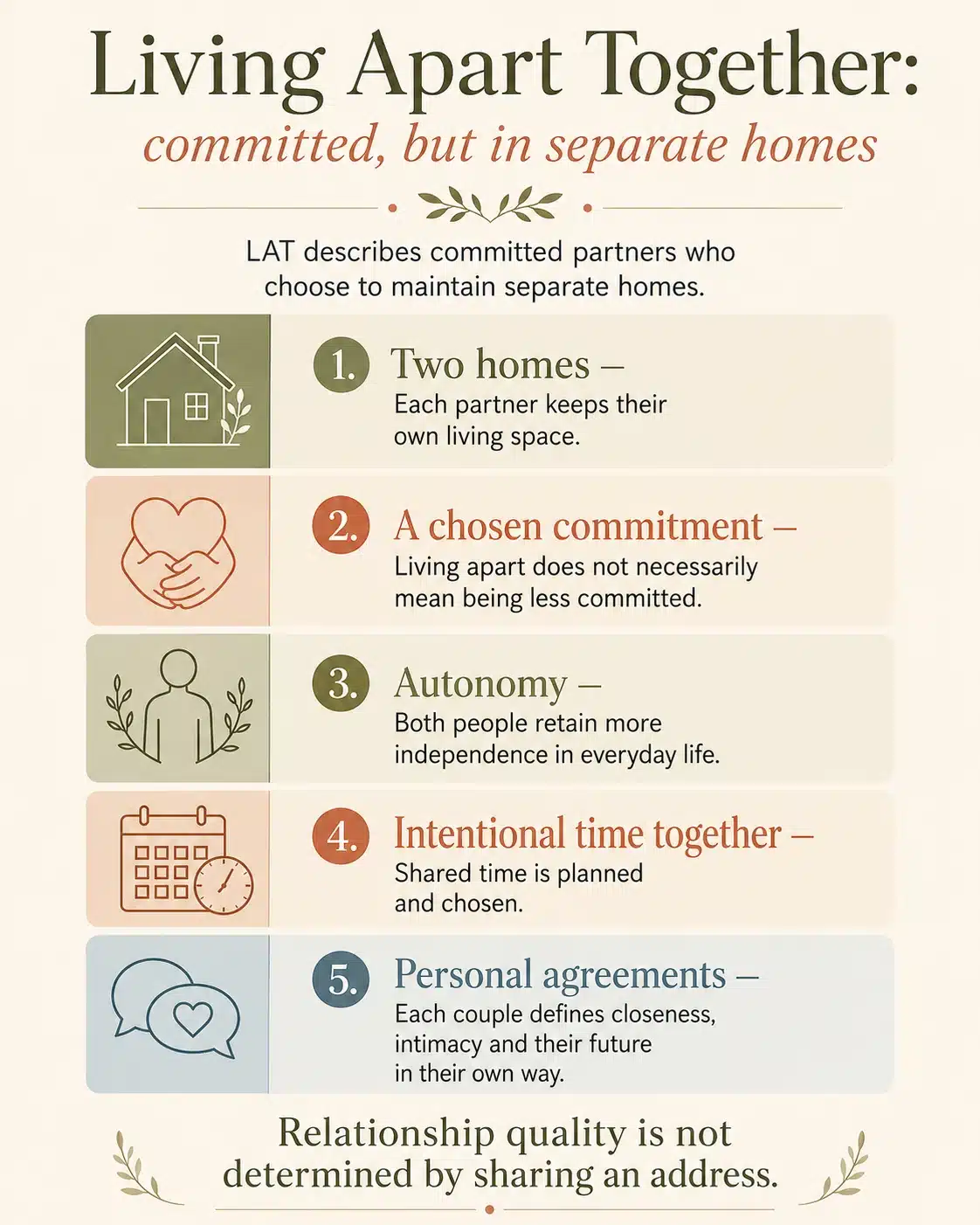
A Living Apart Together (LAT) couple has an intimate, committed relationship while each partner keeps their own home. It may be a lasting choice or a stage. It tends to work better when living separately is sufficiently mutual and there are clear agreements about time, care, money, exclusivity, emergencies and the future.
Loving someone without sharing a home can seem contradictory because commitment is still often associated with one sequence: meet, move in, marry and build a single household. Some couples, however, choose to maintain two homes and one shared relationship.
This guide explains what Living Apart Together means, the very different realities included under the LAT label and the conversations that help autonomy remain connected rather than turning into emotional distance. Neither cohabitation nor separate homes is inherently better; the useful question is whether the arrangement is freely chosen, fair and well cared for.
What are Living Apart Together relationships?
Living Apart Together describes people who identify as a couple, maintain separate households and do not consider residential distance to cancel their bond. Some live a few minutes apart; others are based in different towns or countries.
The central feature is not sleeping apart every night but not merging the main household. Partners may spend nights together, hold keys, keep belongings at each home or stay for long periods. Commitment is expressed through decisions, support, intimacy and shared direction, not only through one address.
LAT, long-distance and separation are not the same
Chosen LAT relationship
Separate homes are part of the preferred arrangement, although the decision can still be reviewed.
Long-distance relationship
Geography often imposes the distance, and partners may hope to live closer when circumstances allow.
Delayed cohabitation
The couple wants to live together, but work, study, housing, migration or care responsibilities make it impractical for now.
Relationship separation
Moving into separate homes may accompany a break-up or trial period; it does not automatically become a LAT choice.
These boundaries can change. Delayed cohabitation may become a lasting preference, and a LAT couple may later share a home. Labels help, but it matters more that both partners understand the relationship and its direction in broadly similar ways.
Why might a couple choose separate homes?
There is no single reason. European research finds considerable diversity connected with age, life stage, resources and cohabitation intentions. Reasons may include:
- protecting autonomy, rest, routines or time alone;
- avoiding a disruptive household merger for children after divorce or bereavement;
- maintaining work, study or care responsibilities in different places;
- preserving housing, assets or a degree of financial independence;
- accommodating different schedules, sleep, health, disability or sensory needs;
- wanting a committed relationship without everyday cohabitation.
A reason need not sound romantic to be valid, but it should be discussable. “I need space” may mean healthy rest, fear of losing independence or avoidance of intimacy. Understanding what the distance protects makes its benefits and costs easier to assess.

Do LAT relationships work? What research can tell us
There is no universal answer. A four-country study of 9,604 people found differences in relationship satisfaction across union types and, within LAT relationships, according to future intentions. The LAT label includes very different situations: wanting separate homes is not the same as being unable to live together yet.
Qualitative interviews with 28 Canadian LAT couples found that many constructed commitment through mutual support, affection, shared history, long-term orientation and a willingness to work through difficulties. A shared address was not their only measure of commitment.
Among adults aged over 60 in the UK, a longitudinal study published in 2025 found better mental health while in a LAT relationship than while single, and little overall difference across LAT, cohabiting and marital partnerships. This finding concerns older adults; it is not a clinical promise for every age group.
Most evidence is observational. It identifies associations and experiences but does not prove that moving into separate homes causes greater wellbeing. Choice, context, resources and the existing quality of the relationship may all shape the findings.
Possible benefits and difficulties of living apart
Everyday autonomy
Each partner can manage sleep, routines, tidiness, visitors and solitude with less domestic negotiation.
Intentional time together
Shared time can be planned and experienced with greater presence rather than assumed.
Cost and logistics
Two households, travel and duplicated resources may create financial pressure or exhaustion.
Less immediate support
Illness, emergencies and difficult weeks require clear decisions about who travels and provides care.
Ambiguity
If one partner sees LAT as a destination and the other as a stage, waiting can create insecurity and resentment.
Social pressure
Friends or relatives may question the couple’s commitment, particularly when the relationship is less visible.
Seven agreements worth making explicit
Living apart does not remove negotiation; it changes its subject matter. Agreements are most useful as revisable conversations rather than rules designed to control.
Shared time and personal time
How often does each partner need to meet? Discuss nights together, weekends, holidays and room for spontaneity.
Communication between visits
Decide what helps you stay connected without turning messaging or location sharing into surveillance.
Access to each home
Talk about keys, unannounced visits, belongings, privacy, children or relatives in the home and the right to request time alone.
Money and travel
Share travel, meals, holidays and joint costs fairly and visibly. Fair need not mean identical.
Exclusivity and relationship boundaries
Separate homes do not imply monogamy or openness. Define fidelity, boundaries and what information each partner needs.
Care and emergencies
Who can enter, accompany a partner to hospital or be contacted? Make realistic plans rather than impossible promises.
Future direction
Is LAT a stable plan, a stage or an open question? Set times to revisit the answer without using deadlines as threats.

Maintaining connection without a shared household
Residential distance can protect autonomy while concealing emotional disconnection. Mix enjoyable dates with access to ordinary life: know what is worrying your partner, take part in important decisions and remain present when time together is not special or effortless.
- a weekly check-in for plans, logistics and needs;
- time together that is not entirely administration;
- one concrete question: “What helped you feel supported this week?”;
- a flexible plan for illness, stress and unexpected events;
- a monthly review of what works and what is quietly accumulating.
Travel, organising and remembering should not consistently fall to the same person. Equity is about workload and available resources, not simply counting visits.

Healthy autonomy or avoidance: how can you tell?
Needing space is not a psychological problem. Healthy autonomy allows both closeness and distance without punishment, makes difficult conversations possible and leaves room to ask for help. Avoidance is more likely when distance is used to escape repair, conceal relevant information or refuse any mutual dependence.
Ask yourselves: can we be vulnerable, are we available in a crisis, do boundaries protect us both, can we discuss cohabitation without panic or threats, and does each home expand our lives or provide somewhere to disappear whenever discomfort appears?

Children, care, money and legal recognition
When children, dependent relatives or established homes are involved, LAT may reduce disruptive changes while creating complex timetables. Discuss who knows about the relationship, how new partners are introduced, which spaces are shared and which decisions remain with each parent.
Illness and ageing raise questions that early excitement may overlook: accompaniment, accessibility, everyday care, inheritance, medical decisions and housing. Separate homes do not prevent care, but they require it to be designed.
Legal recognition does not automatically follow emotional commitment and varies by jurisdiction and circumstances. Seek specific legal advice about wills, property, partnership rights, benefits or healthcare decisions.

Signs that living apart is harming the relationship
- one partner accepts the distance for fear of being abandoned;
- there is no reliable response to illness, crisis or important needs;
- every conversation about the future ends in threats, silence or disappearance;
- a private home is used to keep secrets that affect consent;
- cost, travel and organisation are unfairly concentrated;
- the relationship works only by avoiding all conflict or vulnerability;
- there is control, coercion, violence or fear.
Changing structure does not by itself repair contempt, control or insecurity. Separate homes may reduce friction, or they may postpone a necessary decision. Where there is abuse or coercion, prioritise safe individual support rather than joint therapy.
Could Living Apart Together work for us?
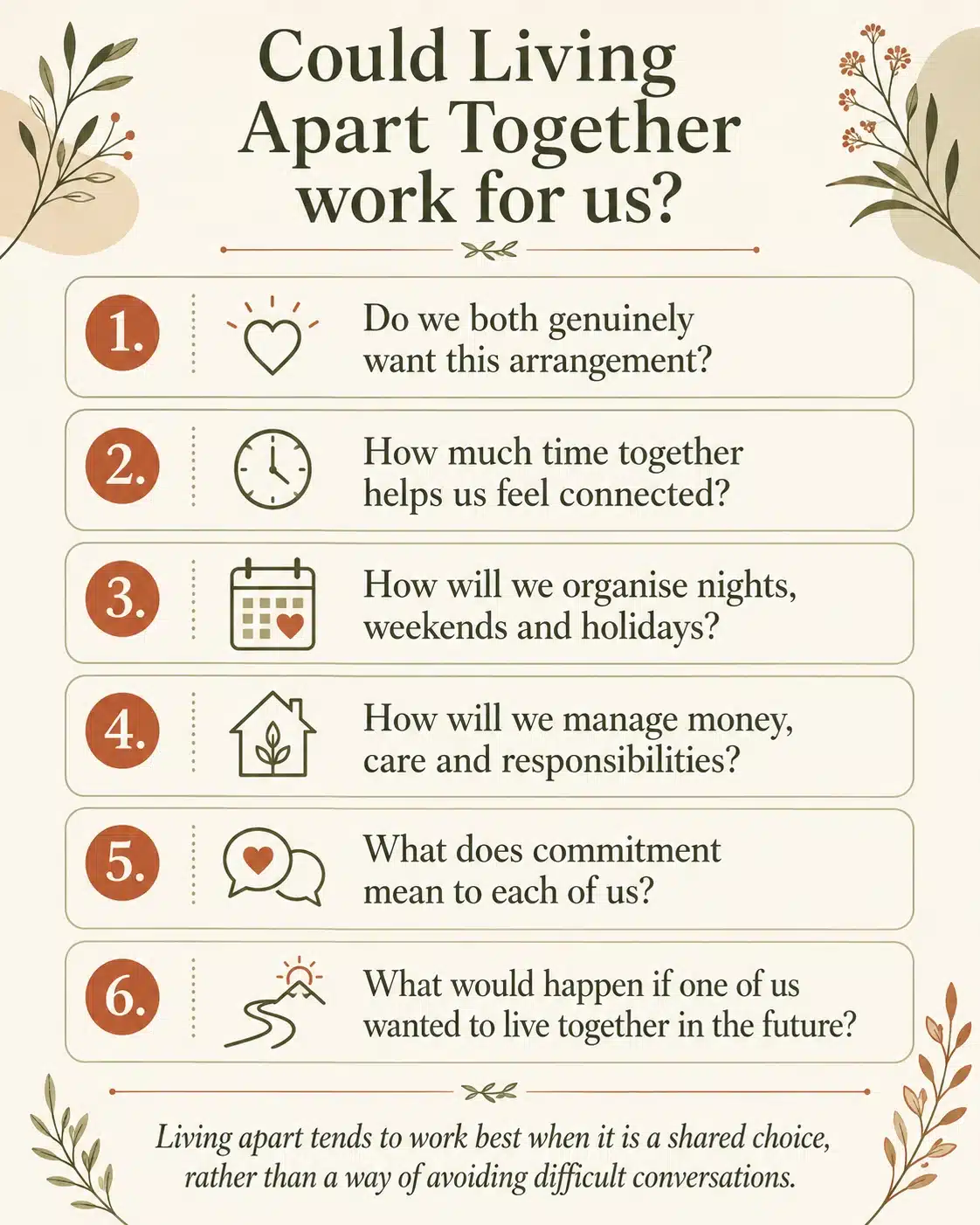
Is this a choice or an emergency exit?
Name the problem you hope to solve and what would still require relationship work.
What does commitment mean to each of us?
Define support, exclusivity or openness, shared projects, visibility and presence during difficulty.
Can we sustain it materially?
Calculate housing, travel, care and time, including work that never appears on a bill.
How much contact do we need?
Compare desired minimums with realistic maximums without treating either partner’s needs as unreasonable.
What if one of us changes our mind?
Agree how the arrangement will be reviewed and what options exist if your needs become incompatible.
When might couples therapy help?
Therapy may help before separating households, during the transition or when loneliness, jealousy, financial disagreements or different visions of the future emerge. The aim should not be to push a couple towards cohabitation or automatically endorse distance, but to understand each person’s needs and support informed decisions.
Ocnos provides couples therapy in Palmones and online. Our guide to communication and recurring conflict may also help when physical distance has become the only way to stop an argument.
Related relationship resources
Frequently asked questions about LAT relationships
Are LAT couples less committed?
Not necessarily. Commitment may be expressed through support, agreements, care and shared direction. Cohabitation does not guarantee commitment either. What partners do matters more than their address alone.
Are Living Apart Together relationships always monogamous?
No. LAT describes where partners live, not their exclusivity agreement. It can exist in monogamous or consensually non-monogamous relationships and should be discussed explicitly.
Does living apart prevent conflict?
It may reduce domestic friction but does not remove differences about time, money, care, jealousy or the future. If distance is used to avoid every difficult conversation, conflict usually returns.
Is LAT only a stage before moving in together?
It is a stage for some couples and a lasting choice for others. Difficulty arises when one partner expects cohabitation while the other sees separate homes as the long-term plan.
Can a LAT relationship work when children are involved?
It can, but time, boundaries, introductions, care and parenting decisions require thought. Children’s stability and needs must be considered alongside those of the adult couple.
When should we seek support?
Consider support when the arrangement is not mutual, loneliness persists, conflict repeats, the workload is unfair or you cannot discuss the future without pressure. Therapy can help clarify needs and options.
Two homes still need a shared place to talk
If you are considering separate homes, want to review your agreements or feel that distance protects one partner while hurting the other, we can support you without imposing a relationship model. Appointments are available face to face in Palmones, Campo de Gibraltar, and online.
Scientific sources consulted
- Tai, T., Baxter, J. and Hewitt, B. (2014). Relationship satisfaction in married, cohabiting and LAT couples across four countries. Demographic Research.
- Kobayashi, K. M., Funk, L. and Khan, M. M. (2017). Constructing commitment in Living Apart Together relationships. Current Sociology.
- Ayuso, L. (2019). Future intentions among LAT couples in seven European countries. The Sociological Review.
- Coulter, R. and Hu, Y. (2017). Living Apart Together and cohabitation intentions in Great Britain. Journal of Family Issues.
- Hu, Y. and Coulter, R. (2025). Living Apart Together and older adults’ mental health in the United Kingdom. The Journals of Gerontology: Series B.
Clinical note: this information does not replace individual psychological, medical or legal assessment. A relationship structure is not a diagnosis. If there is abuse, coercion or fear, seek safe individual support.