


Relationship anarchy does not mean an absence of care, agreements or commitment. It is a philosophy that questions the automatic rights and hierarchies attached to labels such as partner, friend or family. It proposes building each connection through autonomy, consent, communication and chosen commitments.
The name may sound like chaos. In practice, many people approach relationship anarchy for the opposite reason: to stop relying on assumptions and speak clearly about what each connection means.
It is neither a clinical technique nor a diagnosis, and there is no single formula. It is a political, ethical and relational framework asking which commitments we choose and which privileges we take for granted.
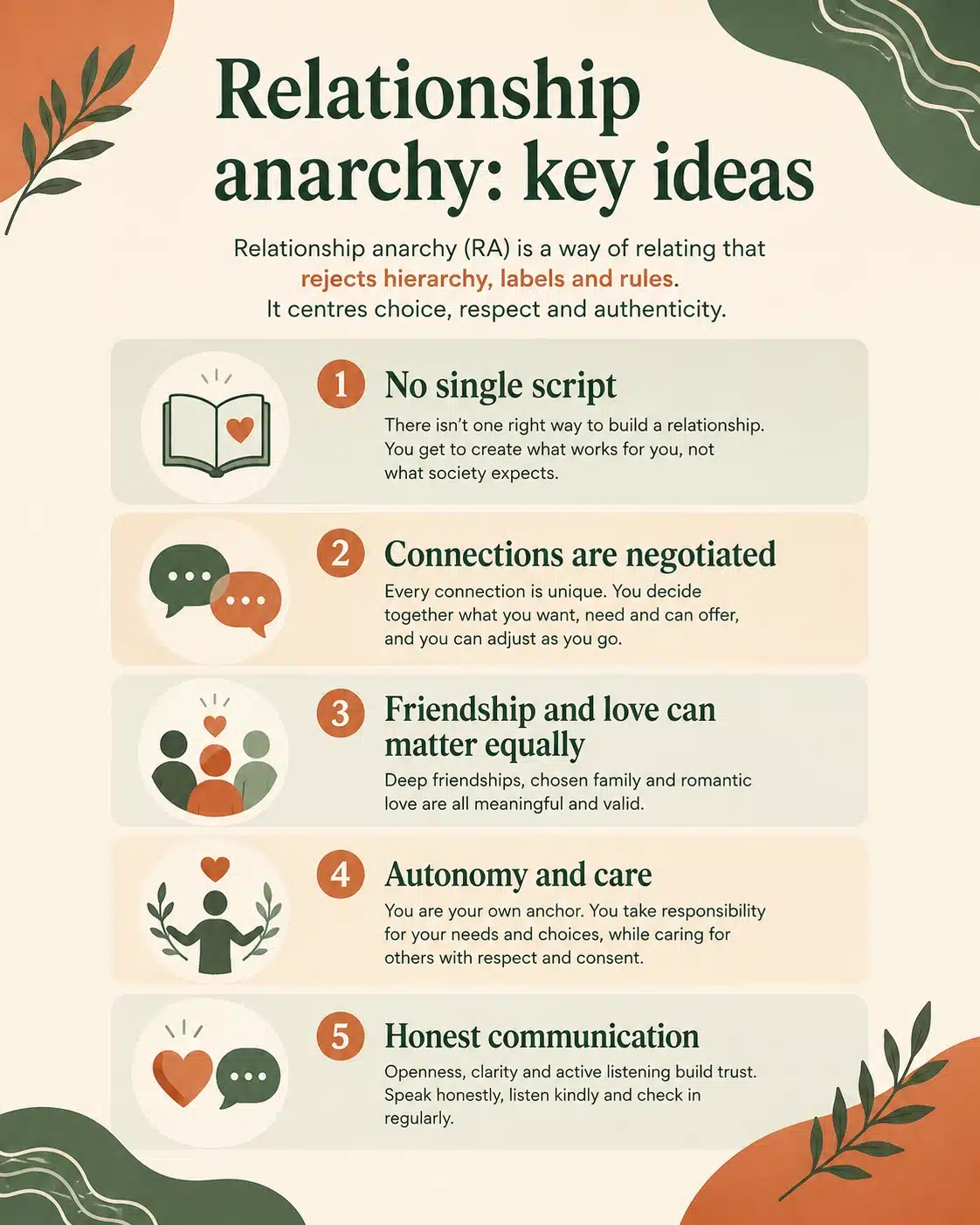
What is relationship anarchy?
Relationship anarchy applies anti-authoritarian and feminist ideas to human connections. It questions whether romance must always sit at the top, whether living together is compulsory progress, and whether a label grants control over another person’s time, body and relationships.
It does not claim that every relationship is identical. Differences should reflect needs, circumstances and agreements rather than a prefabricated social ladder. A friendship may carry central care; a romantic relationship may not include cohabitation; a chosen network may share long-term responsibilities.

Core principles
Autonomy
Each person retains decision-making power over their body, time, privacy and connections.
Consent
Agreements are chosen, understood and reviewable; they do not emerge automatically from a label.
Non-prescriptive hierarchy
No relationship has universal priority merely because it is romantic, sexual or familial.
Designed commitment
People make specific, realistic promises instead of assuming a complete package of duties.
Community care
Individual freedom coexists with responsibility for impact and interdependence.
Questioning norms
Monogamy, cohabitation, ownership, gender and family are examined without an obligation to reject them.

It is not “doing whatever I want”
Autonomy does not mean indifference to impact. Choosing freely includes sharing relevant information, keeping agreements, repairing harm and accepting that other people may also say no or leave.
Somebody may use the language of freedom to avoid conversations, cancel without care or keep others uncertain. That is not an inevitable outcome of relationship anarchy; it is a failure of accountability. Avoiding labels should not be used to deny a bond that requires substantial time, intimacy and care in practice.
“You cannot ask anything of me because I am free” turns autonomy into unilateral power. A free relationship allows requests, negotiation and consequences; it does not guarantee access without responsibility.
How it differs from other models
Non-hierarchical polyamory
Avoids predetermined ranks among multiple intimate relationships. Relationship anarchy also questions the automatic boundary between romance and friendship.
Open relationship
May retain a central couple with agreements for outside experiences. Relationship anarchy does not necessarily begin with that central unit.
Solo polyamory
Prioritises personal autonomy and avoids merging life projects. It may share principles, but not every relationship anarchist lives this way.
Monogamy
Exclusivity may be chosen. What is challenged is the idea that it grants ownership or automatic priority over every other bond.
To place these ideas in context, read our guides to types of relationships, consensual non-monogamy and hierarchical and non-hierarchical polyamory.

Building commitments without an automatic script
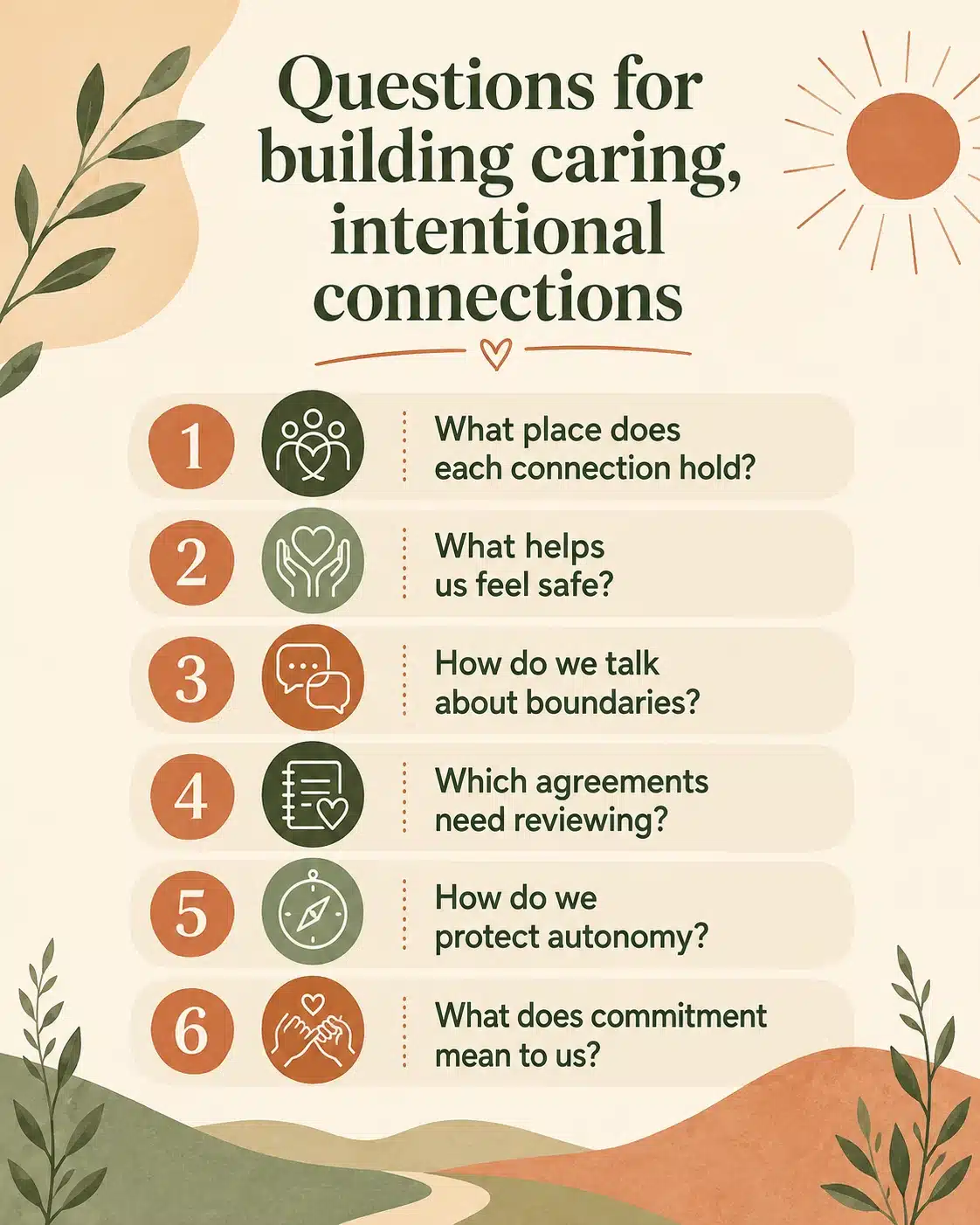
Rather than assuming what “partner” or “friend” means, discuss separate dimensions:
- time: frequency, planning and availability in emergencies;
- affection: forms of closeness, public expression and language;
- sexuality: desires, boundaries, sexual health and privacy;
- care: illness, emotional support, tasks and resources;
- projects: housing, parenting, money, travel or ageing;
- visibility: family, work, social media and community spaces;
- change: how agreements will be reviewed and how endings will be handled.
Commitment becomes a set of specific promises rather than a package. This may increase clarity, but requires accepting that not everybody wants or can offer the same things.

Non-hierarchy is not mathematical equality
Living together, parenting, sharing money or providing care during illness creates real obligations. Pretending that all relationships receive exactly the same time can hide these differences rather than remove them.
Ask whether a priority reflects a concrete, reviewable responsibility or automatic privilege. Also consider who bears the consequences. A newer person should not discover too late that a cohabiting partner may veto every decision.

Power, privilege and consent
Even where hierarchy is rejected, differences in housing, money, citizenship, age, health, experience and social recognition remain. Naming them prevents a statement of equality from being mistaken for equal power.
Ask who decides, who waits, who has information, who can leave without losing housing or community, and which relationship remains secret. Autonomy needs material conditions and safety, not just the right language.

Friendship, community and chosen family
One valuable contribution of this approach is challenging the idea that a romantic partner must meet every need. Friends, former partners, queer networks, neighbours and chosen family may sustain intimacy, grief, illness and celebration.
Recognising these bonds does not turn them into romance. It allows people to identify which care already exists and share it without making the work of long-standing supporters invisible.

Jealousy, boundaries and agreements
Non-hierarchy does not remove jealousy, fear of losing a place or the need for security. The goal is not to stop needing others, but to distinguish need from ownership. You may ask for predictability, time or information without claiming complete control.
A boundary describes what you will do to care for yourself: “I will not remain in a relationship where relevant sexual-health information is hidden.” A rule directs somebody else: “You may not connect with anyone who makes me uncomfortable.” Agreements are built together and need realistic consequences.

Exercise: map connections and commitments
- Write down significant relationships without sorting them by category.
- Note what you give and receive: time, listening, housing, sexuality, care or resources.
- Mark explicit commitments and expectations that were never discussed.
- Notice unequal power or invisible labour.
- Choose one concrete conversation: clarify availability, ask for recognition or review a promise.
Do not use the map to rank who matters most. Use it to find where an expectation needs to become an agreement or where an obligation is no longer sustainable.

Common challenges
Ambiguity
Avoiding labels may leave needs unnamed when agreements are also avoided.
Negotiation fatigue
Discussing everything takes time; not every decision needs to begin from zero.
Invisibility
Family, work, housing and law recognise some relationships but not others.
False horizontality
Claiming there is no hierarchy may conceal cohabitation or seniority privilege.
Isolation
Breaking scripts without community may reduce support during conflict or crisis.
Defensive language
Autonomy may be used to avoid repair or dismiss legitimate needs.

When therapy may help
Couples therapy may help translate values into agreements, recognise power, work with jealousy, repair broken trust or assess whether people want compatible commitments.
A therapist should not assume that romance must always come first or that non-monogamy explains every difficulty. They should also explore consent, violence and material dependency without pathologising the relationship model.
Frequently asked questions
What is relationship anarchy?
It is a philosophy for building relationships through autonomy, consent and chosen commitments, questioning whether labels or social convention should automatically determine each connection’s priority, rights or obligations.
Does it mean having no rules or commitments?
No. It rejects automatic or imposed commitments, not responsibility. It may include robust agreements, long-term care and obligations that people explicitly choose.
Is relationship anarchy always non-monogamous?
Not necessarily. It often questions compulsory exclusivity and may coexist with non-monogamy, but somebody may choose exclusivity while still rejecting the idea that a romantic relationship automatically owns or outranks every other connection.
Is it the same as non-hierarchical polyamory?
Not exactly. Non-hierarchical polyamory organises multiple intimate relationships without predetermined ranks. Relationship anarchy also questions the automatic hierarchy between romance, friendship, family and other bonds.
Does non-hierarchy mean treating everybody identically?
No. Time, cohabitation, parenting, health and responsibilities create real differences. The aim is to make and negotiate them openly, not pretend that every relationship can be mathematically equal.
Can relationship anarchy be discussed in therapy?
Yes. Affirming therapy may help with boundaries, jealousy, power, communication and commitments. It should not assume the model is pathological or impose conventional labels and hierarchies.
Freedom with relational responsibility
Relationship anarchy does not provide a closed map. It asks who drew the previous one and invites people to create connections that can be explained, chosen and sustained. Freedom becomes relationally ethical when it includes information, care, repair and respect for no.
Would you like help clarifying relationships and agreements?
We can help you discuss autonomy, jealousy, boundaries and commitment from a relationship-diversity-affirming perspective.
Sources consulted
- De las Heras Gómez, R. (2019). Thinking relationship anarchy from a queer feminist approach. Sociological Research Online.
- Bröning, S. (2025). Autonomy in multi-partnered relationships. Archives of Sexual Behavior.
- Flicker, S. M. et al. (2021). Relationship satisfaction and attachment in hierarchical and non-hierarchical polyamory. Archives of Sexual Behavior.
- Gupta, S. et al. (2024). A scoping review of research on polyamory and consensual non-monogamy. Journal of Family Theory & Review.
- Schechinger, H. A., Sakaluk, J. K. and Moors, A. C. (2018). Helpful and harmful therapy practices with consensually non-monogamous clients. Journal of Consulting and Clinical Psychology.
Clinical note: relationship anarchy is neither a diagnosis nor a treatment. This educational guide does not replace professional assessment where there is distress, coercion, violence or dependency.