


Hierarchical polyamory gives different priorities or decision-making rights to particular relationships; non-hierarchical polyamory aims not to decide in advance which relationship must prevail. Neither label removes real differences in time, home life or responsibilities. The crucial questions are who can decide, who bears the costs and whether every person remains free to consent and renegotiate.
Hierarchy in polyamory often prompts strong opinions. Some people find that naming a primary relationship brings clarity to cohabitation, parenting or shared plans. Others find that these categories restrict newer relationships or leave somebody with little influence over a bond that is also theirs.
This guide compares hierarchical and non-hierarchical polyamory without portraying one as good and the other as bad. It explains where hierarchy actually appears, how practical differences become rigid privilege and which conversations support more honest agreements.
What is hierarchical polyamory?
It is an arrangement in which one or more relationships receive different priority, rights or responsibilities. People may use “primary” and “secondary”, describe a nesting relationship and non-nesting relationships, or choose their own terms. Hierarchy can affect time, holidays, housing, finances, public recognition, sex, care and major decisions.
It does not always mean somebody is loved more. It may describe existing commitments such as children, a mortgage, marriage or many years of shared history. Difficulty arises when a practical difference becomes permanent authority to decide what happens inside another relationship without hearing the people who form it.
Instead of asking only “Who is primary?”, ask: “In which decisions does this relationship have priority, why, for how long, and what effect does that have on everybody else?”
What is non-hierarchical polyamory?
It aims to avoid giving one relationship predetermined superiority over the others. Each relationship can develop according to the needs and agreements of the people within it, without another partner automatically holding the power to restrict or end it. This does not demand equal feelings, identical hours or the same milestones.
Differences remain. Somebody may live with one partner, care for another during illness and see a third person less frequently. A non-hierarchical commitment means those differences do not automatically create lower dignity, less voice or reduced authority over one’s own relationship.
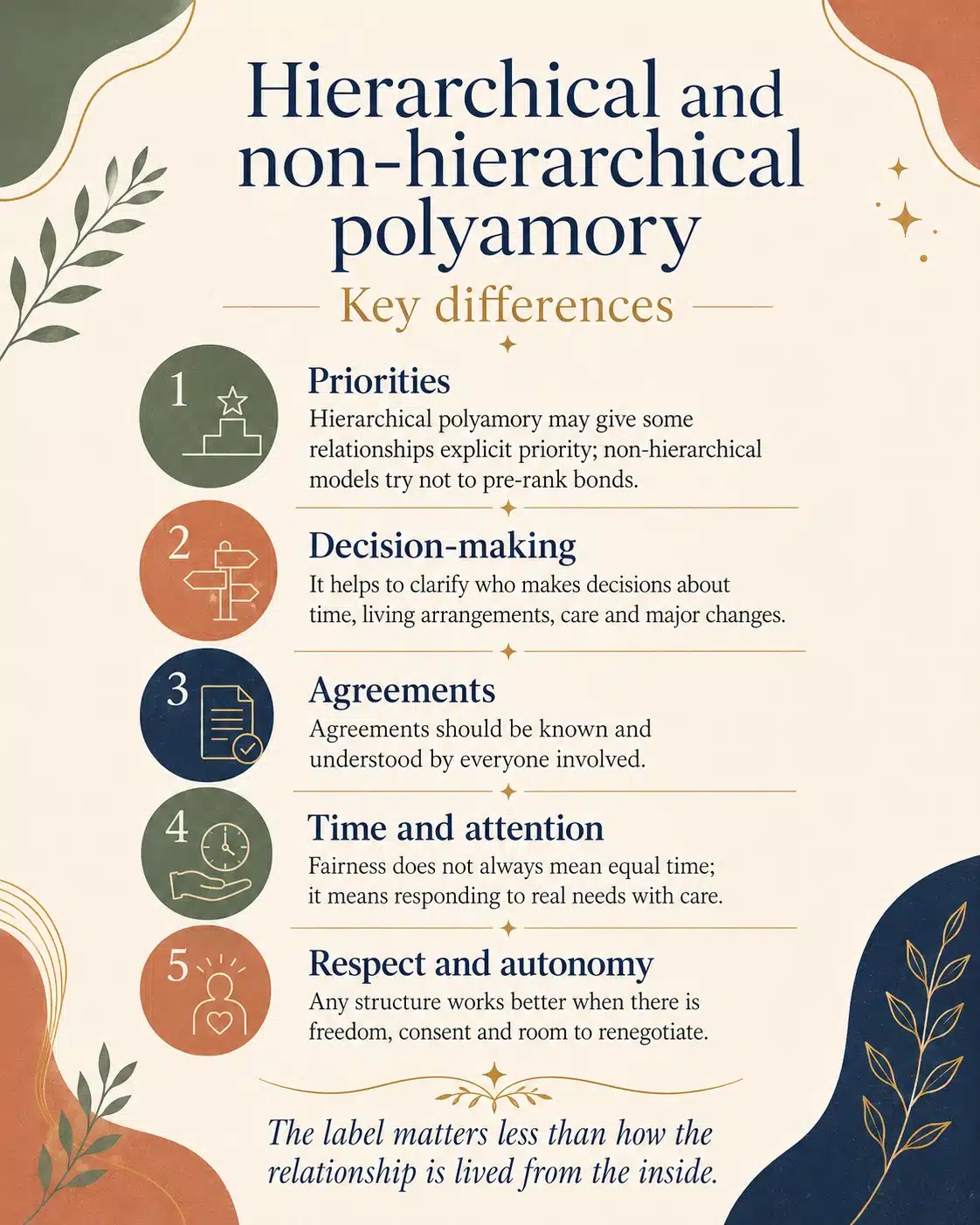
Key differences between the two approaches
Priority
A hierarchy may reserve time or precedence for one relationship in advance. A non-hierarchical approach considers needs in the circumstances.
Decisions
A primary couple may influence decisions affecting other bonds. Without hierarchy, each relationship governs itself and coordinates shared consequences.
Growth
A hierarchy may set prior limits on cohabitation, travel or future plans. Non-hierarchy avoids a fixed ceiling, although practical limits still exist.
Security
Hierarchy may offer predictability. Non-hierarchy seeks security through agreements, reliability and responsiveness rather than rank.
Real networks often lie on a continuum. Some have a few explicit priorities and negotiate everything else. Others call themselves non-hierarchical whilst retaining strong advantages attached to cohabitation or an established couple. Behaviour reveals more than the label.
Explicit, implicit, descriptive and prescriptive hierarchy
Explicit hierarchy is acknowledged and explained. Implicit hierarchy operates without being named: perhaps the same relationship is always cancelled or only one couple is publicly recognised. Transparency does not guarantee fairness, but it allows people to evaluate what they are accepting.
Descriptive hierarchy reflects current realities such as housing, parenting, care or availability. Prescriptive hierarchy says those differences must remain even if needs change. “We live together and coordinate more tasks” describes a situation; “No other relationship may ever become as important” imposes a ceiling.

Hierarchy created by home, money and everyday life
Marriage, housing, parenting, caring responsibilities, financial dependence and family recognition distribute power even when nobody uses the word hierarchy. A nesting partner generally has more spontaneous time and information. The person who owns the home may have material security that others lack.
Denying these differences can be more harmful than recognising them. The purpose is not to pretend everybody is equal, but to notice which advantages exist, which responsibilities accompany them and how to avoid leaving one person exposed to disproportionate loss. Property, children or dependence may require individual legal advice.
What is couple privilege?
Couple privilege describes social and relational advantages often given to a recognised central couple: being invited together, treated as family, consulted first or protected by legal rights. In a polyamorous network, this can make other relationships seem optional even when they contain deep commitment.
Acknowledging privilege does not require ending cohabitation or distributing everything identically. It allows the network to ask who remains invisible, who always adjusts their schedule, who can receive care and who carries the risk if the central couple changes its mind.

Veto power: security for some, vulnerability for others
Veto power exists when one person can require their partner to end or limit another relationship. It may be presented as protection from jealousy or instability, but it gives somebody direct authority over a relationship they are not part of. For the outside person, a meaningful bond may disappear without their needs being heard.
This differs from setting a boundary. Anybody may decide what they will do if a situation becomes incompatible or unsafe, and intervention may be necessary where abuse or serious risk exists. The distinction is between governing somebody else’s relationship and taking responsibility for one’s own choices.
Knowing that a veto exists does not remove inequality when somebody has no real room to negotiate or when their housing, employment, support or belonging depends upon acceptance. Consent requires viable alternatives, not information alone.
Equality and equity: relationships do not need identical resources
Equality distributes resources in the same way. Equity considers need, responsibility and context. Somebody with a medical emergency may require more time that week; a long-distance relationship may concentrate its visits; parenting demands availability that another relationship does not.
Equity should not become an explanation for why the same person always comes first. Look at the pattern over time: who receives flexibility, who waits, who provides care and who joins decisions that affect them. A distribution need not be symmetrical to preserve dignity, but it should be explainable and open to review.

Ten questions for discussing hierarchy
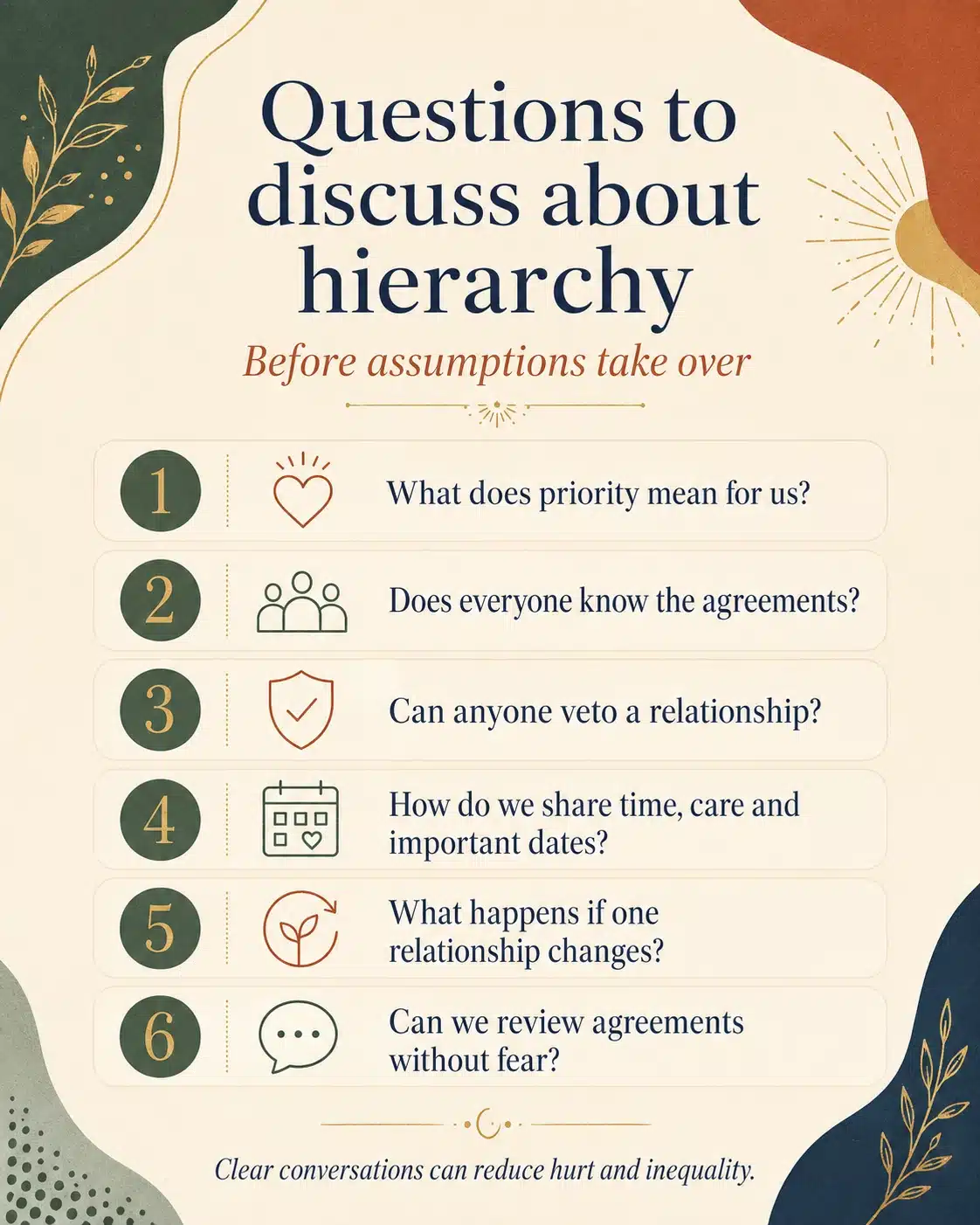
Which priorities exist?
Name the exact areas: time, housing, holidays, care, money, sex, family and visibility.
Who chose those priorities?
Check whether everybody affected participated or inherited conditions that were already settled.
Are they descriptive or prescriptive?
Distinguish what happens now from what is forbidden to change in the future.
Who decides about each relationship?
Protect the autonomy of each bond and coordinate only matters with shared consequences.
Is there veto power?
Clarify what anybody may request, who decides and how the people affected will be treated.
Which forms of growth are possible?
Discuss travel, introductions, cohabitation, care and future plans without offering possibilities that do not exist.
How are time and cancellations handled?
Define emergencies, protected commitments and repair when the same person repeatedly adjusts.
Which information remains private?
Coordination does not authorise sharing conversations, sexual details or conflicts without consent.
How will power be reviewed?
Arrange check-ins and allow any member to identify an unequal impact.
What if people are incompatible?
Negotiation does not oblige anybody to accept a permanent position that harms autonomy or security.
Jealousy and security when priorities differ
Hierarchy may reduce uncertainty for one couple and increase it for somebody else. A primary partner may fear losing their place; a secondary partner may fear that their relationship is disposable. In a non-hierarchical structure, the absence of ranks does not remove the need for predictability.
Sustainable security usually rests on observable behaviour: keeping commitments, communicating change, repairing cancellations, refusing to hide anybody and responding with care to distress. Jealousy may contain information about a need, a fear or an actual inequality; it does not confer an automatic right to control.
- What exactly happened?
- Which threat do I perceive: time, belonging, housing, visibility or future?
- Which specific behaviour would help?
- Does my request protect a need or restrict another relationship?
- What effect would it have on the other people?
Non-hierarchical polyamory is not the same as relationship anarchy
Both may question the automatic priority of a romantic couple, but relationship anarchy is a broader framework. It examines social rules that rank relationships by category and may include friendships, chosen family and other forms of care, rather than focusing only on several romantic relationships.
Relationship anarchy does not mean the absence of commitment, boundaries or responsibility. Somebody may build substantial commitments and precise agreements without following a predetermined script. Likewise, a person may practise non-hierarchical polyamory without identifying as a relationship anarchist.
Moving from hierarchy to non-hierarchy — or the reverse
Changing the structure requires more than changing language. Moving towards less hierarchy may involve relinquishing assumed powers, reviewing vetoes, allowing growth and recognising previously invisible people. Moving towards more hierarchy may reflect parenting, care or shared plans, but it still requires explaining what changes and who carries the cost.
Not everybody has to accept the transition. Distinguish a temporary need from a permanent rule, establish a gradual process and speak with each relationship before deciding about it. If the new model requires somebody to lose rights or security, they must be able to refuse without being labelled selfish or immature.

What does research tell us?
Research into consensual non-monogamy does not indicate that one orientation guarantees satisfaction. A recent meta-analysis found no overall difference in relationship or sexual satisfaction between monogamous and consensually non-monogamous people. This cannot establish that every structure works equally well for every person.
Studies of people practising polyamory have found average differences between relationships described as primary and secondary in commitment, investment, communication, intimacy and sexuality. These findings describe samples rather than individual destinies and do not show that hierarchy caused every difference. Direct evidence comparing hierarchical and non-hierarchical polyamory remains limited.
It is therefore more clinically useful to examine consent, comfort, communication, power and care than to promise that a label will produce wellbeing.
Healthy signs and warning signs
Healthy indicators
Priorities are understandable, information arrives before consent, each relationship retains a voice, renegotiation is possible and nobody must hide their needs to remain included.
Warning signs
There are secret rules, sudden vetoes, threats, double standards, triangulation, surveillance, isolation, coordinated punishment or material dependence used to obtain obedience.
Being “primary”, “secondary” or “non-hierarchical” does not make coercion, sexual control, humiliation or abuse acceptable. When somebody cannot speak freely, prioritise individual support and safety before joint therapy.
Exercise: map priorities, resources and power
Each person completes the map separately before comparing it. Record who has access to time, housing, money, recognition, information, the ability to cancel plans and influence over decisions. Add who provides care and what each person would lose if the network changed.
The purpose is not a perfect score. Look for concentrations of power that nobody has named, gaps between stated agreements and lived experience, and one small adjustment that can be tested during the next month. Repeating the map shows whether change actually occurred.

When might therapy help?
Therapy may help when “primary”, “secondary” or “non-hierarchical” mean different things; when vetoes, time or visibility create conflict; when a transition threatens security; or when jealousy is difficult to distinguish from an observable inequality.
A therapist should not assume polyamory caused the problem or direct people towards monogamy. Nor should the absence of hierarchy be idealised. Ocnos offers couples and relationship therapy in Palmones and online, with an informed approach to relationship diversity and careful attention to who can speak, decide and consent.
Continue exploring relationship models
Frequently asked questions about hierarchy and polyamory
What is the difference between hierarchical and non-hierarchical polyamory?
Hierarchical polyamory gives different priority or rights to particular relationships. Non-hierarchical polyamory avoids deciding in advance that one bond must prevail, whilst recognising real differences in time and responsibility.
Is having a primary partner necessarily harmful?
No. It may describe chosen and disclosed commitments. Risk increases when the position controls other relationships, imposes non-negotiable ceilings or makes people with less power disposable.
Does non-hierarchical polyamory mean treating every relationship equally?
No. Needs, histories and responsibilities differ. It seeks equal dignity and autonomy, not identical hours, matching feelings or compulsory symmetry.
What is veto power?
It is an agreed or assumed power to require that somebody else’s relationship end or be limited. It must be distinguished from everybody’s right to state boundaries and decide about their own participation.
Are non-hierarchical polyamory and relationship anarchy the same?
No. They may both question automatic couple priority, but relationship anarchy is a broader framework that examines hierarchy across different kinds of bonds, including friendships and chosen family.
Can a polyamorous network change its hierarchy?
Yes, when everybody affected is consulted and can accept or refuse the change. Changing language without redistributing power, resources and decisions does not alter the real structure.
A space to talk without judgement
If you need to make priorities visible, review veto power, address inequality or change your structure without deciding for other people, we can support you through an inclusive clinical approach. Appointments are available in person in Palmones, Campo de Gibraltar, and online.
Scientific sources consulted
- Anderson, J. R. et al. (2026). Meta-analysis of relationship and sexual satisfaction in monogamous and consensually non-monogamous relationships. Journal of Sex Research.
- Balzarini, R. N. et al. (2017). Perceptions of primary and secondary relationships in people practising polyamory. PLOS ONE.
- Hangen, F. et al. (2020). Consent, comfort and communication in distinguishing consensual non-monogamy from infidelity. Journal of Sex Research.
- Mogilski, J. K. et al. (2026). Relationship-maintenance practices across multiple consensual relationships. Archives of Sexual Behavior.
- Schechinger, H. A., Sakaluk, J. K. and Moors, A. C. (2018). Helpful and harmful therapy practices with consensually non-monogamous clients. Journal of Consulting and Clinical Psychology.
Clinical note: this article is for information and does not replace an individual psychological or legal assessment. A relationship structure is not a diagnosis. If there is abuse, coercion, fear or dependence used to control, seek safe, individual support.