



Swinging is a form of consensual non-monogamy usually centred on shared or coordinated sexual experiences with other people. It never requires a full swap, penetration, group sex or a repeat encounter. Consent is checked at every stage, and anybody can stop even after entering a club or beginning an interaction.
“Partner swapping” can suggest two couples simply exchanging partners, but real swinging practices are more varied. They may involve watching, socialising, kissing, agreed partial sexual contact or more extensive encounters. People and couples of different genders and sexual orientations participate.
This guide explains what swinging means, how it differs from other models, what may happen in a club and which conversations support desire, health and the relationship. Its purpose is neither encouragement nor discouragement, but informed choice without pressure.
What are swinging relationships?
Swinging is a consensual relationship and sexual practice in which a couple — or people who identify with the community — share selected erotic experiences with others. There is usually an established couple and a primarily sexual focus, although arrangements vary.
It belongs within the wider framework of consensual non-monogamy. Knowledge and consent distinguish it from infidelity. Its emphasis, context and agreements distinguish it from other arrangements, although no boundary is perfect.
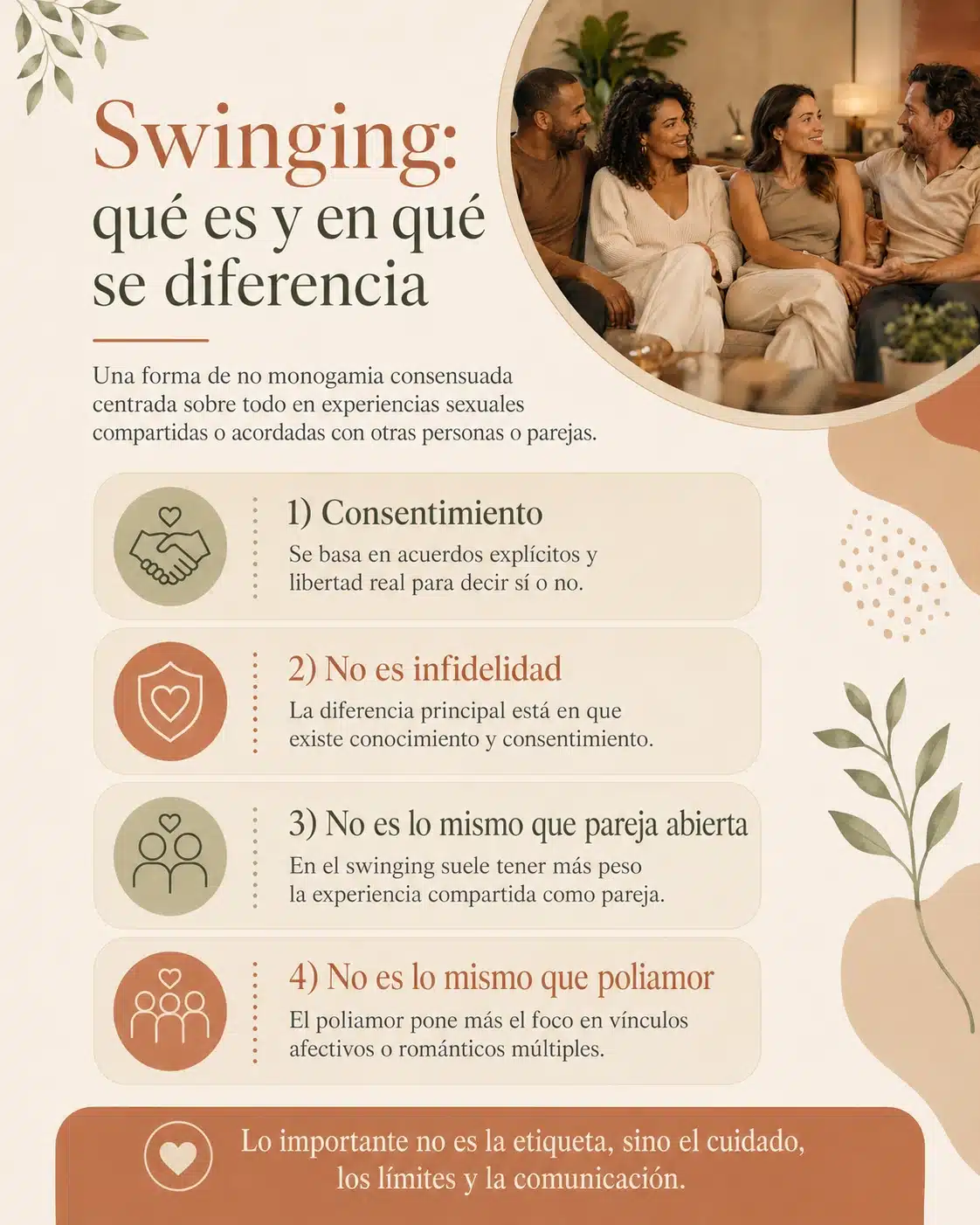
Swinging, open relationships, polyamory and group sex
Swinging
Experiences are commonly shared or coordinated as a couple, often in the same setting, with an emphasis on sex.
Open relationship
An open relationship may allow individual encounters, dating or outside relationships according to its agreements.
Polyamory
Polyamory allows several known and consensual emotional or romantic bonds, rather than focusing only on sexual experiences.
One-off group sex
This describes sexual activity involving several people, but not necessarily an identity, community or ongoing relationship model.
Categories may overlap. Some swingers form lasting friendships; others avoid repeat encounters. A perfect label is unnecessary, but people need to explain their expectations so that one familiar word does not conceal incompatible meanings.
Soft swap, full swap and other forms
- Socialising or watching: attending, learning about the environment or observing without sexual participation.
- Soft swap: kissing, touching or agreed activities that exclude particular forms of sex.
- Full swap: may include penetration, always with specific consent and agreed protection.
- Same room: the couple remains in one space during the experience.
- Separate rooms: interactions happen in different spaces according to the agreement.
- Private meeting or club: the setting may be a home, private event or venue with its own rules.
These expressions offer orientation, not a substitute for clear yeses, noes and uncertainties. Something accepted in theory may not feel right in the moment. Changing one’s mind is part of consent.
Why might couples feel curious?
Motivations may include fantasy, novelty, bisexual exploration, shared eroticism, community or enjoying seeing one’s partner. For some people, discussing the fantasy improves sexual communication even when they never act upon it.
Swinging should not become an obligation to “save” a relationship, prevent a breakup or prove open-mindedness. Novelty can intensify emotion, but it cannot by itself repair resentment, loss of desire, abuse or damaged trust. Sharing a fantasy does not create a duty to enact it.

Consent: freely given, specific and reversible
Consent requires information, choice and freedom from pressure. Agreeing to enter a club does not consent to touch. Accepting a kiss does not authorise another activity. Previous participation creates no obligation to repeat. Silence, freezing or giving in to avoid conflict are not enthusiastic consent.
Consent from every third person matters as much as the couple’s agreement. Nobody is an accessory used to complete another couple’s fantasy. Decisions must be checked directly rather than allowing one partner to speak for somebody else.
If somebody is too intoxicated to understand, choose or communicate, the activity stops. Agreeing boundaries before drinking does not replace checking consent in the moment.
Agreements to discuss beforehand
A couple can agree to “try it” and disagree about everything else. Discuss who may approach, which activities are welcome, barrier use, same or separate rooms, later contact, exchanging telephone numbers, photographs, private signals and how to leave.
A useful agreement also covers surprises. Create a procedure rather than a punishment list: stop, check in, speak privately and decide without humiliation. Asymmetrical boundaries may reflect real needs, but double standards require honest examination.
What is it like to arrive at a swingers club?
Venues differ, but many have reception, an explanation of the space and social areas. Events may use dress codes, identification, membership, themed nights or entry conditions. Checking beforehand reduces uncertainty.
Entry never creates an obligation to participate. A first visit may simply involve having a drink, looking around and leaving. Agree transport, an approximate departure time, a discreet signal and the principle that either person can request to go home without defending the decision at the venue.

Club atmosphere, social areas and intimate spaces
Many clubs separate conversation areas from spaces where sexual activity may occur. This allows people to meet before deciding. Being in an intimate area still does not indicate consent to contact: questions and answers remain necessary.
Music, lighting, crowds and excitement may make it harder to notice one’s internal state. Pauses help establish whether the experience remains chosen. Somebody may enjoy the atmosphere without wanting touch; another person may want one activity and decline every other option.

Respectful club etiquette
- Ask before touching, approaching an activity or joining.
- Accept no immediately, without demanding an explanation or negotiating.
- Never photograph, record or identify other guests.
- Follow the venue’s hygiene, barrier and space rules.
- Do not interpret clothing, orientation or presence as availability.
- Speak to each participant directly rather than treating anybody as part of a package.
- If somebody appears distressed or intoxicated, stop and seek staff support.

Swinging, sexual orientation and diversity
Swinging is not limited to heterosexual couples. Gay, lesbian, bisexual and trans people, as well as couples with different configurations, participate. An environment describing itself as open-minded is not automatically free from homophobia, biphobia, transphobia, racism, ableism or body stigma.
Before attending, ask about inclusion, accessibility and responses to discriminatory behaviour. Bisexual exploration should not objectify anybody or assume that a person desires every member of a gender.

Choosing a place where everybody can feel safer
Review admission policies, complaints procedures, privacy, hygiene and the availability of quieter spaces. Partners with different ages, experience, visible orientation or gender expression may perceive the same place differently.
Plan independent transport and do not rely on strangers to get home. Telling a trusted person where you will be may support safety without disclosing anybody else’s identity. If the environment feels hostile, leaving is valid even after paying or travelling.

Sexual health and reducing risk
Risk depends on activities, barriers, changes in partners, testing, vaccination and communication, not on the word swinger. Discuss external or internal condoms, barriers for oral sex, changing condoms and gloves between people or activities, cleaning toys and which events require later disclosure.
Tests do not replace barriers or guarantee that a recent infection is detectable. Ask a healthcare professional about testing frequency, vaccination and prevention suited to actual practices. Sex therapy may help with desire, anxiety or communication but does not replace medical care.
If a barrier breaks or an activity falls outside the agreement, communicate early. Concealment prevents other people from making health decisions using current information.
Jealousy, comparison and unexpected reactions
An exciting fantasy can feel different when it becomes visible. Jealousy, body comparison, fear that a partner enjoyed somebody else more, exclusion or concern about repeat contact may arise. These reactions do not prove that swinging was a mistake or that somebody is possessive.
Agree what happens when distress rises: a signal, pause, physical reassurance, leaving the space or ending the encounter. The goal is not to endure discomfort to appear confident, but to respond before it becomes disconnection, anger or uncertain consent.

Privacy, messages and later contact
Discuss real names, telephone numbers, social media, photographs and repeat meetings beforehand. Some couples avoid ongoing contact; others build friendships. Nobody should unilaterally decide after personal details have already been exchanged.
Confidentiality protects people who may face family, workplace or community stigma. Do not retell an experience with identifying detail or share screenshots of profiles and conversations. Discretion should not be used to conceal consent-relevant information.

After the experience: care and conversation
Aftercare means actions that support calm, connection and safety afterwards: water, rest, affection, space, food or travelling home together. Needs differ, so ask beforehand.
A detailed conversation may wait until arousal and stress have settled. The following day, discuss what felt good, what felt uncomfortable, whether consent remained clear, which agreement needs changing and whether repair is needed. Avoid interrogating a partner about sexual comparisons or demanding an immediately positive review.

When one person wants to try and the other does not
A difference in desire cannot be solved through persistence. The interested person can explain what the fantasy represents; the other can explore fears or boundaries without committing to enact it. Listening does not mean agreeing.
Statements such as “If you trusted me”, “Every modern couple does it” or “Do this or I will cheat” turn the conversation into pressure. No must be sufficient. If swinging is a central need for one person and a firm boundary for another, there may be a painful incompatibility that deserves honest attention.
A night can be only about socialising
The social encounter may be the whole purpose. Talking, dancing or meeting other couples allows everybody to notice their response without progressing sexually. Treating every visit as a mission increases pressure and makes no harder to hear.
Community may feel enjoyable, but it should not replace outside support or create a duty to return. Every visit requires a new decision.

Can swinging be part of a healthy relationship?
Yes, when desire is shared, consent is genuine, communication is clear and the practice fits the values of those involved. Comparative evidence does not show that monogamy or consensual non-monogamy guarantees greater satisfaction. A meta-analysis of 35 studies involving 24,489 people found no overall difference in relationship or sexual satisfaction.
This cannot predict a particular couple’s outcome. Research often groups different arrangements and uses convenience samples. Motivation, comfort, communication, sexual health and repair matter. There is no psychological test that can determine beforehand whether a couple “are swingers”.
Warning signs that should not be normalised
Pressure or threats
Somebody participates to avoid a breakup, threatened infidelity, anger, humiliation or withdrawal of affection.
Unclear consent
Intoxication, freezing or silence is exploited and later justified by saying it had already been agreed.
Double standards
One person takes freedoms they deny the other without a negotiated reason.
Health concealment
Activities, barrier failures or consent-relevant information are withheld.
Monitoring and punishment
Passwords, detailed sexual confessions or continuous surveillance are demanded afterwards.
Dehumanising third parties
Other people are treated as interchangeable objects whose boundaries no longer matter.
Ten questions before trying swinging
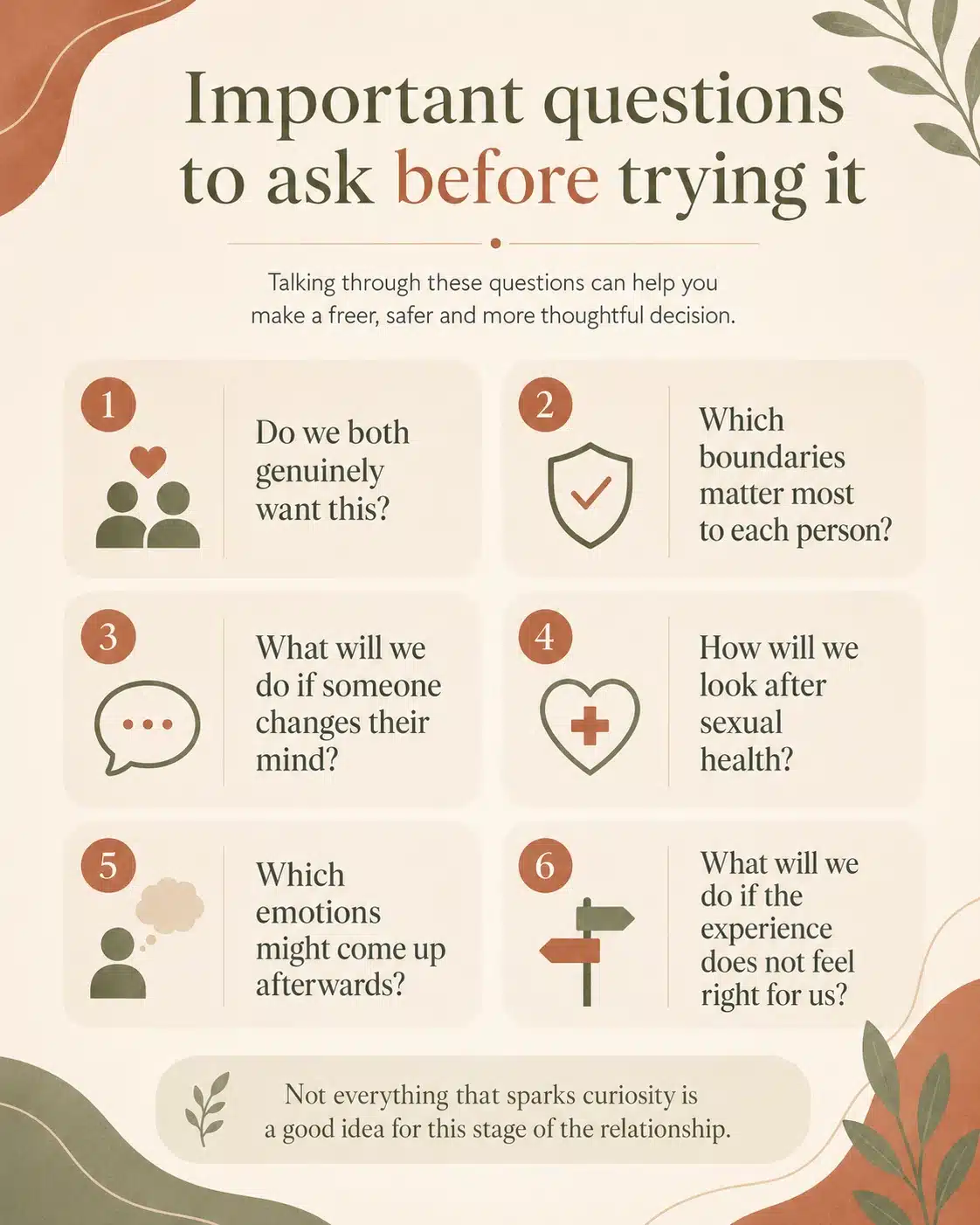
Do we both want this?
Distinguish personal curiosity, shared desire and agreement motivated by fear of loss.
What is welcome and what is not?
Name activities, people, same or separate rooms and areas of uncertainty.
How will we stop?
Agree a word or signal and establish that no justification will be required.
How will we care for sexual health?
Specify barriers, changes between activities, testing and incident disclosure.
What if jealousy appears?
Prepare a pause, contact, exit and a later time to talk.
How much privacy do we want?
Decide about details, telephone numbers, images, social media and future contact.
How will alcohol affect us?
Set limits that preserve the ability to decide and communicate.
Can we leave without blame?
Confirm that either person can end the night and will be respected.
Which care will we need afterwards?
Discuss affection, space, rest and a review time.
What if one person does not want to repeat?
A first experience creates no future obligation; prepare to respect that answer.
When might therapy help?
Therapy may help when desire differs, pressure or intense jealousy appears, an agreement has been broken or the experience is difficult to integrate. It can also be useful before a first encounter, translating a fantasy into concrete questions without assuming it should happen.
An informed therapist should neither pathologise swinging nor recommend it as a universal solution. Ocnos offers couples and relationship therapy in Palmones and online, with respect for relationship diversity and consent and safety at the centre.
Continue exploring relationship models
Frequently asked questions about swinging
Does swinging always mean a full partner swap?
No. It may involve socialising, watching, kissing or agreed partial activities. No form of participation or penetration is compulsory, and anybody may change their mind.
Does entering a swingers club mean agreeing to participate?
No. Entering, watching or talking does not authorise sexual contact. A first visit may be entirely about learning how the place feels and leaving whenever either person chooses.
Is swinging the same as an open relationship?
Not necessarily. Swinging usually involves shared or coordinated sexual experiences as a couple. An open relationship may permit individual encounters or outside relationships through another structure.
Does jealousy mean we are not ready?
Not by itself. Jealousy may point to fear, comparison or a need. The important questions are whether you can stop, talk without pressure and establish whether the experience remains freely chosen.
How can people reduce the risk of infections?
Use practice-appropriate barriers, change protection correctly, arrange testing and vaccination where relevant, and communicate incidents early. A healthcare professional can offer individual advice.
What if one person wants to try and the other does not?
No must be respected. You can discuss what the fantasy means without turning listening into an obligation. If the difference remains central, therapy can help explore it without imposing an outcome.
A space to talk without judgement
If you need to clarify boundaries, explore a difference in desire, repair a difficult experience or discuss sexuality without shame or pressure, we can support you with an inclusive clinical approach. Appointments are available in person in Palmones, Campo de Gibraltar, and online.
Scientific sources consulted
- Anderson, J. R. et al. (2026). Meta-analysis of relationship and sexual satisfaction by relationship orientation. Journal of Sex Research.
- Conley, T. D. and Piemonte, J. L. (2021). Differences between open relationships, polyamory and swinging, and processes associated with dyadic adjustment. Archives of Sexual Behavior.
- Hangen, F. et al. (2020). Consent, comfort and communication in distinguishing consensual non-monogamy from infidelity. Journal of Sex Research.
- Lehmiller, J. J. (2015). Sexual-health history and practices among monogamous and consensually non-monogamous partners. Journal of Sexual Medicine.
- Schechinger, H. A., Sakaluk, J. K. and Moors, A. C. (2018). Helpful and harmful therapy practices with consensually non-monogamous clients. Journal of Consulting and Clinical Psychology.
Clinical note: this article is for information and does not replace an individual psychological or medical assessment. A sexual practice or relationship structure is not a diagnosis. If there is abuse, coercion or fear, seek safe, individual support.