

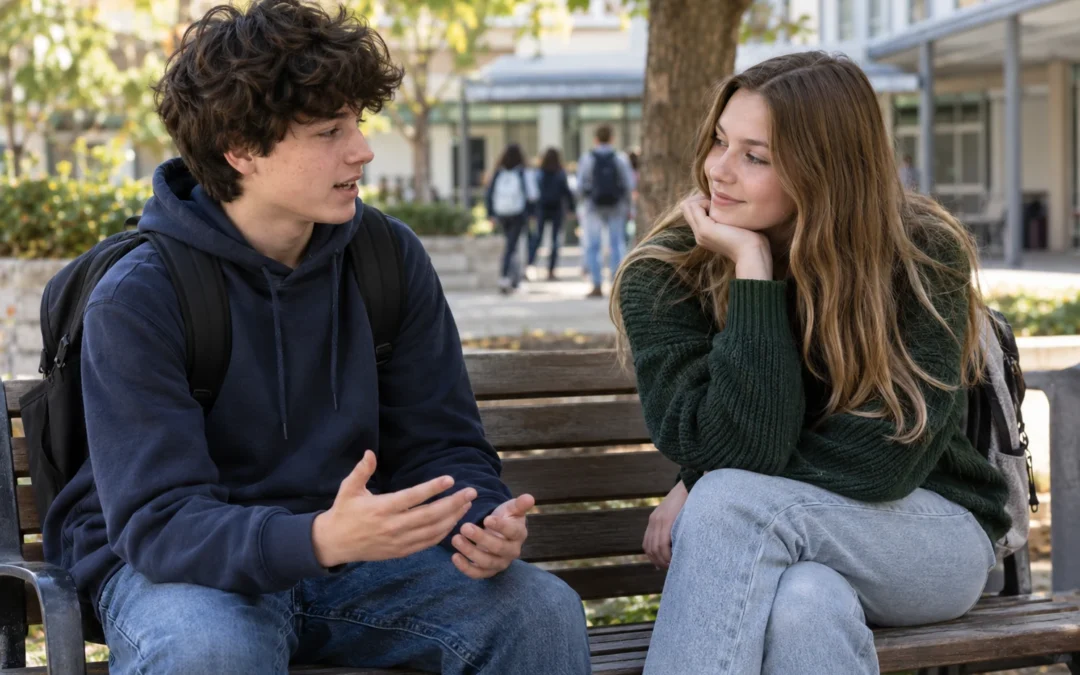

The goal is not to make an autistic teenager collect more friends or socialise in a conventionally “typical” way. What matters is being able to recognise relationships that feel safe, find forms of connection that suit them, set boundaries and seek help when a friendship is no longer reciprocal or safe.
Friendship changes during adolescence. It is no longer only about playing the same game or sitting next to someone in class. Teenagers navigate groups, in-jokes, messaging, spontaneous plans, loyalty, privacy, arguments and rules that are often never stated. For an autistic teenager, that complexity can be enjoyable, confusing, exhausting — or all three.
Some parents seek help because their teenager says they do not need friends and spends a great deal of time alone. Others describe a young person who desperately wants to belong but repeatedly feels rejected. Some teenagers have one important friendship and are genuinely content, although adults worry that they “should socialise more”. Others look well integrated at school but come home depleted by the effort of masking in order to fit in.
Current research supports one important conclusion: peer experiences among autistic young people are highly varied. A 2026 systematic review found lower peer engagement and acceptance overall, but also substantial differences according to age, individual profile, emotional factors, context and who the young person was interacting with. Two opposite stereotypes are therefore unhelpful: “autistic people do not want friends” and “every teenager needs a large friendship group to be happy”.
Choosing to be alone is not the same as feeling lonely
Chosen solitude can provide rest, pleasure and regulation. Loneliness is the distressing gap between the relationships someone has and the relationships they would like to have. That distinction matters far more than counting names in a contact list.
Example: Daniel is 15. He has one friend he games with online twice a week and has no interest in parties. When his mother asks whether he feels lonely, he says no. Pressuring him to widen his circle simply because “teenagers should go out more” may create a problem he does not experience.
Another example: Sophie also spends many breaks alone, but every Sunday evening she becomes upset because nobody has included her in weekend plans. From the outside both teenagers have “few friends”; internally, their experiences are completely different.

Why friendship can become more complicated in adolescence
Childhood friendships are often sustained through shared activities. During adolescence, conversation, intimacy, group reputation, subtle social signals and unspoken expectations become increasingly important. This can place additional demands on social communication.
Groups are less explicit
Knowing when to join a conversation, noticing when teasing has stopped being friendly or interpreting a brief message can depend on very subtle cues.
Friendships involve more negotiation
Teenagers balance time between different people, tolerate friends having other friends and repair misunderstandings without anyone clearly explaining the rules.
Social comparison intensifies
Young people notice who goes out, who gets messages and who seems to belong. This can affect self-esteem even when their own smaller relationships are meaningful.
The cost of adapting may increase
Rehearsing lines, monitoring gestures, copying other people's interests or hiding sensory needs may improve outward fit while increasing internal exhaustion.

Signs that social life may be costing too much
These signs do not automatically indicate a serious problem. They are prompts for a better conversation about what the young person is experiencing.
Always feeling outside the group
A teenager may be physically present but unsure how to participate, find out about plans too late or feel that everybody else understands codes they have missed.
Exhaustion after socialising
Needing recovery does not make a friendship unhealthy. But if every interaction requires days of recovery, it is worth identifying what is making it so effortful.
Misunderstandings that feel impossible to repair
A direct comment, missed joke or late reply can become a major conflict when the teenager does not know what went wrong or how to clarify it.
Very intense or unbalanced friendships
A young person may place all their need for connection in one person, tolerate discomfort for fear of losing them, or assume that intensity automatically means safety.
Constant fear of rejection
Repeatedly checking messages, analysing what someone meant for hours or agreeing to plans they do not want can also reflect anxiety.
Persistent emotional change
Low mood, irritability, withdrawing from valued activities, school avoidance or intense self-criticism deserve attention beyond “friendship problems”.

Not every social difficulty needs “social skills training”
Structured programmes exist for conversation, managing teasing and planning get-togethers. Some have evidence of benefit. The 2024 autism intervention handbook we have used as clinical background reviews approaches such as PEERS and Children’s Friendship Training. But this does not mean every autistic teenager needs to learn to appear more typical.
A systematic review and meta-analysis of social skills groups for autistic adolescents found improvements on some outcomes while also highlighting methodological limitations and questions about whether gains generalise into everyday life. A better starting question is: what does this teenager want to become easier, and why?
We may practise how to clarify a misunderstanding, say no or join a group if the young person wants those skills. We should not use intervention to suppress harmless autistic behaviours, force eye contact, impose “normal” interests or teach a teenager to tolerate unhealthy relationships for the sake of appearing included.
Intense friendships: closeness does not always mean reciprocity
An intense friendship can be wonderful. Intensity is not the problem. The concern is imbalance: one person always decides, mocks the other, threatens to end the friendship to get their way, demands constant availability or makes affection conditional on compliance.
Some autistic teenagers may find it harder to identify when a relationship has become one-sided, particularly when they are frightened of being alone or take statements such as “if you were really my friend, you would do this” very literally. NICE specifically includes exploitation and abuse among risks professionals should consider when supporting autistic young people.
How do I feel with each person?
Instead of sorting people into “friend/not a friend”, draw several circles around your name and place people according to how the relationship actually feels.
The aim is not to judge people quickly, but to notice how the relationship functions for you.
Conflict, an unbalanced friendship or bullying: they are not the same
Friends disagree. A normal conflict usually allows both people to talk, take some responsibility and repair the relationship. An unbalanced friendship repeatedly gives one person much more power. Bullying involves repeated harm or a power imbalance that makes it difficult for the target to defend themselves.
Conflict
Both people may get things wrong, there is room to listen and repair can happen without either person feeling afraid.
Imbalance
One person gives in most of the time, fears upsetting the other, agrees to things they do not want or feels they must earn the right to remain friends.
Bullying
There may be humiliation, deliberate exclusion, threats, aggression, sharing private content, repeated mockery or abuse of power. Stopping it is an adult and institutional responsibility.
Misunderstanding
It can hurt even without intent, but genuine mistakes change after clarification. Bullying continues despite the harm.
A Spanish study from the EPINED project published in 2024 again highlighted vulnerability to bullying among autistic pupils. Autismo España also provides specific resources for families and schools and emphasises that the context — not autism itself — must be addressed.
If you suspect bullying, do not make the response primarily about teaching the teenager to defend themselves or become more sociable. Record concrete incidents, keep messages or screenshots where it is safe to do so, inform the school and use the appropriate safeguarding or anti-bullying procedure.
Repairing misunderstandings without turning friendship into a social exam
Repair is a useful skill for everyone. A simple structure can help without asking a teenager to memorise a perfect script.
Three steps for clarifying what happened
- Check: “I think I may have misunderstood. What did you mean?” or “Did what I said upset you?”
- Explain without defending everything: “I wasn't trying to hurt you. What I meant was…”
- Agree the next step: “How can we sort this out?” or “Next time, it helps me if you tell me directly.”
If the other person mocks, threatens or uses the conversation to pressure them, the issue may no longer be a simple communication misunderstanding.
Social exhaustion counts too
An afternoon with friends can be enjoyable and tiring at the same time. Following several conversations, coping with noise, interpreting cues and monitoring one's own behaviour may require a great deal of energy. Tiredness does not cancel enjoyment.

Before, during and after
For one week, rate three things from 0 to 10 after social plans: enjoyment, effort and recovery needed. Add brief context: number of people, noise, duration, whether you could leave when you wanted, and whether you felt able to be yourself.
The pattern may show that the solution is not “socialise less”, but meet one person instead of eight, choose a quieter setting or make the plan shorter.
Online friendships can be real friendships too
For some autistic teenagers, written communication provides more processing time, removes several simultaneous non-verbal cues and makes it easier to find people who share a particular interest. A systematic review of digital communication among autistic people identified potential benefits such as greater control over interaction and connection with autistic communities, while also noting that the evidence remains preliminary and risks are real.
An online friendship should not be dismissed simply because it happens through a screen. It does need digital-safety conversations: protect personal data, be cautious about requests for money or sexual content, do not share intimate images, verify identity before meeting offline and seek help if someone threatens, pressures or tries to isolate the young person from others.
A useful rule: a safe relationship allows you to say “no”, change your mind and take time away without being threatened, humiliated or blackmailed. That applies online and offline.
What parents can do without interrogating or taking over
When a teenager has experienced rejection, parents naturally want details in order to protect them. But a rapid sequence of “Who were you with?”, “What did they say?” and “Why didn't you reply?” can feel like another test after a demanding social day.
- Ask about the experience, not only the behaviour: “Did you feel comfortable?” can be more useful than “Did you talk to anyone?”
- Do not turn every disagreement into a family emergency: otherwise they may stop telling you what happens.
- Avoid automatically criticising friends: help the teenager examine specific behaviour and keep room for their own judgement.
- Practise boundaries at home: being allowed to say “I don't want to talk right now” in a safe setting makes boundaries easier elsewhere.
- Respect their version of a satisfying social life: one close friendship may be enough.
- Keep the door open: “If anyone pressures or frightens you, you can tell me even if you did something you feel embarrassed about.”

What can secondary school do to support belonging?
Belonging is not created by forcing participation in group activities. Schools can create more accessible opportunities: interest-based clubs, smaller groups, projects with explicit roles, quieter break-time options, trusted adults and a clear response to bullying.
Our guide to autism at school covers environmental support in more detail. For friendship, peers are part of the environment too. NICE recommends considering peer-mediated social-communication support for school-aged autistic young people, and recent reviews highlight the need to support meaningful participation rather than simply teach social rules in isolation.

What do we work on in therapy when friendships are causing distress?
We do not begin with “Which social skill is missing?” We begin with the teenager's experience. Do they want more relationships? What does friendship mean to them? Which situations are confusing? Is anxiety involved? Masking? Rejection? A specific friendship? Attention or impulsivity? Bullying?
Depending on the goal, therapy may include interpreting ambiguous situations, direct communication, repairing conflict, assertiveness, boundaries, managing uncertainty and finding ways to initiate or maintain relationships. We may also explore anxiety, self-esteem or mood if loneliness is affecting wider wellbeing.
If ADHD is also part of the picture, impulsivity, forgetting to reply, interrupting or emotion regulation can create additional friendship difficulties. In those cases it helps to integrate what we know about autism and ADHD rather than attributing every disagreement to autism alone.

When loneliness deserves clinical attention
Feeling lonely sometimes is part of human life. We become more concerned when distress is persistent, a teenager loses interest in valued activities, stops attending school, sleeps or eats poorly, constantly blames themselves, says nobody will ever care about them or isolates themselves despite wanting connection.
A 2024 qualitative meta-synthesis on psychological wellbeing in autistic young people emphasised the importance of listening directly to their perspectives, rather than relying only on adult interpretation. That is particularly important in friendship: what looks like “too little social life” to a parent may be enough for a teenager, while apparent social success can sometimes hide deep loneliness.
If self-harm, suicidal thoughts or statements about not wanting to live appear, do not treat this as simply a friendship problem. In Gibraltar, the GHA Mental Health Crisis Service is available 24/7 via 111; use 999 for an immediate emergency. In Spain, the national 024 line supports people with suicidal thoughts or risk, and 112 is the emergency number.
Frequently asked questions
Do autistic people want friends?
Many do, some prefer a very small number of relationships, and some enjoy a great deal of solitude. The wish for friendship varies between people and across life. Autism does not tell us in advance how much social contact somebody wants.
Is it a problem if a teenager has only one or two friends?
No. If those relationships are safe and satisfying and the teenager does not feel lonely, the number itself is not a problem.
Should we make them attend parties or social activities?
Forcing attendance usually increases pressure and does not create genuine connection. It is more useful to explore which situations interest them and adjust group size, duration, noise and the option to leave.
How can I tell whether a friendship is unbalanced?
Look for patterns: fear of saying no, frequent guilt, controlling behaviour, threats of abandonment, mockery, constant demands or one person always giving in. A healthy friendship can tolerate limits and disagreement.
Are online friendships less valid?
Not necessarily. They can provide genuine connection and may be particularly accessible for some autistic people. They need the same conversations about reciprocity and boundaries as offline relationships, plus digital privacy and safety.
Can a social skills programme help?
It may help when it addresses goals the teenager actually values and includes practice in relevant contexts. It should not be used to hide autistic traits or impose one acceptable way of socialising.
What should we do if we suspect bullying?
Listen without blame, record concrete incidents, preserve digital evidence where appropriate and contact the school so that its safeguarding or anti-bullying process can be activated. Bullying is not something the teenager should solve by learning to fit in better.
Related articles
The goal is not to fit in at any cost
If friendships are leading to anxiety, loneliness, repeated conflict or uncertainty about how best to help, we can explore what is happening and work on specific goals while respecting the teenager's personality, identity and preferences.
Sources and further reading
- NICE. Autism spectrum disorder in under 19s: support and management.
- NICE. Autism spectrum disorder in under 19s: recognition, referral and diagnosis.
- Yardeni-Stern M, Schneider M, Bauminger-Zviely N. Peer interactions in autistic children and adolescents: a systematic review. Research in Developmental Disabilities. 2026.
- Cooper K, et al. Perspectives of autistic young people and their parents on psychological well-being: systematic review and meta-synthesis. Clinical Psychology Review. 2024.
- Systematic review and meta-analysis of social skills group programmes for autistic adolescents. Journal of Autism and Developmental Disorders.
- Morales-Hidalgo P, Voltas N, Canals J. Self-perceived bullying victimization in pre-adolescents on the autism spectrum: EPINED study. Autism. 2024.
- Autismo España. Bullying and autism: information and resources for families and schools.
- Benefits and risks of information and communication technology use by autistic people: systematic review.
This article is for general information and does not replace an individual assessment. Friendship, loneliness and social wellbeing should be understood in relation to each teenager's own preferences, context and needs, rather than a single model of “normal” social life.


