

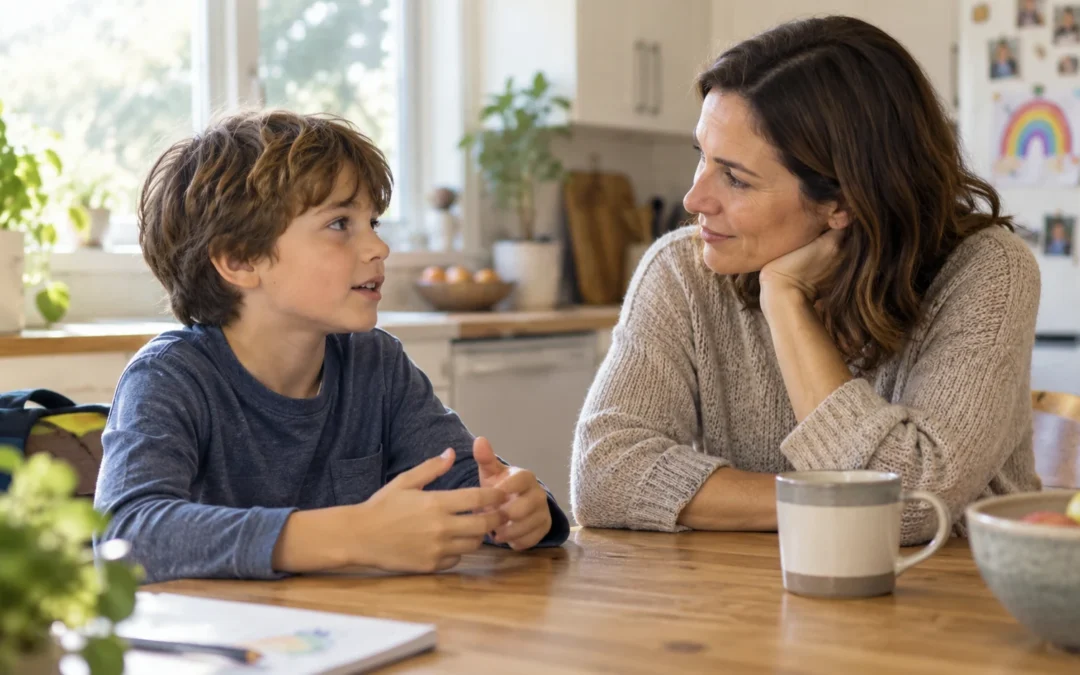

Speaking fluently and communicating easily are not quite the same thing. A child may have a rich vocabulary, clear speech and an impressive memory for facts, yet need more support to know when to join in, how to change topic, what an indirect comment means or what another person expects without saying it explicitly.
A sentence I often hear in clinical work is: “But they speak perfectly.” Sometimes a family has ruled out any communication difficulty for years because their child spoke on time, has a wide vocabulary, tells detailed stories or uses unusually sophisticated words. Yet social communication involves much more than the number of words someone knows.
Communication also means interpreting context, sharing turns, noticing when someone else wants to contribute, adjusting the amount of detail, repairing misunderstandings, understanding implied meaning, combining speech with gesture and expression, and deciding what is useful to say in a particular situation. For some autistic children, these skills can be demanding even when formal language — vocabulary and grammar — is strong.
A difficult conversation is not, by itself, evidence of autism. Shyness, social anxiety, ADHD, developmental language disorder, previous rejection, cultural differences and temperament can all affect communication. What matters is the wider developmental pattern and its impact on everyday life.
What is social communication, and why is it different from speaking well?
Clinicians and speech and language therapists often use the term pragmatic language for the way language is used in real-life situations. It is less about knowing what a word means and more about knowing what to say, to whom, when, how and for what purpose.
A child might do very well in English lessons yet freeze at break time. They may explain the mechanics of an electric train in extraordinary detail but not notice that a classmate has been trying to change the subject. They may understand a direct instruction perfectly but be confused when a teacher says, “We should probably be finishing up,” because no one has stated exactly what needs to happen next.

Social communication differences in autism can look very different from one child to another. In verbally fluent children they may be subtle enough to go unnoticed for years. NICE specifically warns that autism can be missed in verbally able children and should not be ruled out simply because language milestones were reached.
Signs that may appear when a child speaks fluently
There is no conversational checklist that can diagnose autism. The situations below are examples to help families notice patterns, not a test for labelling a child.
Conversations that become one-sided
A child may share a great deal of information about a topic they love but find it harder to notice when the other person wants to ask something, add their own experience or finish the conversation.
Joining a group
One-to-one conversation may feel manageable while entering a conversation between three or four children is much harder, particularly when topics change quickly.
Literal understanding
Jokes, irony, idioms or ambiguous language may sometimes be interpreted more literally. Not every autistic child is literal, and literal thinking alone does not indicate autism.
Preparing what to say
Some children rehearse questions or replies, need longer to formulate an answer, or feel far more comfortable when they know what kind of interaction to expect.

Six everyday examples that often make things clearer
1. “They talk endlessly about what they love”
An intense interest is not a problem in itself. It can be a major source of learning, enjoyment and connection. The difficulty may arise when a child finds it hard to adjust the conversation to the listener: how much that person already knows, whether they share the interest, whether they want a turn or whether they are signalling that they would like to stop.
Example: Leo gives his uncle a detailed explanation of every train used on a particular route. His vocabulary is excellent. When his uncle tries to move to another subject, Leo immediately returns to trains. This does not mean he is selfish. The social cue that says “let’s change topic” may simply not be explicit enough.

2. “They speak brilliantly with adults, but not with children their age”
Adult conversations tend to be more structured. Adults ask questions, wait, clarify and adapt. Peer conversations include interruptions, jokes, shared references, rapid topic changes and unwritten rules. This is why a child can appear highly communicative at home and feel lost in the playground.
3. “They answer questions, but rarely ask anything back”
Reciprocity is not about forcing a social script. It is about an exchange in which both people can contribute. A child may answer perfectly but not spontaneously return a question, comment on the other person’s experience or notice that the other person wants to keep talking.
4. “They do not always know when we are joking”
Non-literal language requires the listener to combine words, tone, context, previous knowledge and the likely intention of the speaker. Some autistic people need more effort to bring those clues together. Clarifying is usually more helpful than teasing: “That was a joke — I meant I am extremely tired, not that I am actually going to die.”
5. “They can sound blunt or very direct”
Literal or direct communication does not mean someone intends to hurt another person. We can teach that a phrase may have an unexpected effect without teaching the child that their natural way of communicating is wrong.
6. “After being with people, they need to be alone”
Following conversations, interpreting subtleties, monitoring turns and thinking about expectations can use a great deal of energy. In children who also use autistic masking or camouflaging, the cost may be even higher. Needing recovery time does not mean they do not like people.

Non-verbal communication: it is not all about eye contact
Communication includes tone, pauses, posture, personal space, facial expressions and gesture. But eye contact should not become a test of respect or sociability. Looking into someone’s eyes can be distracting, intense or simply unnecessary for listening.
The useful goal is for a child to understand and be understood in a way that works for them. One person may listen better while looking away. Another may use unconventional gestures. Another may benefit from visual support to organise what they want to say. The clinical question is not “Do they look typical?” but “Can they communicate their needs, understand enough of what others mean and participate with a reasonable level of wellbeing?”

A helpful perspective: communication happens between people
Social interaction used to be described as if the whole problem sat inside the autistic person. The double empathy perspective offers a more two-way account: when people experience and interpret social information differently, misunderstanding can happen on both sides.
It is a useful perspective rather than a diagnostic criterion, and research continues to examine its limits. In everyday life it reminds us of something important: the child should not have to do all the adapting. Adults and peers can also communicate more clearly, ask rather than assume, respect processing time and learn how that particular child shows interest, tiredness or affection.
Could it be something other than autism?
When a family seeks help, we look at the developmental pattern rather than a single behaviour. Several conditions can affect social communication.
Social anxiety
A child may know what to do socially but avoid it because they fear judgement or embarrassment. Autism and anxiety can also coexist. See anxiety and autism in children and teenagers.
ADHD
Interrupting, losing track or struggling to wait for a turn may relate to attention and impulsivity. Developmental history and the wider social profile help clarify the picture. Read autism and ADHD in children.
Developmental language disorder
Vocabulary, comprehension, grammar and pragmatic language can all be affected. Pragmatic difficulties also occur outside autism, so the whole language profile matters.
Social (pragmatic) communication disorder
This also involves social use of language, but autism additionally requires a current or developmental history of restricted or repetitive patterns of behaviour, interests or activities.
What can help at home without turning every conversation into therapy?
One of the best supports is allowing home to remain home. There is no need to correct every turn, gesture or sentence. Practice tends to be more helpful when it is respectful, brief and connected to situations that matter to the child.
- Say what you mean explicitly. “We are leaving in five minutes” is clearer than “We should probably get going soon”.
- Allow processing time. A few extra seconds can prevent an adult from answering on the child’s behalf.
- Use interests as a bridge. Talk about what they love and gently practise questions, comments and topic changes if these are useful goals for them.
- Explain misunderstandings without shame. “I think Maya understood that differently. Shall we work out how you could clarify it?”
- Respect social recovery time. Not every afternoon needs another group activity.
- Do not require eye contact. Looking and listening are not the same skill.

Three practical exercises
Conversation map
Choose one situation the child finds difficult — for example, talking to classmates at break — and review it afterwards, only if they want to.
- Before: Did you know who would be there? What did you expect?
- During: What part was easy and what part was confusing? Were there too many people or rapid topic changes?
- After: Did you feel settled, tired, worried or keen to do it again?
The aim is not to find what the child “did wrong”, but what information or support would have made the situation easier.
“Literal meaning or intended meaning?”
Use real phrases from everyday life and think of two possible meanings. “Break a leg”, “I’m dying of tiredness” or “That went brilliantly” said after a mistake. Then ask: “What clues tell us what the person probably means here?” Treat it as a puzzle you solve together, not a test.
A rescue phrase for confusing social situations
Prepare one or two phrases the child can use when they are unsure: “I’m not sure if that was a joke”, “Could you say what you mean more directly?” or “I need a minute”. Knowing there is a way out can reduce a great deal of pressure.
What can help at school?
School is especially demanding because communication happens while the child is learning, changing rooms, following rules, managing noise and trying to belong. Good support is not about forcing more social contact; it is about making interaction more accessible.
Clear instructions, warning before group work, enough processing time, opportunities to interact in smaller groups, a trusted adult and consistent home-school communication can all help. NICE recommends developmentally adjusted social-communication interventions and notes that peer mediation can be considered for school-aged children when delivered appropriately by trained professionals.
One important point: a child can look very different at school and at home. This does not necessarily mean anyone is exaggerating. Social load, noise, structure, familiarity and the effort involved in adapting can change functioning substantially.
What do we look at in an assessment?
We do not assess communication only by placing a child in front of a test. A structured one-to-one conversation with an adult may be exactly the situation in which they function best. That is why assessment needs information from several sources.
We may explore developmental history, early play and relationships, spontaneous gesture, reciprocity, interests, flexibility, literal language, friendships, group situations and the emotional cost of interaction. We also consider the child’s own perspective, the family’s observations and, where appropriate, information from school.

Where diagnostic questions remain, assessment may include naturalistic observation, language and communication measures, specific autism assessment tools when appropriate, and consideration of alternative or co-occurring explanations. Rating scales can contribute useful information, but they do not replace an integrated clinical assessment.
You can read more about our approach on the autism spectrum assessment page.
When is it worth seeking an assessment?
You do not need to wait until a child is “failing socially”. It can be worth asking for help when the pattern is persistent and begins to affect friendships, school participation, self-esteem, wellbeing or independence; when the child says they do not understand other people; when repeated conflict arises from misunderstanding; or when social interaction requires a disproportionate amount of effort.
Support may still be useful even if the eventual explanation is not autism. Understanding whether anxiety, ADHD, pragmatic language difficulties, sensory needs or another profile is involved can lead to much more specific help.
Frequently asked questions
Can an autistic child speak perfectly?
Yes. Some autistic people have fluent formal language and may have advanced vocabulary. Difficulties may instead involve reciprocity, pragmatic use of language, context or non-verbal communication.
If a child understands jokes, does that rule out autism?
No. Autism is highly varied. Some autistic people understand humour and irony very well, particularly in familiar contexts, and may still have other social communication differences.
Should we teach eye contact?
Not as a goal in itself. Eye contact is not the same as listening, empathy or understanding. Functional communication and the child’s regulation are more important.
Are intense interests always a communication problem?
No. Interests can support connection, learning and confidence. Support may be useful when the child wants more flexibility in conversation or finds it difficult to notice the other person’s needs.
Can shyness look like autism?
Some behaviours may look similar from the outside. Developmental history, communication quality in safe settings and the presence or absence of other autistic characteristics help clarify the picture.
Is autism the same as social (pragmatic) communication disorder?
No. Both can involve pragmatic communication differences, but autism also includes restricted or repetitive patterns of behaviour, interests or activities, either currently or in the developmental history.
Can communication be supported without changing the child’s personality?
Yes. The aim should be greater understanding, autonomy and useful tools, not teaching a child to perform a more “typical” version of themselves.
Related articles
Understanding more can change how we support a child
If you are unsure about your child’s communication, social development or the possibility of autism, an assessment is not about applying a label quickly. It is about understanding what is happening and what may genuinely help this particular child.
Sources and further reading
- NICE. Autism spectrum disorder in under 19s: recognition, referral and diagnosis.
- NICE. Autism spectrum disorder in under 19s: support and management.
- Autismo España. Communication and speech and language intervention.
- Systematic review of instruments used to measure pragmatic intervention effects in autistic children (2025).
- Systematic review of peer-mediated social interventions in primary-school autistic children (2024).
- Review of autism and the double empathy problem (2026).
This article is for general information and does not replace an individual assessment. At Ocnos Psychology Clinic we adapt assessment and support to the child or young person’s development, communication profile, family and school context, and individual needs.


