

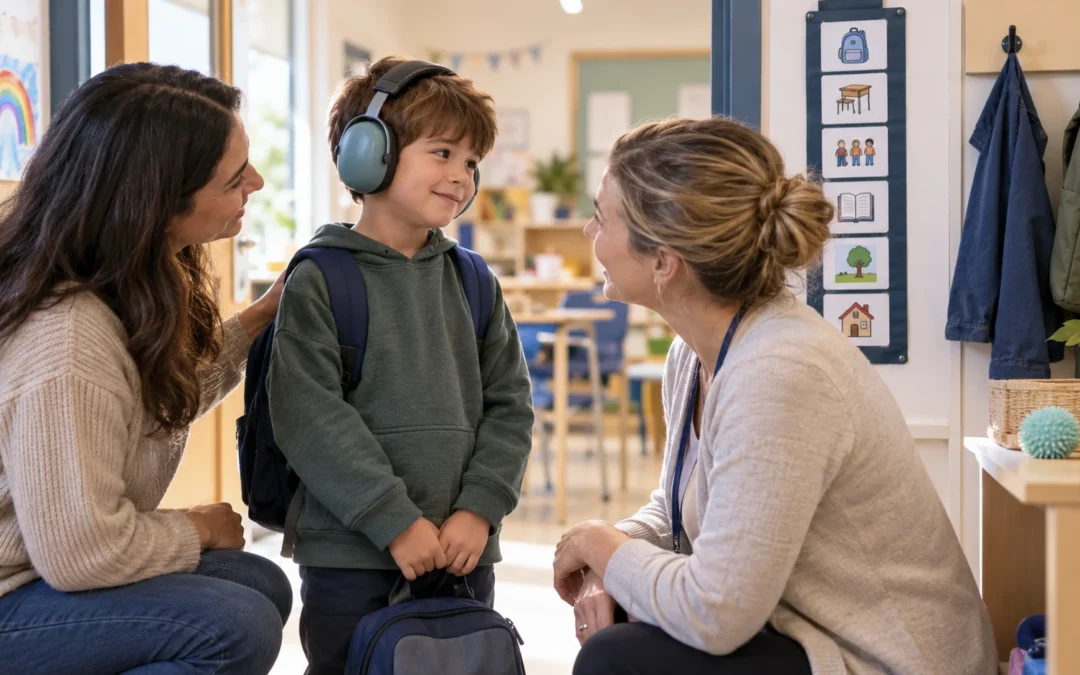

When a sound, seam or food texture causes intense distress, making a child “put up with it” does not automatically teach tolerance. First we need to understand the sensation, its impact and which support makes participation possible. Then, where there is a useful and safe goal, independence can be developed gradually.
“They cannot wear that jumper.” “They cover their ears in the dining hall.” “They only eat food with certain textures.” “They cope at school, but once home they cannot tolerate anybody talking to them.” From the outside, reactions like these can look like fussiness, rigidity or a lack of practice. The child's experience may be far more intense.
Sensory differences are part of the current clinical description of autism: some autistic people respond strongly to certain sensations, some respond less than expected, and some actively seek particular kinds of sensory input. There is no single autistic sensory profile. The same person may be highly sensitive to sound, notice cold less readily and seek movement.
In clinical work, rather than asking simply “Are they hypersensitive?”, it is usually more useful to ask: which sensation, in what setting, what happens before and after, how much does it interfere, and what changes when the environment is adjusted?
Not every intense reaction is sensory. Pain, migraine, hearing or vision problems, anxiety, poor sleep, hunger, gastrointestinal problems, ADHD or previous frightening experiences can look similar. A sudden or substantial change deserves consideration of medical causes as well.
What does a different sensory profile mean?
The nervous system is constantly receiving information from the environment and from inside the body. Sensory processing is not limited to the familiar five senses. Movement, body position and internal signals such as hunger, thirst, pain and the need to use the toilet also matter.
Autistic people may show patterns of hyper-reactivity, hypo-reactivity or sensory seeking. One child may show all three across different sensory systems.
Hyper-reactivity
A sensation is experienced very intensely or becomes uncomfortable quickly: a hand dryer, clothing label, bright light, smell or mixed food texture.
Hypo-reactivity
The response may be lower than expected: noticing cold, pain, food on the face or internal body signals less readily.
Sensory seeking
A person actively seeks sensations that feel regulating or enjoyable: movement, pressure, touching surfaces, rocking or repeated sounds.
A changing profile
Tolerance can vary with tiredness, stress, hunger, environment and how much stimulation has already accumulated.
There are more than five senses
The clinical assessment literature we use as background recommends considering sensory functioning as part of the whole developmental profile rather than as an isolated feature. Parent, teacher and self-report measures can contribute useful information, but they should be interpreted alongside what actually happens in everyday settings and activities.

Noise: when “not liking it” does not capture the problem
A school dining hall combines voices, trays, chairs, cutlery, echoes, smells, movement and the need to eat and interact. A pupil may tolerate each sound separately and become overwhelmed when they all occur at once.
Example: Marcus eats the same meal comfortably at home but barely touches it in the school dining hall and repeatedly asks to leave. If we decide he is being “fussy with food”, we may apply pressure in the wrong place. Noise, combined smells or the number of people may be the main difficulty.

Ear defenders or headphones may be helpful in specific settings, but they do not need to become an all-day default. For one child they reduce load; for another they make instructions harder to hear or feel isolating. Define when they are used, why and for how long, then review the outcome.
Clothing, seams and touch: “it doesn't hurt” may not match their experience
A label that most people barely notice can become a persistent, intrusive sensation for somebody else. The same can be true of fabrics, socks, waistbands, shoes, school uniform or a recent haircut. The response may look disproportionate to the size of the stimulus, but subjective intensity is not measured by the size of a seam.

- Use fabrics already known to be tolerable when the immediate goal is getting dressed and attending school.
- Remove labels or choose gentler seams if a simple adjustment solves the barrier.
- Offer two or three acceptable choices rather than the entire wardrobe if decision-making is also difficult.
- Prepare school uniform, costumes or new clothing in advance rather than introducing them five minutes before leaving.
- Do not turn uncomfortable clothing into an improvised “exposure” simply to prove the child can tolerate it.
Food and texture: selectivity is not automatically fussiness
Eating combines several sensory systems at once: smell, colour, temperature, consistency, chewing sound and oral sensation. Predictability also matters. A packaged cracker is usually almost identical every time; a strawberry can be sweet, sour, firm or soft. For some children that variability is a major factor.
Recent reviews report high rates of food selectivity in autistic children and teenagers and repeatedly identify texture, taste and oral sensory sensitivity as relevant factors. But a restricted diet is not always “just sensory”. Gastrointestinal pain, allergy, oral-motor or swallowing difficulty, anxiety, learned fear and eating disorders such as ARFID also need consideration.

If the diet is extremely restricted, weight or growth is affected, there is dehydration, choking, marked constipation, fatigue or concern about nutritional deficiency, “working on textures” is not enough. Medical and, where appropriate, dietetic or swallowing assessment may be needed.
Should we make a child try foods?
High pressure can turn meals into a threat. Sometimes it is more useful to separate goals: first tolerate the food being present, then explore it, perhaps touch or smell it, and only later taste it if appropriate. But there is no universal hierarchy for every child, and hunger should not be used as a pressure technique.
What is sensory overload?
There is no instrument that shows the exact moment a person reaches their limit. Sensory overload describes a situation in which the amount or intensity of incoming information temporarily exceeds the capacity available to process and respond in the usual way.
It may look like irritability, urgent escape, crying, difficulty speaking, repetitive movement, freezing, anger or a powerful need to withdraw. Some autistic people use the words meltdown and shutdown for particular forms of overwhelm or reduced functioning. They are descriptive terms, not diagnoses.
Example: Elena manages bright light, two teacher changes and a noisy break. During the final lesson a classmate repeatedly scrapes a chair and she reacts intensely. The chair may be the final input, not the whole explanation. The rest of the day has been filling the cup.
Sensory overload and anxiety can look similar — and can coexist
Anxiety can increase vigilance and reduce tolerance for sensory input; anticipating a difficult sensory environment can also create anxiety. In real life, the two often interact.
When a child avoids a place, the question is not simply “sensory or anxiety?”. We ask what they expect to happen, what bodily or sensory experience occurs, whether lowering noise or light changes things, whether there is pain, what happened previously and how much uncertainty is involved. Our guide to anxiety and autism in children and teenagers explores this interaction in more depth.
Why some children cope at school and unravel at home
Sensory load can accumulate. Add social communication demands, executive functioning, transitions, academic work and masking, and the total cost may become substantial. A safe home can be exactly where the body stops holding everything together.
This does not mean every difficult evening is caused by school. It does mean that comparing days, timetables and settings can be more informative than concluding that the child “behaves worse for their parents”.

Exercise 1: a seven-day sensory profile
A simple pattern-finding record
For one week, record only situations involving substantial distress or moments where something works particularly well.
- Situation: where were they and what were they expected to do?
- Input: noise, light, clothing, smell, food, movement, temperature, touch, people…
- Early sign: what appeared before overwhelm? More movement, less speech, repeated questions, covering ears?
- Response: what did the child do? Leave, freeze, ask for help, cry?
- Support: what changed? Less noise, a break, removing clothing, leaving the setting, separating foods?
- Outcome: did anything improve and how long did recovery take?
You do not need to monitor the whole day. The aim is repeated patterns, not constant surveillance.
Exercise 2: the overload traffic light
Green, amber and red
Build the system using the child or teenager's own words.
Green: I am okay; I can listen, think and participate. Amber: early signs appear; sounds feel louder, I speak less, move more or want to leave. Red: I can no longer process in the same way; I need demands reduced and time to regain safety.
The most useful part is agreeing what can happen at amber. Waiting until red and then demanding self-control is often too late.
Exercise 3: change one thing, not ten
A small everyday experiment
Choose one common situation and one adjustment. For example: ear defenders for the first 15 minutes of lunch; removing a jumper label; sitting away from the hand dryer; using softer lighting for homework.
Compare the outcome across several days: distress, participation and recovery. If it adds no value, stopping it is also good practice. A support is not effective because it sounds therapeutic; it is effective when it helps this person.

What can help at home, school and in public spaces?
- Reduce specific barriers: lower unnecessary noise or light, choose tolerable clothing and avoid intense fragrances where practical.
- Prepare difficult situations: explain how long they will last, where a break is possible and what alternatives exist.
- Offer regulation before crisis: preventive breaks generally work better than waiting for complete overload.
- Allow safe self-regulation: movement, fidgeting, pressure, headphones or repetition may be useful when they are safe and genuinely help.
- Make requesting a break accessible: an agreed word, card or gesture may be easier than a detailed explanation during overload.
- Review the impact: supports should increase participation and independence, not simply accumulate into a permanent list.
At school, these ideas work best as part of an individual, coordinated plan. Our guide to autism at school includes a simple demand → sign → support → outcome record that families and schools can use together.

Does adjusting the environment mean avoiding every discomfort?
No. Everyday life contains noise, change, new clothing, crowded settings and unfamiliar foods. There is, however, an important difference between learning to manage tolerable discomfort and being required to remain in an experience that feels painful or overwhelming.
A good plan can combine accessibility with learning. A pupil might use ear defenders during the noisiest period and take them off in a quieter classroom; visit a new setting in advance and gradually increase time there; or explore unfamiliar food without being required to eat a specified amount.
Gradual exposure can be appropriate where there is a meaningful functional goal, the situation is safe, everybody understands what is being practised and the level of difficulty can be adjusted. It should not be used to dismiss sensory pain.
What if the child seeks sensory input rather than avoiding it?
Some autistic children and teenagers need to move, rock, jump, touch particular objects, squeeze their hands, carry weight or repeat sounds. These behaviours may help organise attention and body state.
Not every repetitive movement needs to be stopped. We consider change when there is physical risk, it prevents an activity the person wants to do, or a safer way exists to meet the same need. Otherwise, harmless self-regulation can reduce unnecessary effort.
Sensory integration therapy: what do we actually know?
This is an area where absolute claims are not justified. The UK SenITA trial randomised 138 autistic children with sensory processing difficulties and found no significant overall advantage of manualised sensory integration therapy over usual care on its main outcomes at six or twelve months. Families and therapists did, however, report improvements in some individual functional goals.
More recent reviews, including a 2026 review of occupational therapy using Ayres Sensory Integration, report evidence for some individualised participation and occupational-performance outcomes. This does not make sensory integration a treatment for autism itself, and it does not mean that the approach has equal value for every child.
A cautious way to decide: if occupational therapy or a sensory-focused intervention is used, start with a concrete functional difficulty — dressing, self-care, accessing a setting, participating in class — set measurable goals and check whether change appears in everyday life. Be wary of claims to “normalise the nervous system”, cure autism or apply the same programme to every child.
NICE also advises against auditory integration training for speech and language problems in autistic children and young people. This is a specific treatment approach and should not be confused with ordinary, targeted use of ear defenders or headphones to reduce environmental load.
What do we do in clinic?
When sensory differences interfere with everyday life, we place them within the wider picture: development, communication, anxiety, ADHD, sleep, eating, pain, school functioning and the regulation strategies the person already uses.
We may use observation, structured records, family and school information and, where appropriate, standardised questionnaires. If the difficulty concerns eating, motor skills, sensory processing or particular everyday occupations, collaboration with occupational therapy, paediatrics, dietetics, speech and language therapy or other professionals may be appropriate.
If sensory differences occur alongside wider questions about social development, communication, flexibility or developmental history, assessment needs to consider the complete profile rather than diagnosing from sensory sensitivity alone. You can read more about our autism spectrum assessment.
When is it worth seeking help?
Support may be useful when sensory differences prevent dressing, eating, sleeping, attending school, using transport, joining activities or managing hygiene; when they cause frequent pain or severe overwhelm; or when family life is increasingly organised around avoiding triggers and distress is still growing.
Seek medical advice promptly where there is weight loss, dehydration, concern about nutritional deficiency, choking, pica, injury from sensory-seeking behaviour, burns or wounds that the child seems not to notice, persistent pain, sudden regression or a new and abrupt sensory change. These signs require consideration of physical health as well as autism.
Frequently asked questions
Is every autistic person hypersensitive?
No. There may be increased responses, reduced responses, sensory seeking or a mixture. The pattern differs between people and across contexts.
Does covering the ears mean a child is autistic?
No. It can occur because of auditory sensitivity, fear, ear pain, anxiety or other reasons. Autism assessment looks at a much broader developmental pattern.
Are headphones a good idea?
They can be useful in specific settings if they reduce load and support participation. Their purpose should be clear and they should not prevent the child hearing important information.
Should we always remove clothing labels and buy the same clothes?
If a simple adjustment removes pain and supports independence, it may be entirely reasonable. Flexibility can be developed where useful without creating unnecessary distress.
Is food selectivity always sensory?
No. Oral sensitivity and texture are common factors, but pain, gastrointestinal conditions, swallowing, anxiety, learned responses and eating disorders may also contribute.
Is sensory overload the same as a tantrum?
No. Sensory overload describes a state in which incoming demands exceed available processing and regulation capacity. Understanding any individual behaviour still requires looking at what happened before, its function and the context.
Is sensory integration therapy evidence-based?
The evidence is mixed and depends on the protocol and outcome. Recent reviews support some individualised participation outcomes, while a large pragmatic trial did not show an overall advantage on its main outcomes. Functional goals and outcome monitoring are therefore important.
Can sensory sensitivity change with age?
Yes. Sensory experience and coping strategies can change with development, environment, experience, anxiety and other factors. A support that is essential at eight may be unnecessary at fifteen.
Related articles
Understanding the sensation can completely change the response
If noise, clothing, food, movement or other sensory experiences are restricting everyday life, we can help identify patterns, consider alternative explanations and build support that makes sense for this particular person.
Sources and further reading
- NICE. Autism spectrum disorder in under 19s: support and management.
- NICE. Autism spectrum disorder in under 19s: recognition, referral and diagnosis.
- Autismo España. Hyper- and hypo-reactivity to sensory stimuli.
- Ferrara R, et al. Food selectivity and autism: a systematic review. World Journal of Clinical Pediatrics. 2025.
- Randell E, et al. Sensory integration therapy for children with autism and sensory processing difficulties: the SenITA RCT. Health Technology Assessment. 2022.
- Piller A, et al. Occupational Therapy Interventions Using Ayres Sensory Integration for Children and Youth (2015–2024): A Systematic Review. American Journal of Occupational Therapy. 2026.
- The use of multisensory environments in children and adults with autism spectrum disorder: a systematic review. 2025.
This article is for general information and does not replace an individual assessment or medical, dietetic, speech and language, or occupational therapy assessment where indicated. Support should be chosen for its effect on participation, independence and wellbeing, not simply because it is described as “sensory”.


