



Anxiety is not an inevitable part of autism, but the two can co-occur. Anxiety may show up as avoidance, irritability, a strong need for control, shutdown, physical symptoms or exhaustion rather than clearly expressed worry. Helpful support begins by understanding what the child fears, what overwhelms them, what they are trying to avoid and what would make a safe next step possible.
“He says his stomach hurts every school morning”, “if a plan changes she becomes very distressed”, “he holds it together at school and falls apart at home”, “she asks the same question over and over”, “he wants friends but is frightened of getting things wrong”. Families often wonder whether they are seeing anxiety, autistic differences, sensory overload, or several things at once.
One behaviour rarely gives us the answer. Clinically, it is more useful to reconstruct the pattern: what happened beforehand, what the young person felt or thought if they can tell us, what their body was doing, how they tried to regain safety or control, how long recovery took and where the same pattern does or does not appear.
For a broader introduction, see our main guide to autism in children and teenagers. This article focuses specifically on anxiety that can occur alongside autism and on practical, respectful ways of helping.
Anxiety and autism can occur together, but they are not the same thing
Autism is a neurodevelopmental condition. Anxiety involves fear, worry and anticipation that can become intense enough to interfere with everyday life. An autistic child may have clinically significant anxiety, or they may experience worries and stress responses that do not fit neatly into one diagnostic category.
The clinical literature we use as background repeatedly highlights two points: anxiety is a common co-occurring mental-health difficulty in autistic people, and assessment works best when it uses several sources of information across more than one setting. We should not assume that every need for routine is anxiety, or that every instance of avoidance has the same cause.
A useful clinical question is: “What is making this situation hard for this particular child?” The answer may involve fear of making a mistake, sensory overload, uncertainty, difficulty reading social situations, fatigue, pain, rejection experiences, or several factors together.
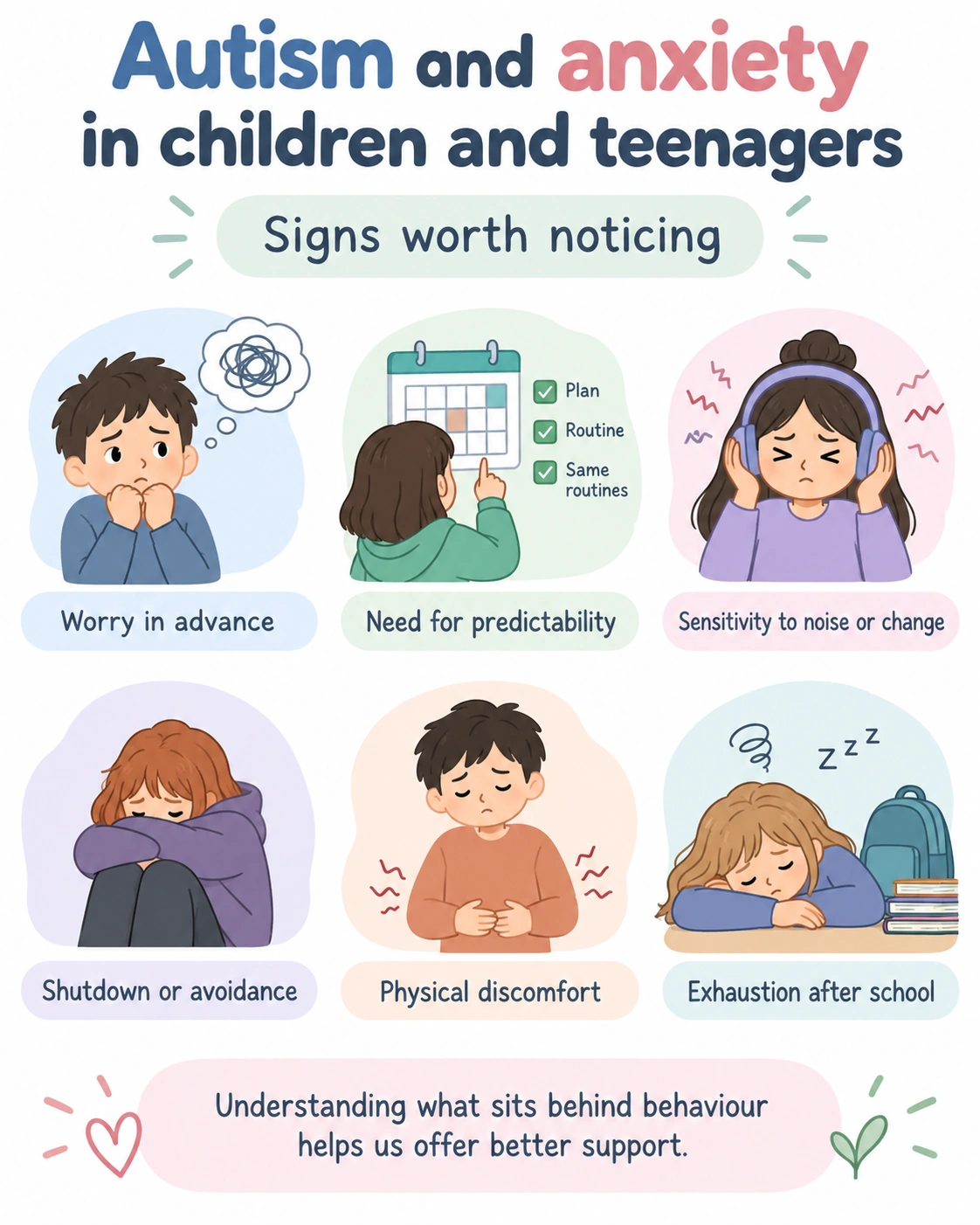
What can anxiety look like in an autistic child or teenager?
Some young people can say, “I am scared”, “I think something bad will happen” or “I am worried people will laugh at me”. Others find it harder to identify or describe internal states. In that case, anxiety may be easier to notice through behaviour or physical signs.
Repeated reassurance seeking
Asking again and again what will happen, who will be there, how long something will last or whether a plan might change. Reassurance helps briefly, then the uncertainty returns.
Avoidance
Not wanting to enter school, withdrawing from an activity, stopping social plans, delaying a task or relying increasingly on an adult to do feared things for them.
Physical symptoms
Stomach aches, nausea, headaches, tension, rapid breathing, needing the toilet, sleep difficulties or fatigue. Physical causes should also be considered where appropriate.
Irritability or shutdown
Anxiety does not always look frightened. It can appear as anger, silence, rigidity, tears, refusal or an urgent need to leave.
When anxiety looks like “bad behaviour”
Families often describe behaviour that becomes much more difficult just when pressure rises: “he knows how to do it but refuses”, “she gets angry every time we have to leave”, “he creates a scene before tests”. Sometimes boundaries or learning are relevant, but behaviour can also be serving an escape function when a situation feels threatening or unmanageable.
Example: Laura, 12, takes longer and longer to get ready for secondary school. She repeatedly “loses” things, goes back to the bathroom and argues about clothes. On the surface this looks like a disorganised morning. Further exploration reveals that she has become frightened of meeting a particular group of pupils in the corridor and does not know how to respond to their ambiguous jokes. The support plan now needs to address social safety and anxiety, not simply speed up the morning routine.
Not all avoidance is anxiety. Fatigue, executive-function difficulties, bullying, sensory overload, sleep problems, pain, learning difficulties and unmet support needs can all contribute.
Anxiety, sensory overload and shutdown: how can we tell the difference?
There is no perfect dividing line. Sensory overload can trigger anxiety, and anxiety can make ordinary sensory input harder to tolerate. Looking at the trigger and what helps afterwards can still be informative.
With anxiety, there is often anticipation of threat: “What if I get it wrong?”, “What if someone talks to me?”, “What if Dad is late?”. Avoidance brings short-term relief. With sensory overload, the difficulty may be more directly related to noise, light, touch, smell, heat, crowds or the sheer amount of input.
Exposure should not be used to make a child tolerate painful or clearly overwhelming sensory input. Gradual exposure is a tool for anxiety-driven avoidance of safe situations. It is not a reason to force someone through pain, bullying, humiliation or unnecessary sensory distress.
If sensory differences are central, our guide to sensory differences in autism explores this further.
Uncertainty can carry a heavy load
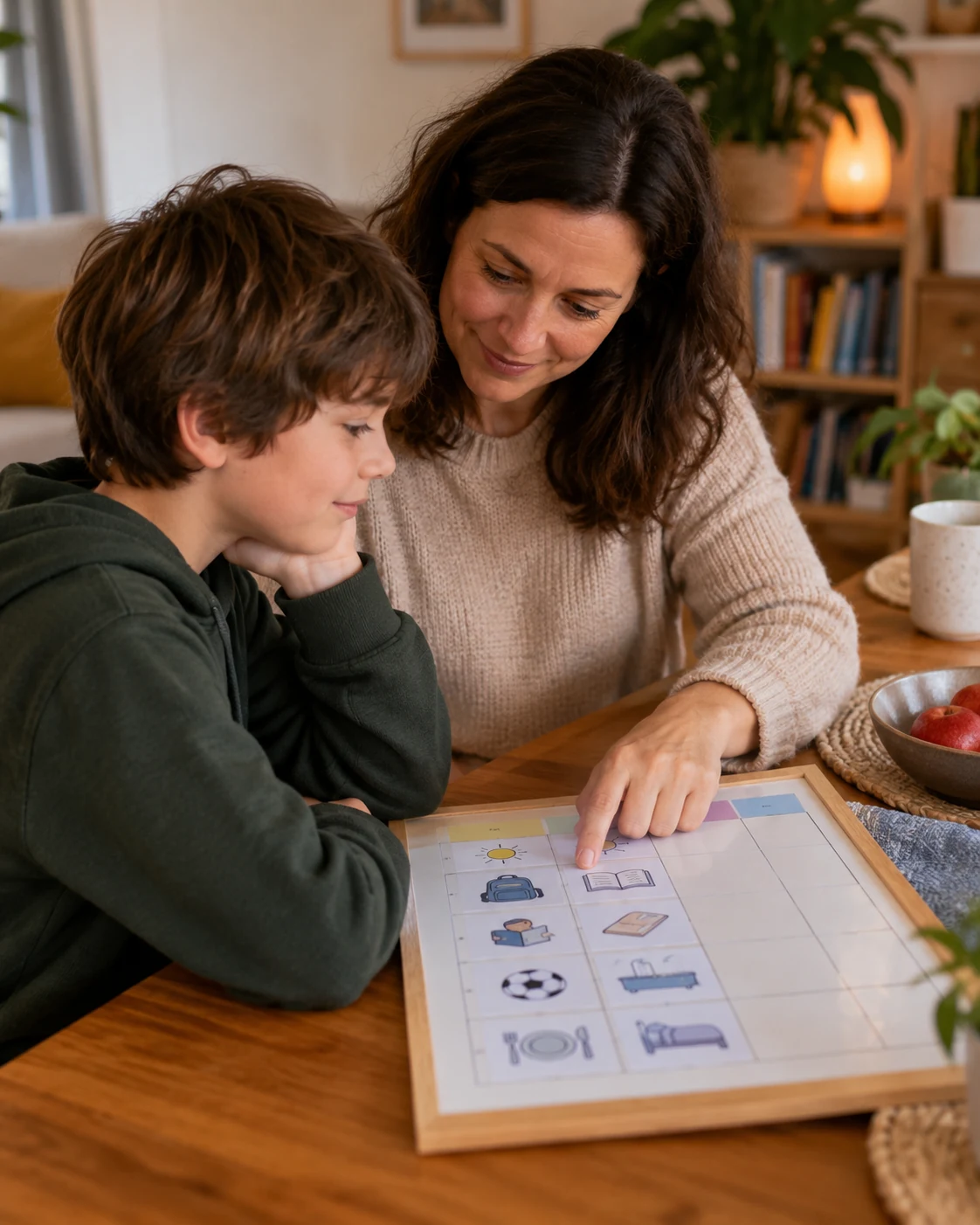
For some autistic young people, knowing what is going to happen reduces a great deal of mental effort. When anxiety is also present, the search for certainty can become repeated questions, checking, increasingly detailed plans or strong resistance to relatively small changes.
The aim is not to promise that nothing will ever change. A more useful approach combines enough predictability with gradual practice in coping with uncertainty: explain what we know, be honest about what we do not know, and agree a simple plan B.
Helpful wording: instead of “nothing is going to happen, stop worrying”, try: “I can see that not knowing who will collect you is making you anxious. I am most likely to come. If I cannot, we will tell you beforehand and Dad will come. Those are the two options.”
Social anxiety: wanting connection and fearing getting it wrong
A teenager may want friendships and still feel unsure about how to join a conversation, what to say, when to speak, how to interpret a joke or what to do when someone changes their mind. If there is also fear of negative evaluation — “they will think I am weird”, “I will say the wrong thing” — social anxiety may be part of the picture.
This matters because social avoidance can look like lack of interest from the outside. We need to ask not only whether a young person socialises, but what they want, what they fear, how much effort it costs and how they feel afterwards.

See also social anxiety or shyness and our cluster article on friendships and autism in teenagers.
Masking, exhaustion and the after-school collapse
Some children and teenagers spend a great deal of energy observing, copying, rehearsing responses, controlling movements, suppressing regulation needs or trying not to stand out. Not every autistic person masks, and not every social adaptation is masking, but sustained effort can contribute to exhaustion.
This can produce an apparent contradiction: “school says she is absolutely fine, but she falls apart at home”. Both observations can be true; they may be seeing different points in the same day.
Our guide to autistic masking in girls and teenagers explores this pattern in more detail.
Anxiety in autistic girls may be easy to miss
In some girls, distress can sit behind good grades, rule-following, perfectionism or apparently competent social behaviour. Anxiety may show as intense self-criticism, fear of mistakes, over-preparation, physical symptoms, exhaustion or a strong need to be alone after social demands.
This is not a separate “female anxiety” and autistic girls are highly diverse. It is simply a reason not to equate quiet behaviour with wellbeing. See autism in girls: signs that can go unnoticed.
The avoidance cycle: why short-term relief can keep fear going
When something feels frightening, avoiding it brings immediate relief. That relief is powerful and can teach the brain that escape was necessary. Over time, the range of situations the young person feels able to handle can shrink.
Example: Marcos is frightened of ordering food in a café. His father orders for him, and the anxiety drops. Next time he asks Dad to do it again. A graded plan might start with choosing the order in advance, rehearsing one sentence, pointing to an item, saying only “this one, please”, and gradually increasing participation. He is not thrown into the hardest step and he is not shamed for being anxious.
Autism-adapted cognitive behavioural therapy is often more structured, visual, concrete and gradual. NICE recommends considering adaptations such as written and visual information, more concrete cognitive work, breaks, parent or carer involvement where useful, and incorporating the young person's interests.
Exercise 1: a seven-day anxiety map
Look for patterns, not perfect behaviour
For one week, record only one or two moments each day. The aim is understanding, not surveillance.
- Situation: what happened immediately beforehand?
- Signals: what did you notice in their body, words or behaviour?
- Possible explanation: fear, sensory overload, uncertainty, frustration, fatigue, or a mixture?
- Response: what did the child do to feel safer?
- Outcome: what genuinely helped, and how long did recovery take?
At the end of the week, look for repeated combinations. A pattern such as PE + noisy lunch hall + test = exhausted evening is more useful than “Tuesdays are always terrible”.
Exercise 2: a traffic-light body map
Many young people notice anxiety only when it is already very high. A simple body map can help identify earlier signs without turning self-monitoring into another task to get “right”.
Green
I am reasonably settled. I can think, talk and carry on. This is where we practise skills.
Amber
Tension rises, questions repeat, noise feels sharper, escape urges appear. This is the best time to use supports.
Red
I am overwhelmed. Priorities are safety, fewer words, fewer demands and reduced stimulation.
Afterwards
Once regulation returns, review what happened and adjust the plan. Reflection works better from a calmer state.
Exercise 3: a ladder of small steps
Move forward without forcing
Choose a safe situation that anxiety is limiting and that the young person also wants to improve. Break it into gradually harder steps. Each step should be challenging enough for learning, but not so large that overwhelm is predictable.
Example: if entering an after-school activity alone is frightening: 1) look at photos; 2) visit the entrance with a parent; 3) go in for five minutes; 4) stay while the parent waits outside; 5) complete a session with a clear exit plan.
If participation is limited by sensory pain, bullying or an objectively unsuitable demand, the answer is not an exposure ladder. Change the environment or protect the young person.
What can help at home
- Validate without chasing absolute certainty: acknowledge the worry, but notice when repeated reassurance is becoming part of the cycle.
- Prepare enough: use schedules, clear options and notice of meaningful changes.
- Reduce language during overwhelm: fewer questions, fewer simultaneous instructions and more recovery time.
- Protect sleep, meals, movement and rest: physical depletion reduces stress tolerance.
- Do not treat all discomfort as danger: safe, collaborative small challenges can build confidence.
- Respect restorative interests and alone time: time alone is not automatically unhealthy withdrawal.
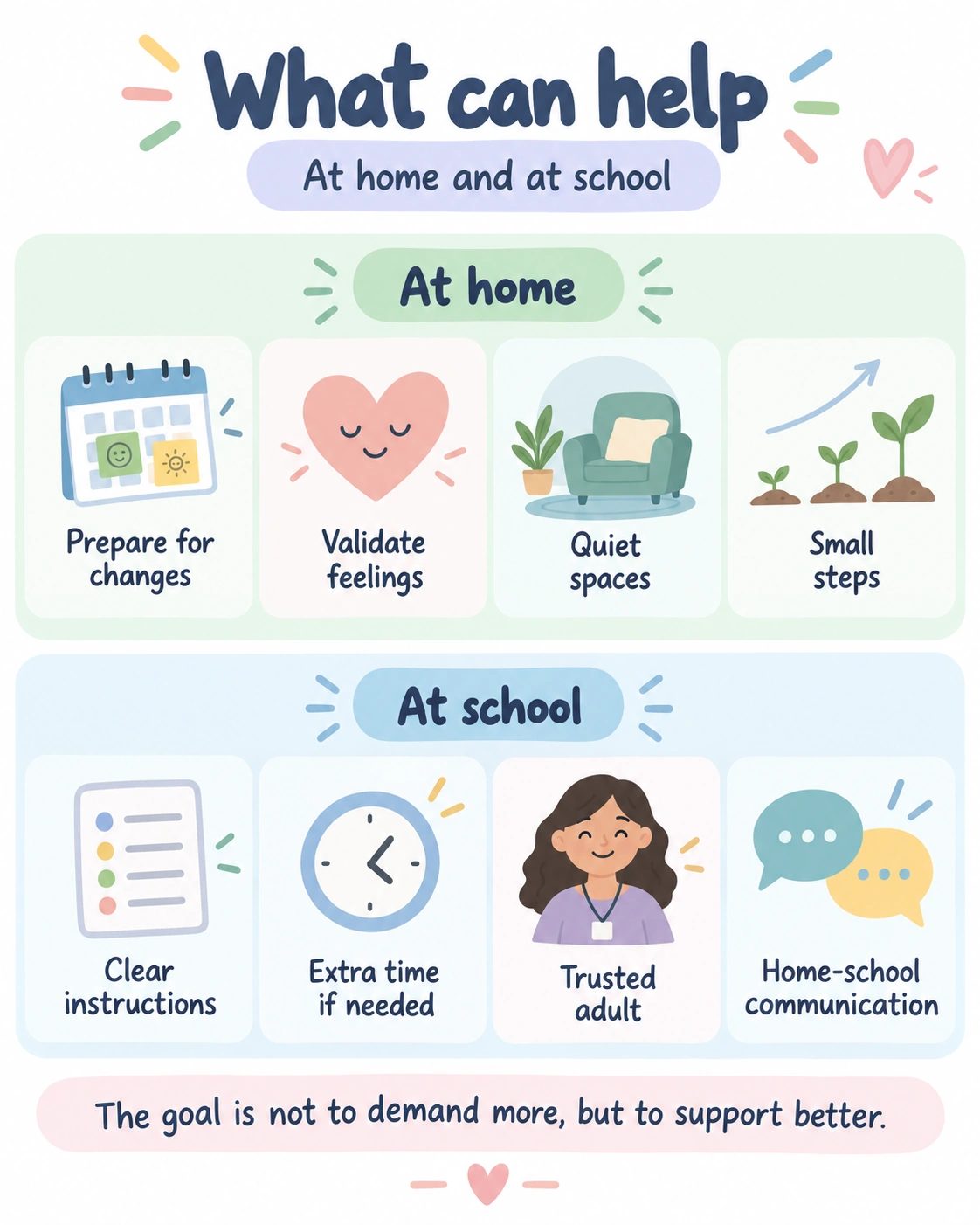
What can help at school
Support cannot sit entirely with the child. If the environment is highly unpredictable, noisy, socially ambiguous or more demanding than their current resources can manage, environmental adjustment is part of the intervention.
Helpful measures may include clear instructions, advance notice of changes, a trusted adult, planned breaks, access to a quieter space, flexible ways to demonstrate learning when anxiety is interfering, preparation for transitions and regular home-school communication.
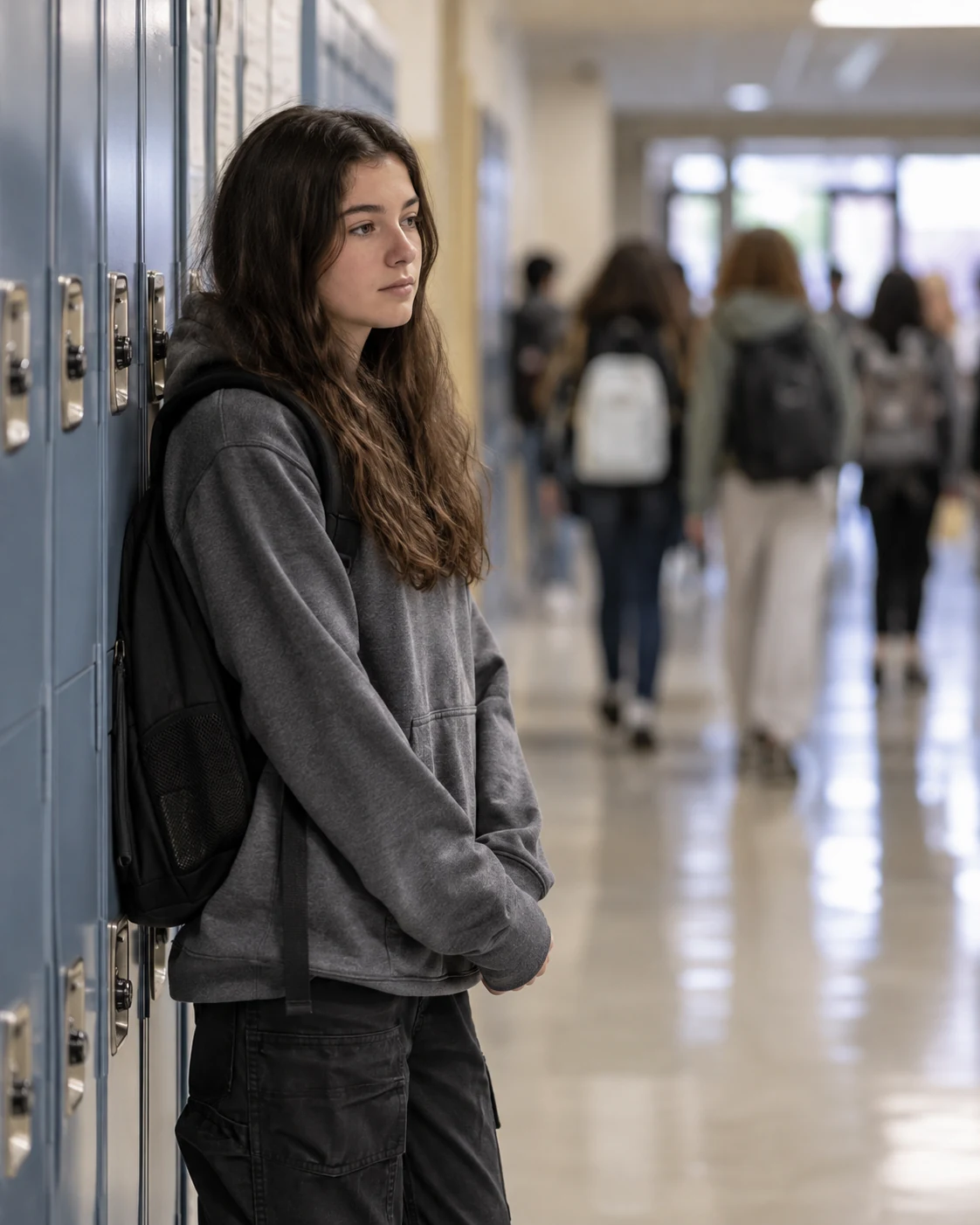
See our guide to autism at school: support and coordination for a broader discussion of reasonable adjustments.
Homework, perfectionism and getting stuck
One child may not start because the first step is unclear; another because making a mistake feels intolerable; another because their resources are already depleted after school. From the outside, all three can look like procrastination.
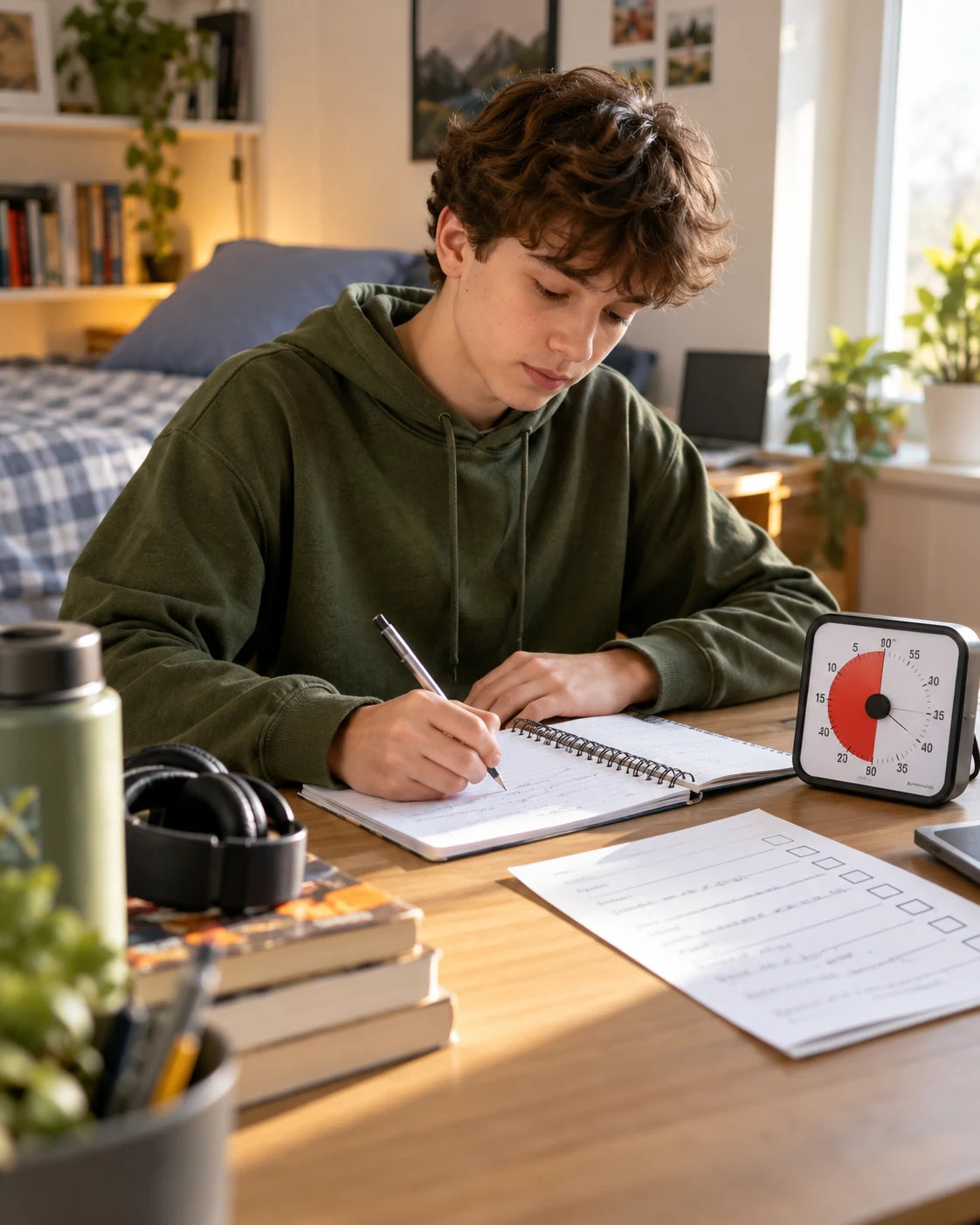
Instead of “do your homework”, try one observable first step: “open the platform”, “choose one subject”, “work for ten minutes and then we will check”. With perfectionism, low-stakes practice of “good enough” work can be useful.
What we do in therapy when anxiety and autism overlap
Work depends on age, language, cognitive profile, communication style, previous experiences, autonomy, family and school context, and the particular form of anxiety. There is no single protocol that fits everyone.
Assessment may include parent or carer interview, direct work with the child or teenager, developmental history, school information where appropriate, questionnaires and clinical observation. We are interested in frequency, intensity and interference, but also in what the avoidance is doing and what environmental factors may be maintaining distress.
When cognitive behavioural therapy is appropriate, it can be adapted with greater structure, visual information, concrete examples, emotion-recognition work, gradual behavioural practice, family involvement and use of motivating interests. A 2024 systematic review and meta-analysis found moderate-certainty evidence for CBT-based approaches to anxiety in autistic young people according to parent and clinician ratings, while also highlighting variability between people and informants.
Therapy is not about making a child “look less autistic”. The aim is to reduce anxiety-related distress and restriction, increase understanding and autonomy, and remove unnecessary barriers in the environment.
If diagnosis is still uncertain, our autism spectrum assessment page explains the assessment service. If anxiety is the main concern, see our anxiety treatment service.
When is professional help worth considering?
You do not have to wait until things are at crisis point. Seek help when worry, avoidance or distress is making life smaller: school absence, dropping valued activities, persistent sleep problems, frequent physical symptoms, escalating family conflict, social withdrawal, academic shutdown or a growing need for adults to remove feared situations.
Assessment is also useful when it is unclear whether anxiety, sensory overload, ADHD, learning difficulties, depression, OCD, bullying experiences or several co-occurring problems are contributing. Differential assessment matters because the right support for one difficulty may be unhelpful for another.
If there is self-harm, hopelessness or immediate risk
If a child or teenager talks about wanting to die, says they cannot go on, has dangerous self-harm, has made an attempt or there is immediate risk, prioritise safety and urgent assessment. In Gibraltar, the GHA Mental Health Crisis Service is available 24/7 on 111, and the main emergency number is 999. In Spain, call 112 in an emergency; the national 024 line supports people affected by suicidal thoughts or behaviour.
We also have a parent guide on self-harm in teenagers. An online article never replaces a risk assessment when safety is in question.
Frequently asked questions
Is anxiety part of autism?
Not necessarily. Autism and anxiety are distinct, although they often co-occur. Autistic differences such as a need for predictability, sensory sensitivities or social uncertainty can interact with anxiety, but not every autistic child has an anxiety disorder.
How can I tell anxiety from sensory overload?
There is overlap. Anxiety often involves anticipation of threat, worry or fear and may temporarily ease through avoidance. Sensory overload is more directly related to the intensity or amount of input. Triggers, physical signs, context and recovery pattern are useful clues.
Should I remove everything that makes my child anxious?
No. Repeated avoidance of safe situations can maintain fear. Equally, children should not be forced through sensory pain, bullying or inappropriate demands. Gradual work should separate treatable fear from a genuine need for adaptation.
Do headphones make sensory sensitivity worse?
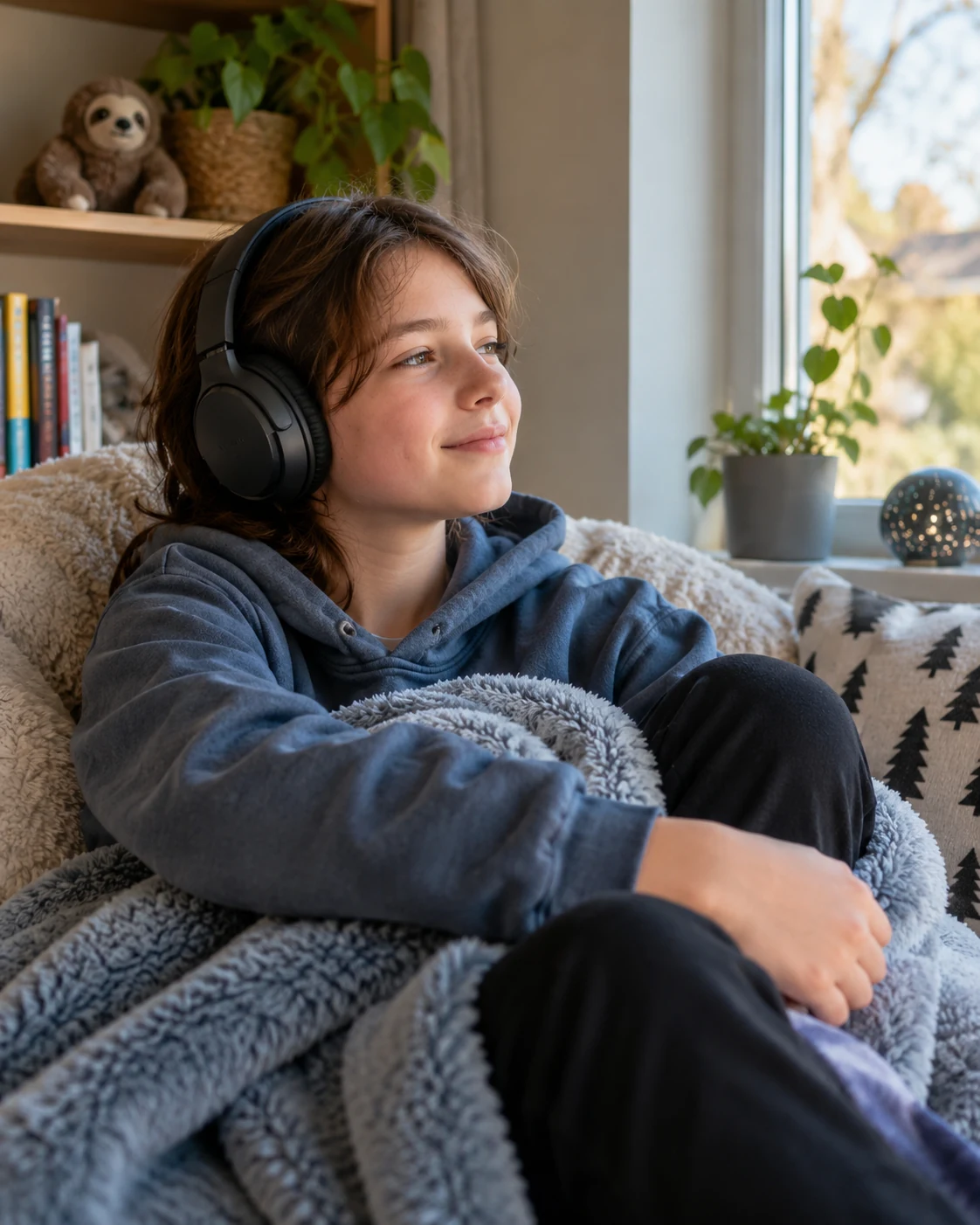
There is no universal rule. Headphones can be a useful regulation tool in specific environments. Their use should be flexible and functional rather than based on the idea that a child must tolerate all noise or avoid all noise.
Can CBT help autistic children with anxiety?
It can be helpful when adapted to the person's needs. NICE recommends considering adjusted individual or group CBT and suggests adaptations such as more structure, visual information, breaks, concrete activities and carer involvement where useful.
Can anxiety increase during the teenage years?
It can. Social complexity, academic pressure, growing independence and awareness of difference may all increase demands. A significant rise in distress should still be understood rather than dismissed as “just adolescence”.
Does my child need an autism diagnosis before anxiety can be treated?
No. Anxiety can be addressed while autism assessment is still ongoing. What matters is adapting the work to the child's actual communication, sensory, cognitive and developmental needs.
Related articles
When understanding the pattern changes how we can help
If anxiety is limiting school, friendships, rest or family life, an assessment can help clarify what is happening and which supports make sense. Ocnos Psychology Clinic is based in Palmones and supports families across the Campo de Gibraltar and Gibraltar, with online work where clinically appropriate.
Scientific and institutional sources
- NICE. Autism spectrum disorder in under 19s: support and management (CG170). Recommendations on coexisting conditions, environmental adjustments and adapted CBT for anxiety.
- World Health Organization. Autism fact sheet. Institutional information on autism, diversity of support needs and co-occurring conditions.
- Pemovska T, et al. Psychological Medicine, 2024. Systematic review and meta-analysis of approaches to improving mental-health care for autistic children and young people.
- Sharma S, et al. 2021. Systematic review and meta-analysis of CBT for anxiety in autistic children and young people.
- Adams D, et al. 2023. Meta-analysis on anxiety and social outcomes in autistic children and adolescents.
This article is for general information and does not replace an individual psychological, medical or psychiatric assessment. All examples are fictional and used for educational purposes only.


