

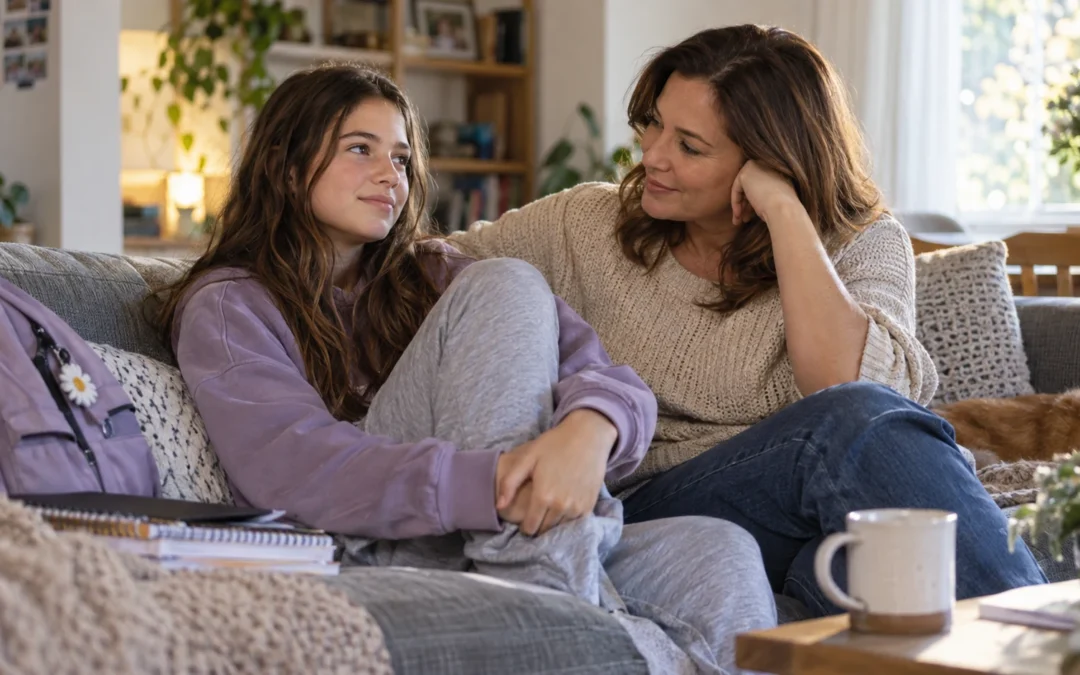

Autistic masking in girls and teenagers describes the conscious or unconscious effort to hide, compensate for or alter traits and needs in order to fit in socially. A young person may look as though she is coping while arriving home exhausted, anxious or disconnected from what she needs. Masking on its own does not diagnose autism; what matters is the wider developmental pattern and the cost of maintaining that adaptation.
“School says she is doing brilliantly. She has friends, gets good marks and never causes trouble. But the moment she gets home, she has nothing left.” That gap between what other people see and what happens afterwards can be confusing for families.
For some autistic girls and teenagers, part of that gap may involve masking or social camouflaging: watching other people to work out what to do, rehearsing conversations, suppressing self-regulating movements, forcing certain facial expressions, tolerating uncomfortable sensory input without saying so, or trying to look relaxed while feeling tense inside.
This guide is not designed to turn masking into another internet checklist. It is here to help families notice effort as well as appearance, find practical ways to reduce unnecessary pressure and understand when an autism assessment may be useful. If you are new to the topic, you may also want our guide to autism in children and teenagers and our article on signs of autism in girls.
What autistic masking or camouflaging means
Research uses terms such as masking, camouflaging, compensation and assimilation for strategies people use to reduce the visibility of their differences or navigate social expectations that may not feel intuitive. Some strategies are deliberate. Others become so automatic over time that the person may barely notice she is using them.
Hiding
Suppressing self-regulating movements, hiding interests, tolerating sensory discomfort or concealing confusion to avoid standing out.
Copying
Mirroring gestures, tone of voice, expressions, interests or conversation styles in order to work out how to behave.
Compensating
Learning social rules explicitly, preparing answers, studying turn-taking or building scripts for familiar situations.
Trying to fit in
Changing how one presents in order to reduce rejection, teasing, conflict or the feeling of being the odd one out.
These strategies are not necessarily dishonest or manipulative. They can be learned responses to environments where difference has social consequences. They are also not exclusive to autism: non-autistic teenagers may adapt their behaviour to fit in too. That is why masking is not a diagnosis.

Why masking can be particularly easy to miss in girls and teenagers
Clinical guidance specifically warns that autism may be under-recognised in girls. NICE also notes that when older children and young people first present for assessment, autistic features may previously have been masked by coping strategies or a supportive environment. The DSM-5-TR similarly recognises that compensation and current supports can mask difficulties in some settings.
Adolescence also raises the social stakes. Friendship rules become more subtle, peer groups shift, irony and unspoken expectations become more complex, and social media adds another layer of comparison and performance. For a teenager who has learned many social rules consciously, that transition can demand a great deal of cognitive and emotional energy.

Worth remembering: masking is not a girls-only phenomenon. Boys, non-binary people and other neurodivergent young people may mask too. This article focuses on girls because they have historically been at greater risk of having autistic needs overlooked.
What masking can look like in everyday life
During conversation
A teenager may rehearse questions before entering a room, keep a bank of phrases that have worked before, laugh when other people laugh without fully understanding why, or devote significant attention to calculating eye contact. From the outside the conversation can look spontaneous. Internally, it may feel like a demanding task.
In the classroom
A pupil may sit quietly, copy what classmates do, avoid asking for help because she does not want to stand out, and follow rules meticulously. Good grades and “excellent behaviour” tell us very little about how much energy that performance takes. Perfectionism can sometimes become a safety strategy: if everything is done exactly right, there is less chance of making a visible mistake.

With friends
She may adopt interests to create common ground, agree to plans that are actually overwhelming, let someone else set all the rules of a friendship, or copy the group's style of dress and expression. Other autistic teenagers have genuine, meaningful friendships but need substantial recovery time after socialising.

With sensory and regulation needs
A girl may tolerate a noisy dining hall, bright lights, uncomfortable clothing or unwanted touch without complaining because she has learned that objecting draws attention. She may also suppress movements, fidgeting or other forms of self-regulation. Once she reaches a safe place, the accumulated tension may become much more visible.
So alongside “Can she do it?”, add a second question: “What does it cost her to do it?”
Looking as though she is coping is not the same as coping easily
One of the most informative patterns can be a striking difference between settings. Some teenagers hold everything together throughout the school day and then need darkness, silence, soft clothes, time alone or freedom from decisions when they get home. Others become irritable, tearful, headachy, shut down or say they simply cannot talk.
This pattern does not prove autism or masking. After-school exhaustion has many possible causes. But when it is repeated, intense and closely linked to social, cognitive or sensory demands, it deserves curiosity rather than being dismissed as bad behaviour.

Instead of: “If you can cope like that at school, you can do it at home.”
Try: “It looks as though today took a lot out of you. Would you rather have some space, get something to eat, or leave questions until later?”
Masking, anxiety and mental health: what the research actually says
Research in autistic children and teenagers has found an association between higher camouflaging and more internalising difficulties, including anxiety, depression, stress and physical complaints. Recent work with girls around the transition to adolescence has also found a strong relationship between greater camouflaging and poorer mental health.
That needs careful interpretation. An association does not prove that masking is the sole cause. The relationship may run in both directions and may be influenced by rejection, stigma, bullying, sensory overload, school experiences, other mental health difficulties and the effort involved in trying to fit in. The useful clinical message is not “masking causes X”; it is that high levels of camouflaging should prompt us to ask about wellbeing.
Masking may also serve a protective function in unsafe or stigmatising environments. Some autistic people use it to reduce the risk of being targeted or excluded. For that reason, telling a teenager to “stop masking” as though it were a switch can be unhelpful. The aim is to create contexts in which she needs less performance to be accepted, not to force disclosure or vulnerability.
Unmasking should not mean removing every coping strategy. A young person has a right to decide what she shares, with whom and when. Authenticity also requires safety, privacy and control over one's own identity.
Three practical exercises to understand invisible effort
These are not diagnostic exercises. They are ways of noticing patterns and starting conversations that can be useful at home, at school or in a clinical assessment.
A social effort map
For one week, note four things about selected social situations — ideally together, if your teenager wants to take part: what happened, how much effort it took, what her body was telling her and how long recovery took.
- Context: lesson, break time, birthday, family conversation, after-school activity.
- Effort: low, medium or high. No precise score is needed.
- Signals: tension, headache, going blank, irritability, fatigue, need for quiet.
- Recovery: what helped and how much time she needed.
At the end, do not look for “proof of autism”. Look for which settings use the most energy and which supports actually help.
“What people see / what it costs me”
Make two columns. In the first, write something other people see: “I talk to classmates”, “I give presentations”, “I go to parties”. In the second, if she wants, add what may sit underneath: “I rehearse beforehand”, “I lose track when several people talk”, “I need two hours alone afterwards”.
The exercise separates visible performance from internal cost. Do not correct her answers or turn them into symptoms.
A traffic-light map of settings
Choose green, amber and red. Green means people or places where she can relax; amber means manageable but tiring; red means high tension or a strong sense of having to perform. Then ask: “What would help an amber situation move a little closer to green?”
The answer might be a break, knowing the plan in advance, going with a trusted friend, sitting somewhere quieter or simply having permission to say “not today”.
What can help at home
- Build in decompression time after school before questions, homework or decisions if she seems to need it.
- Ask about effort, not just outcome: “Which part of today took the most energy?” can be more useful than “How was school?”.
- Do not force eye contact, sociability or a particular emotional expression in order to make her look more comfortable than she feels.
- Take sensory needs seriously even when the trigger seems minor to other people.
- Protect time for interests and recovery; time alone is not automatically unhealthy isolation.
- Talk about boundaries and consent. A teenager who has learned to please others at any cost may need explicit permission and practice to say no, ask for time or leave a situation.
If your daughter already has an autism diagnosis, support should not be about training her to “look less autistic”. Helpful work aims to improve communication, autonomy, regulation, wellbeing and participation while respecting who she is.

What school can do without making her feel singled out
A teenager who masks heavily may receive little support because she is not disrupting lessons. Yet the absence of visible difficulty does not mean there is no need.
Depending on the young person, reasonable adjustments might include a trusted adult, warning about changes, short breaks, access to a quieter space, clearer instructions for ambiguous tasks, fewer unnecessary public-performance demands or a discreet way to ask for help. Adjustments should always be individualised.
A useful message to school might be: “She appears to manage well during the day, but we are seeing very intense exhaustion after certain situations. It would help us to know not only whether she participates and completes work, but whether she seems to use extra effort to follow group conversations, cope with changes, manage sensory demands or ask for help.”
For more detail, see our guides to autism and support at school and friendships and autism in teenagers.
What we look at in an assessment when masking may be involved
A good assessment should not mean giving one masking questionnaire and making a decision from the score. Standardised instruments can be useful, but autism diagnosis remains clinical and integrative: developmental history, current functioning, observation, information from different settings and alternative or co-occurring explanations all need to be considered.
When camouflaging is suspected, it can be particularly important to explore:
Developmental history
Early social communication, play, friendships, flexibility, interests, sensory differences and transitions over time.
Differences across settings
What happens at home, school, activities, groups, one-to-one relationships and less structured situations.
The teenager's own account
It is not enough to ask adults whether she “looks fine”. We need to understand what she does to achieve that and how she feels before, during and afterwards.
Differential diagnosis and co-occurring needs
Social anxiety, ADHD, depression, communication differences, trauma and other conditions can overlap or co-exist and need careful consideration.
At Ocnos, an autism spectrum assessment is intended to answer a whole clinical question rather than confirm a theory at all costs. If autism is not the best explanation, the assessment can still help clarify the source of distress and what support may be useful.

When to seek help even if you are not sure it is autism
You do not need a diagnostic label before taking distress seriously. Consider seeking professional support if there is a sustained increase in anxiety, school avoidance, unwanted isolation, frequent after-school crashes, significant sleep problems, eating changes, falling self-esteem or a persistent sense that being herself is unsafe.
If self-harm appears, our guide My teenage daughter is cutting herself: a guide for parents may help you respond. If there are suicidal thoughts, immediate danger or a risk of serious harm, seek urgent local emergency support rather than waiting for an autism assessment.
The purpose of seeking help is not to prove autism. It is to understand what is happening, reduce distress and find appropriate support, whether or not an autism diagnosis is eventually made.
Related guides in our autism series
Frequently asked questions about autistic masking
Are masking and autistic camouflaging the same thing?
They are often used as near-synonyms in everyday discussion. Research sometimes uses camouflaging as a broader term covering hiding traits, compensating for difficulties and trying to assimilate socially. Families do not need to master these labels before asking for support.
Does a girl always know that she is masking?
No. Some teenagers describe very deliberate strategies, such as rehearsing conversations or copying gestures. Others have adapted for so long that it is difficult to tell what feels spontaneous and what was learned to fit in.
Does having friends rule out autism?
No. Autistic people can want friendship and have meaningful relationships. Assessment looks at how those relationships are understood and experienced, reciprocity, flexibility, misunderstandings and the amount of effort required to maintain them.
Does being exhausted after school mean she is masking?
Not necessarily. Fatigue has many possible causes. It becomes useful information when it forms a repeated pattern linked to social, sensory, academic or self-regulation demands and is considered alongside the wider developmental history.
Should we encourage her to stop masking?
Not as an instruction. Some strategies may help her feel safer in certain environments. It is usually more helpful to reduce pressure, increase acceptance and create places where she can relax, choose and express needs without negative consequences.
Do only girls mask?
No. Masking is described in boys, adults and people of different genders. The particular focus on girls reflects evidence that camouflaging can contribute to some autistic girls being recognised later or receiving support later.
Can a masking questionnaire diagnose autism?
No. A questionnaire can help explore experiences, but diagnosis requires a broader clinical assessment integrating developmental history, observation, information across settings and differential diagnosis.
What is the difference between masking and social anxiety?
They can overlap and can co-exist. Social anxiety centres on fear of negative evaluation; autistic masking may also involve compensating for differences in communication, regulation or sensory processing. A careful assessment helps establish timing, context and function. You can also read our guide to social anxiety or shyness.
If she looks fine on the outside but is exhausted inside, that is worth understanding
You do not need to come to an appointment with a diagnosis already decided. We can help you make sense of the history, understand what is happening and consider whether an autism assessment or another form of support would be appropriate. Ocnos Psychology Clinic is based in Palmones, Campo de Gibraltar, and offers online appointments where appropriate.
Scientific and clinical sources consulted
- NICE. Autism spectrum disorder in under 19s: recognition, referral and diagnosis.
- NHS. Signs of autism in children, including recognising autism in girls.
- National Autistic Society. Masking.
- Cook J, Hull L, Crane L, Mandy W. Camouflaging in autism: a systematic review.
- The relationship between camouflaging and mental health in autistic children and adolescents.
- McKinney A et al. Camouflaging in neurodivergent and neurotypical girls at the transition to adolescence.
- The relationship between autistic camouflaging and mental health: a scoping review (2026).
Clinical note: this article is for information and cannot replace an individual assessment. Masking is not a diagnosis in itself and should be interpreted in the context of each young person's development, functioning and environment.


