



There is no standard psychological category for a “permeable couple”. This guide describes a couple who occasionally invite a third person into shared experiences. Health does not depend on the label: all three people need sufficient information, autonomy, their own desire, reviewable agreements and a safe way to stop.
Fantasising about sharing an experience with somebody else is relatively common. Turning the fantasy into reality introduces questions the fantasy never has to answer: who suggests it, how somebody is chosen, what may happen, how anyone can stop and what follows afterwards.
This guide is not intended to persuade you to open or close your relationship. It helps you examine whether consent is genuine and whether the plan treats all three people as individuals rather than using somebody to fulfil the couple’s fantasy.
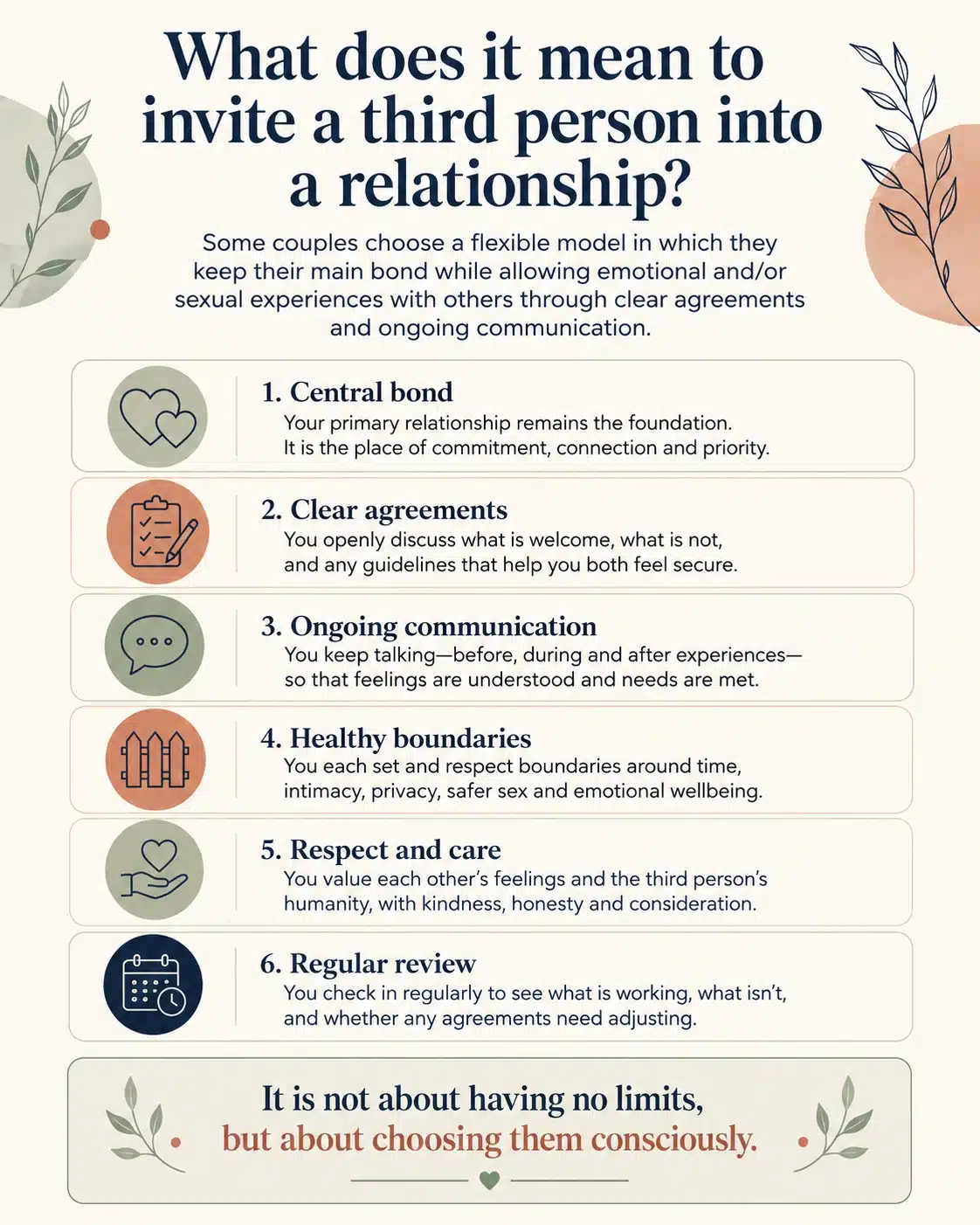
What does inviting a third person mean?
Some people use terms such as permeable couple for a couple who occasionally allow a third person to join shared experiences. The couple may retain a central bond without seeking independent dates or necessarily building an ongoing relationship between three people.
The term has no single scientific definition and sounds unnatural in everyday UK English. We therefore use the clearer phrase couple inviting a third person. For one couple this may mean a one-off encounter; for another, repeating an experience with somebody known. Naming the arrangement never replaces stating what has actually been agreed.
A third person does not “enter the couple” as though accessing somebody else’s space without a voice. They participate in a three-person experience and retain their own desire, boundaries, privacy and right to change their mind.
How it differs from other relationship models
Open relationship
Usually allows independent experiences or connections, rather than shared ones only.
Swinging
Often involves social and sexual exploration or partner exchange between couples, although practices vary.
Throuple
There is an ongoing relationship between three people, not just an occasional invitation.
Polyamory
Recognises the possibility of multiple consensual romantic or intimate relationships.
One-off threesome
Describes an experience, not necessarily the couple’s ongoing relationship structure.
Consensual non-monogamy
The broad umbrella covering different openly agreed non-exclusive arrangements.

Understand your reasons first
Motivations may include curiosity, exploring a fantasy, sharing a bisexual aspect of desire, novelty or enjoying a partner’s connection. No motivation guarantees a good outcome, but understanding it exposes incompatible expectations.
Take particular care if the aim is to rescue a distressed relationship, prove you are adventurous, prevent threatened infidelity, please a partner for fear of losing them, or ask a third person to solve unequal desire. A novel experience often magnifies difficulties that were already unspoken.

Consent from three people, not permission from two
Consent must be freely given, specific, informed, reversible and current. Agreeing to meet somebody is not agreement to every activity. A previous yes may become no during the encounter. Nobody should have to justify needing to stop.
Distinguish between I want this, I may be willing to explore and I am agreeing to avoid consequences. Only an unhurried conversation can reveal the difference. Silence, freezing or continuing “so as not to spoil things” should not be read as enthusiasm.

How to care for the third person
- explain that you are a couple and the type of experience you seek;
- do not promise ongoing contact that you cannot guarantee;
- ask for their preferences rather than presenting a closed script;
- do not demand identical attraction or attention towards both partners;
- agree what private information may later be shared within the couple;
- allow them to contact you, pause or leave without debating their no;
- discuss aftercare and what happens if somebody would like to meet again.
The word “unicorn” is sometimes used for a person — often a bisexual woman — invited by a couple. It can become objectifying when it assumes availability, symmetrical attraction and total adaptation to the couple’s rules. Speak about an actual person and listen to what they need.
Agreements to discuss beforehand
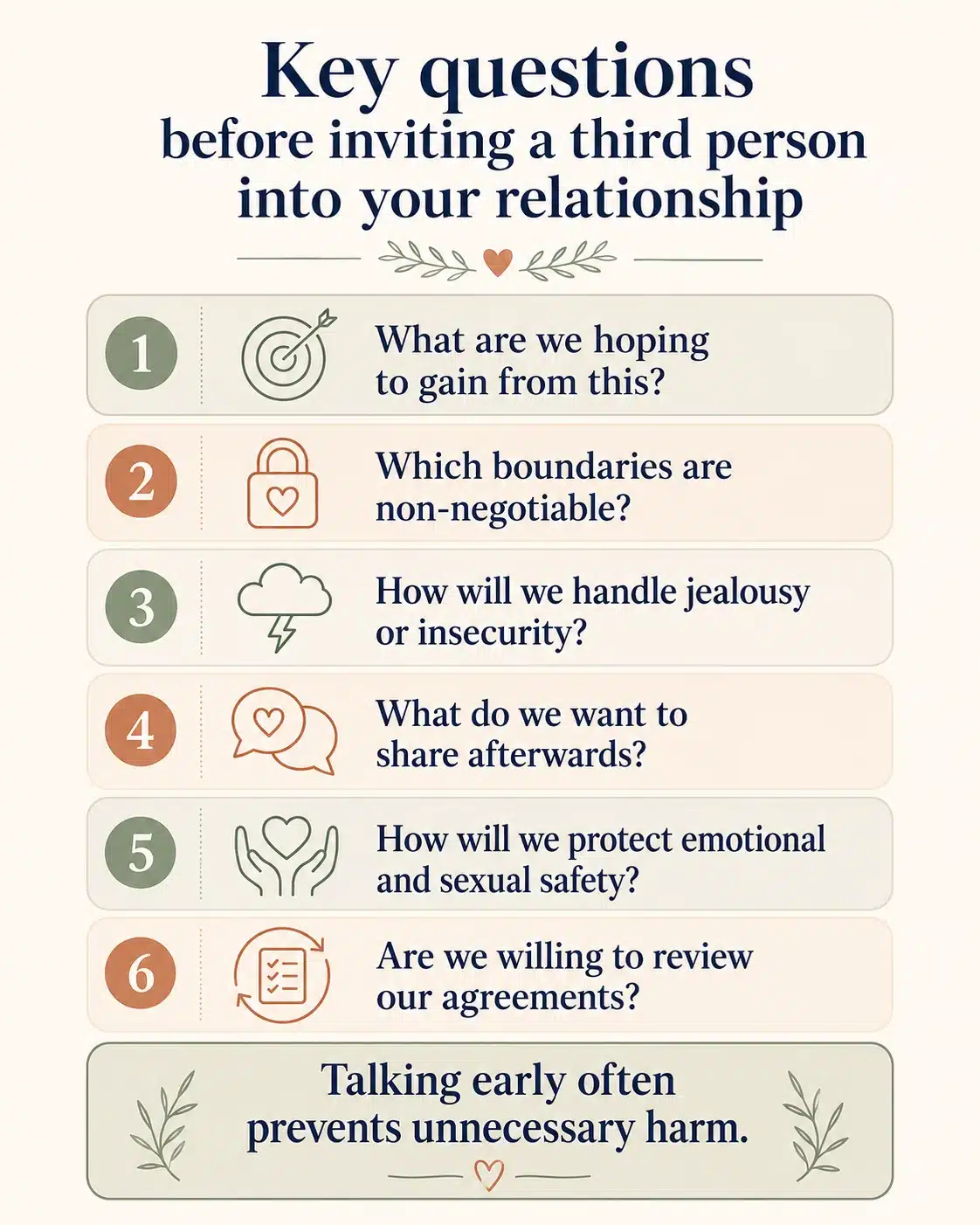
Scope
Which activities interest each person, which do not and where individual boundaries differ.
Choosing
How you will meet somebody and what happens if attraction is not symmetrical.
Sexual health
Barriers, testing, contraception, fluids, toys and communication after an incident.
Pause signal
A word or gesture that stops interaction without requiring an immediate debate.
Privacy
Messages, photographs, personal details and what may be discussed afterwards.
Future contact
Meeting again, independent contact and what you will do if attachment develops.
You cannot predict every feeling. The purpose is to create enough safety to respond to the unexpected. Include a simple clause: anyone may request a pause and agreements will be reviewed without punishing the person who reports discomfort.
During the experience: check rather than assume
Use short, concrete questions: “Would you like to continue?”, “Shall we pause?” or “Are you comfortable with this?” Notice sudden changes in tone, rigidity, disconnection or passivity. When unsure, stop and ask.
Do not turn attention into impossible accounting. Desire naturally fluctuates. What matters is that nobody is ignored, mocked or pushed into participating. Alcohol or other substances may reduce decision-making capacity and make boundaries harder to read.

Jealousy, comparison and unequal desire
Watching a partner enjoy themselves may bring pleasure, curiosity, jealousy or several feelings at once. Comparison often focuses on bodies, arousal or attention. No single reaction automatically makes the experience a mistake.
If somebody becomes overwhelmed, use the agreed signal. Do not argue about who “ruined” the moment. Later, separate observation from interpretation: “my partner looked at them for longer” does not automatically mean “my partner no longer desires me”. Pausing future experiences is valid when distress persists.
Read our guides to jealousy in an open relationship and what to do when one partner wants openness and the other does not.
Afterwards: care and review
Allow unhurried time to rest, hydrate and check how everyone is. Do not make the immediate conversation an interrogation. Some feelings only emerge the following day as activation settles.
Within the next 24–72 hours, ask: what did I enjoy, when did I disconnect, what needs repair, what would I not repeat, and what does the third person want regarding contact? Appreciate honesty even when it changes the plan.

When to stop
- somebody agrees through fear of abandonment, anger or infidelity;
- no is met with repeated persuasion, pressure or punishment;
- relevant information is hidden from the third person;
- identical attraction is demanded or veto is used to control feelings;
- substance use prevents clear decision-making;
- sexual-health or privacy agreements are broken;
- the experience is repeated despite persistent distress.
Stopping does not mean your relationship failed. It may mean you need a different pace or agreement, or that this practice does not suit one of you.
When therapy may help
Couples therapy or sex therapy may help where desire is unequal, saying no feels difficult, jealousy is intense, an experience caused pain or fantasy and relational need have become confused.
The aim should never be to persuade somebody to take part. A relationship-diversity-affirming professional can help you clarify decisions, practise conversations and protect consent.

Frequently asked questions
What does a couple inviting a third person mean?
It is not a standard psychological category. Here it describes a couple who, through explicit agreements, occasionally include a third person in shared experiences without necessarily having independent relationships or forming an ongoing three-person relationship.
Is this the same as an open relationship?
Not necessarily. Open relationships often allow independent experiences or connections. In the arrangement described here, exploration is usually shared and occasional, although every couple must define its own meaning.
Must both partners be equally attracted to the third person?
No. Desire is rarely symmetrical. All three people must understand the situation, be able to express preferences and boundaries, and remain free to stop without pressure to perform an equality that is not real.
Can we make a rule that nobody falls in love?
You can agree which behaviours and contact are acceptable, but cannot guarantee feelings. Discuss what you would do if attachment develops rather than promising it never will.
Does jealousy mean the experience went badly?
Not always. It may signal novelty, comparison, fear or a need for care. Pause when jealousy is accompanied by pressure, surveillance, persistent resentment or loss of consent.
When might couples therapy or sex therapy help?
When desire is unequal, saying no feels difficult, jealousy is intense, agreements are unclear, an experience was painful or you are unsure whether to continue. Therapy should remain neutral about the model and protect everyone’s autonomy.
A shared experience needs three voices
The question is not simply whether the couple is ready. Each person must be able to choose, change their mind and retain dignity before, during and after the experience. Shared exploration works better when it stops protecting only the fantasy and starts caring for all three people’s reality.
Would you like to discuss it safely?
We can help you explore motives, boundaries, jealousy and agreements without judging your relationship model or pushing you to open.
Scientific sources consulted
- Hangen, F. et al. (2020). Consent, comfort and communication in distinguishing consensual non-monogamy from infidelity. The Journal of Sex Research.
- Bröning, S. (2025). Autonomy in multi-partnered relationships. Archives of Sexual Behavior.
- Schechinger, H. A., Sakaluk, J. K. and Moors, A. C. (2018). Helpful and harmful therapy practices with consensually non-monogamous clients. Journal of Consulting and Clinical Psychology.
- Anderson, J. R. et al. (2026). Relationship satisfaction in monogamous and consensually non-monogamous relationships: a meta-analysis. The Journal of Sex Research.
- Levine, E. C. et al. (2018). Open relationships, non-consensual non-monogamy and monogamy among US adults. Archives of Sexual Behavior.
Clinical note: this educational guide does not replace individual psychological, sexological or medical assessment. If there is coercion, violence or fear of saying no, prioritise safe support.