



A closed relationship is one in which the people involved agree that certain romantic or sexual connections will remain within a defined relationship unit. It may be a monogamous couple, but it could also be a closed throuple, quad or polycule. “Closed” describes the boundary of an agreement; it does not authorise control or determine relationship quality.
People often use “closed relationship” and “monogamous relationship” interchangeably. Sometimes that works, but not always. The phrase mainly answers a practical question: who is included in the exclusivity agreement, and which connections fall outside it?
This guide explores what a closed relationship means, the forms it can take, the conversations that prevent assumptions and the difference between chosen commitment and monitoring. It does not present this structure as more mature, secure or stable than other models.
What is a closed relationship?
It is a relationship in which the members agree not to begin certain romantic, sexual or emotionally intimate connections with people outside the unit. The agreement might cover sex, dating, romantic relationships or a particular combination. It needs defining: two people can both promise exclusivity whilst imagining different rules.
A relationship may be closed from the beginning, close after an open period or review its status at an agreed time. What matters is that everybody affected understands the arrangement, can influence it and has a genuine ability to say no.
“Closed” does not tell you whether flirting, dating apps, contact with former partners, pornography, sexting or a deeply intimate friendship are included. Discuss what matters without trying to turn every human interaction into a prohibition.
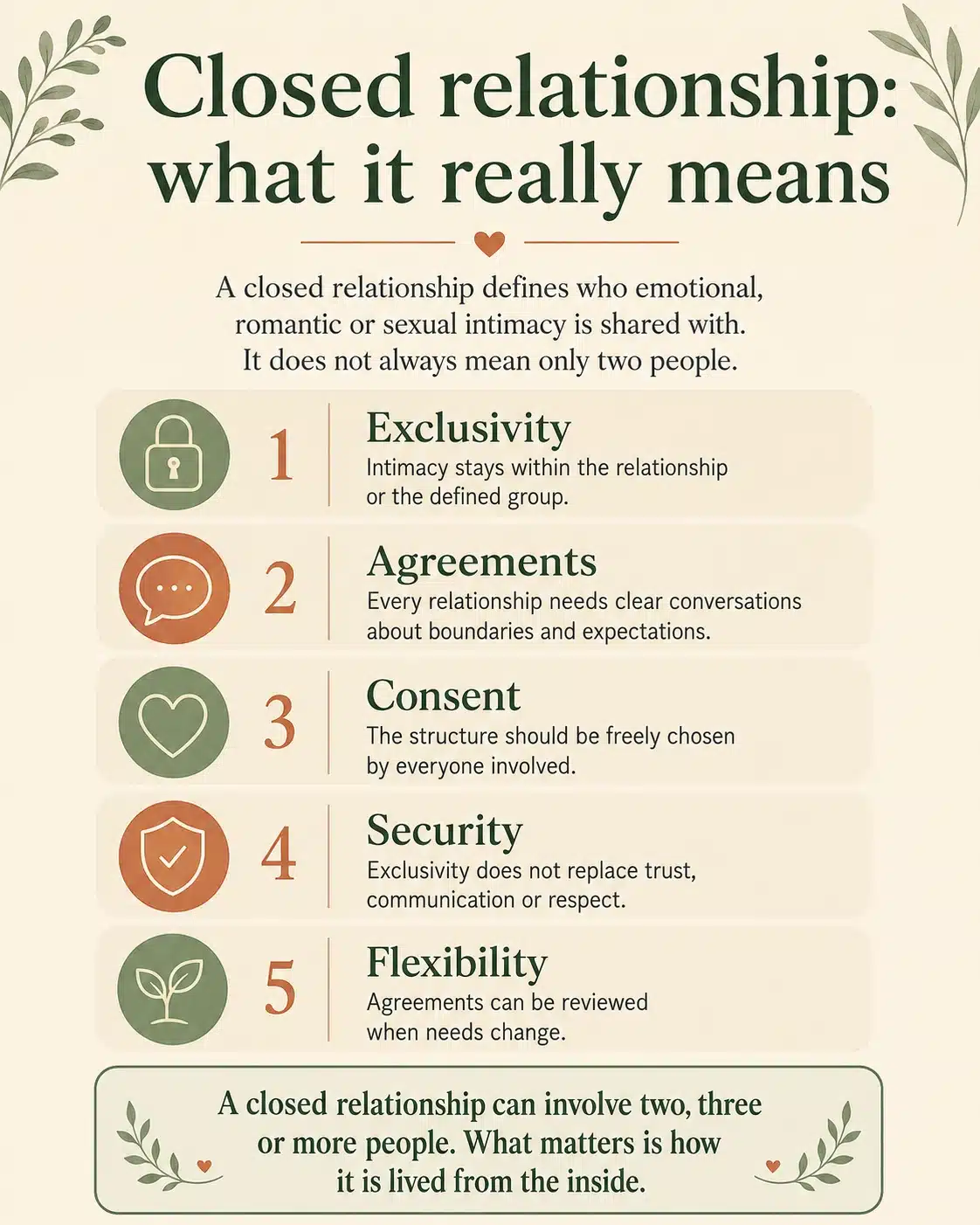
Closed relationship and monogamy are not identical
A monogamous relationship involves two people who agree exclusivity, so it is usually closed. A closed relationship can nevertheless include more than two people. Three people in a throuple, for example, may agree to keep their romantic and sexual connections within that group.
Some communities use polyfidelity for multi-person groups that do not pursue outside relationships. Not everybody adopts this term. A useful description identifies the people in the unit and the commitments involved without requiring every relationship inside it to be identical.
What can be “closed”?
Sexual exclusivity
Agreed sexual activities take place only between members. Clarify what counts as sexual and how an unexpected situation would be handled.
Romantic exclusivity
No outside dating or romantic relationships, whilst close and meaningful friendships can continue.
Emotional exclusivity
Some people include particular forms of emotional intimacy. Take care not to use this idea to control feelings or friendships.
A mixed boundary
One dimension may be closed whilst another remains open, such as allowing agreed sexual experiences without new romantic relationships.
Feelings cannot be completely governed by a rule. A workable agreement focuses on choices and actions: what happens if attraction develops, what information is relevant and when a conversation is needed. Promising never to experience an emotion creates a standard nobody can reliably enforce.

Which configurations can be closed?
- Closed couple: two people agree sexual exclusivity, romantic exclusivity or both.
- Closed throuple: three people form the unit, even when the relationships differ in intensity.
- Closed quad: four members agree not to form specified connections outside the group.
- Closed polycule: a defined network of more than two people maintains internal exclusivity although not everybody dates one another.
The number of members does not reveal how love, sex, home life or power are organised. A closed network might contain romantic relationships, emotionally intimate bonds, metamours, co-parenting or shared housing. The actual map matters more than the shape implied by a label.
Why might people choose a closed relationship?
It may fit their values, offer a clear framework for commitment or make time and shared projects easier to organise. Some people experience less uncertainty when everybody uses the same definition of exclusivity. Others decide to close after exploring an open relationship or another form of consensual non-monogamy.
No motive makes closure healthy automatically. Wanting it together differs from agreeing because of fear, financial dependence or a threatened breakup. Closing is not an automatic treatment for jealousy and should not serve as proof of love. It alters permitted behaviours; it does not by itself resolve insecurity, resentment or damaged trust.
Can a closed relationship be healthy?
Yes, when the agreement is voluntary, understandable, reciprocal and compatible with the needs of those involved. Comparative evidence does not show that a monogamous or non-monogamous orientation guarantees greater satisfaction. A meta-analysis of 35 studies involving 24,489 people found no overall difference in relationship or sexual satisfaction between the two.
This finding cannot predict the wellbeing of a particular relationship. Compatibility, communication, intimacy, support, power and repair all matter. Evidence specifically about closed groups of more than two people remains limited and is usually included within broader non-monogamy categories.

Nine important agreements in a closed relationship
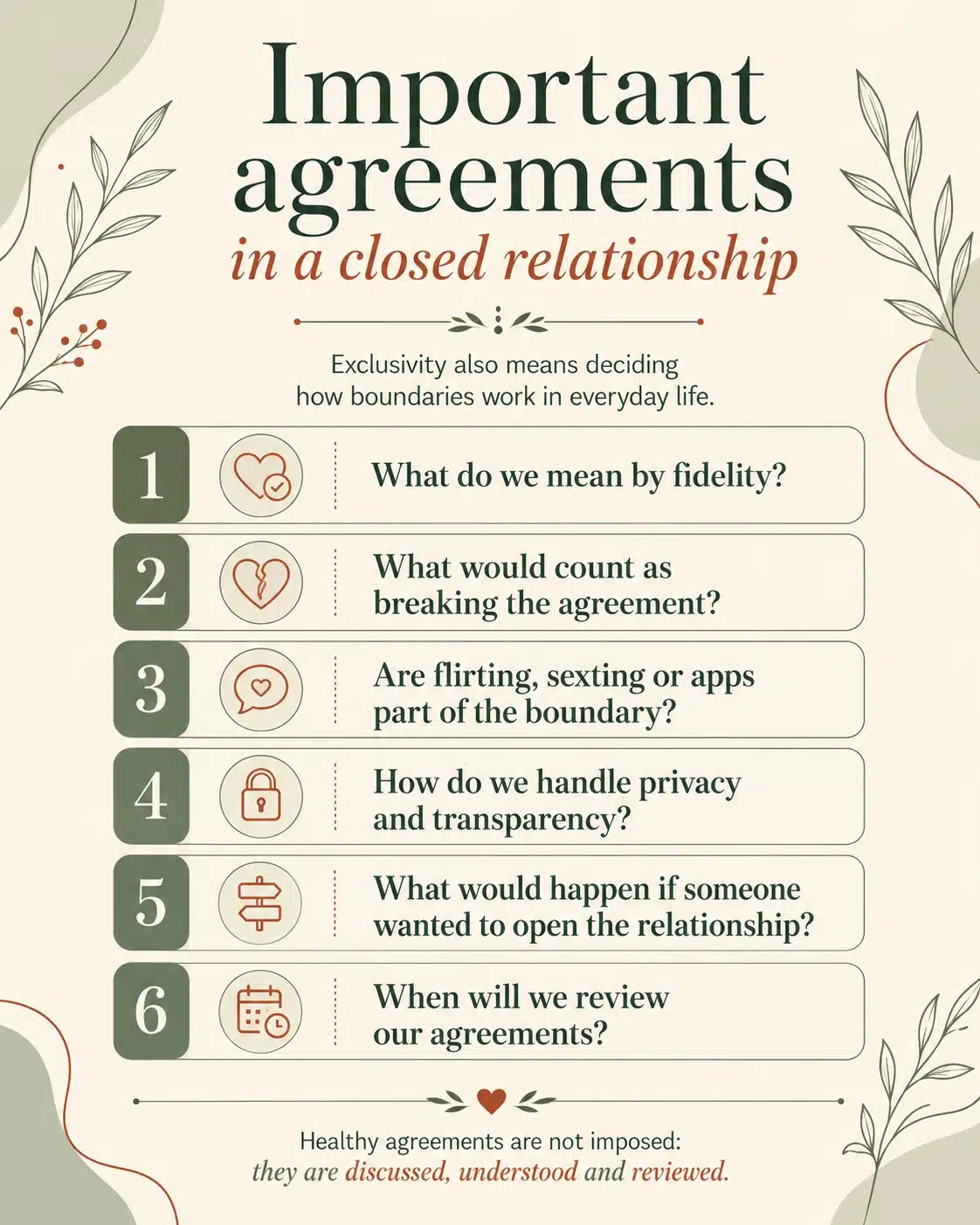
Who belongs to the agreement?
Name the people included and distinguish romantic, sexual, cohabiting and friendship bonds.
What does exclusivity mean?
Define relevant actions through everyday examples rather than relying only on words such as fidelity or respect.
What about flirting and digital contact?
Discuss apps, messages, sexting, erotic content and former partners without assuming one universal answer.
How is privacy protected?
Agree which information is shared and which conversations, devices and personal spaces remain private.
How will sexual health be cared for?
Cover barriers, testing, contraception where relevant and communication about changes that affect consent.
How can attraction be discussed?
Create room for uncertainty without interrogation, punishment or pressure to disclose every passing thought.
What happens after a breach?
Distinguish immediate safety, necessary information, accountability and repair rather than deciding everything during a crisis.
When will the agreement be reviewed?
Arrange check-ins and allow anybody to request an earlier conversation when their needs change.
What if agreement is impossible?
Acknowledge incompatibility: negotiation does not oblige anybody to accept a structure they do not want.
Boundaries, rules and control
A boundary describes what a person needs and how they will care for themselves: “I will not remain in a relationship where outside sexual contact is hidden.” A request invites collaboration. A shared rule organises conduct everybody has accepted. Control begins when somebody tries to govern another person’s life through surveillance, fear or punishment.
Demanding passwords, checking a phone, preventing friendships, policing clothes or requiring continuous location sharing does not become healthy because a relationship is closed. Voluntary transparency may be useful; imposed monitoring undermines autonomy and cannot manufacture trust.

Autonomy and personal space within commitment
Exclusivity is not fusion. Each member needs friendships, interests, rest, privacy and the ability to make personal decisions. A relationship can be deeply committed whilst leaving room for time alone and meaningful social support beyond the romantic unit.
In closed relationships involving more than two people, each internal bond also needs protection. Doing everything as a group may conceal inequality and make intimacy difficult. Individual, two-person and group time can be distributed equitably without being mathematically identical.

Jealousy, comparison and the need for security
Jealousy can arise even when there are no outside relationships. A friendship, a shift in desire or differences between internal bonds may activate fears about losing attention, value or belonging. Feeling jealous does not prove betrayal or automatically make someone controlling.
Separate emotion, interpretation and action. “I feel frightened” is an experience; “you clearly want to replace me” is a hypothesis; secretly checking a phone is an action. Regulating the feeling, checking the evidence and making a specific request creates a response that does not invade another person.
- Which observable event activated this insecurity?
- What story am I telling myself about it?
- Do I need information, affection, time, repair or a boundary?
- Can I ask without demanding control over another person?
- Is there a recurring pattern we need to address?
Sexual health: being closed does not remove all risk
A closed unit may simplify some sexual-health decisions, but only when the agreement is followed and everybody has adequate information. Risk depends on practices, testing, barriers, vaccination, history and communication, not the label. Concealing a breach can prevent others from consenting on the basis of current information.
Comparative research reminds us that stated monogamy is not the same as perfectly implemented exclusivity. Testing and prevention can therefore be discussed without treating them as accusations. Sex therapy may support conversations about desire, anxiety or discrepancies, but does not replace medical care.
Closing a throuple, quad or polycule
When more than two people are involved, closing the network affects several relationships. The decision should not belong to a majority or to the couple that existed first. Each member needs a voice concerning their sexuality, relationships and the practical consequences of the agreement.
Changes in membership also need thought. If one bond ends, does the network continue? May two people maintain their connection? Who decides whether somebody new joins? Preparing these questions is not expecting failure; it reduces the risk of improvising through “two against one” or “three against one” alliances.

What happens when the agreement is broken?
A breach may bring pain, anger, confusion and a need for protection. The first task is to understand what happened and what information each person needs to make decisions about health and participation. Accountability means recognising the impact without minimising it, blaming the agreement or demanding immediate forgiveness.
Repair is not an automatic return to the previous arrangement. It may include pausing decisions, sexual-health testing, answering agreed questions, changing routines and allowing consistent behaviour to become visible. The affected person retains the right to continue, renegotiate or leave. Permanent surveillance can look like security whilst keeping the wound open.
Moving from open to closed — or closed to open
Relationship structures can change, but a conversation does not guarantee consensus. If one person wants to open and another wants to remain closed, neither should be portrayed as more evolved or less loving. Explore needs, fears and limits, then consider whether any option is genuinely acceptable to everybody.
A temporary closure may make sense during a health crisis, a shortage of time or a period of repair, provided it is not an ambiguous promise with no end. Agree its duration, purpose, review conditions and what happens if disagreement continues. Compliance under threat is not freely given consent.
Healthy signs and warning signs
Healthy indicators
The agreement can be explained, everybody has a voice, privacy exists, expectations are reciprocal, doubts can be expressed and requesting a review is not treated as betrayal.
Warning signs
There is fear of saying no, isolation, double standards, financial control, digital monitoring, threats, sexual coercion or coordinated punishment.
If there is abuse, fear, coercion or financial control, prioritise individual support and a safety plan. Joint therapy may be inappropriate when somebody cannot speak freely in front of the other people involved.
When might therapy help?
Therapy may help turn vague expectations into clear agreements, address differences about exclusivity, repair a breach of trust, prepare for a structural change or understand patterns of jealousy and control. People do not need to wait for a severe crisis.
The goal should not be to impose monogamy, openness or separation. Informed practice explores what each person wants, where genuine choice exists and which conditions allow safe discussion. Ocnos offers couples and relationship therapy in Palmones and online, with respect for relationship diversity.
Continue exploring relationship models
Frequently asked questions about closed relationships
Is a closed relationship always monogamous?
No. A monogamous couple is usually closed, but a throuple, quad or polycule can also agree exclusivity within a defined group.
What does being in a closed relationship mean?
It means that the people have agreed to keep specified sexual, romantic or emotionally intimate connections within the unit. The scope needs discussion because no single practical definition suits everybody.
Does a close friendship break a closed relationship agreement?
Not necessarily. A closed relationship should not prevent friendships or social support. If emotional intimacy creates uncertainty, discuss actions and needs without trying to prohibit feelings.
Is requesting passwords an exclusivity agreement?
Not by itself. Access may be shared voluntarily, but demanding passwords, checking devices or monitoring location to prevent infidelity are forms of control rather than evidence of trust.
Can an open relationship become closed?
Yes, when everybody affected freely chooses it and agrees what will change, for how long and when it will be reviewed. Giving in because of threats or fear does not create a sustainable agreement.
When should people consider therapy?
When agreements cannot be discussed without escalating conflict, differences about the structure persist, trust has been damaged or jealousy, monitoring or fear appear. Therapy can also be preventive.
A space to talk without judgement
If you want to turn assumptions into clear agreements, repair harm or understand whether closure still feels chosen by everybody, we can support you with an inclusive clinical approach. Appointments are available in person in Palmones, Campo de Gibraltar, and online.
Scientific sources consulted
- Anderson, J. R. et al. (2026). Meta-analysis of 35 studies comparing relationship and sexual satisfaction in monogamous and consensually non-monogamous relationships. Journal of Sex Research.
- Hangen, F. et al. (2020). Consent, comfort and communication in distinguishing non-monogamous agreements from infidelity. Journal of Sex Research.
- Conley, T. D. and Piemonte, J. L. (2021). Consensual non-monogamy styles and dyadic adjustment. Archives of Sexual Behavior.
- Lehmiller, J. J. (2015). Sexual-health history and practices among monogamous and consensually non-monogamous partners. Journal of Sexual Medicine.
- Mogilski, J. K. et al. (2026). Practices used to maintain multiple consensual relationships. Archives of Sexual Behavior.
- Schechinger, H. A., Sakaluk, J. K. and Moors, A. C. (2018). Helpful and harmful therapy practices with consensually non-monogamous clients. Journal of Consulting and Clinical Psychology.
Clinical note: this article is for information and does not replace an individual psychological or medical assessment. A relationship structure is not a diagnosis. If there is abuse, coercion or fear, seek safe, individual support.