

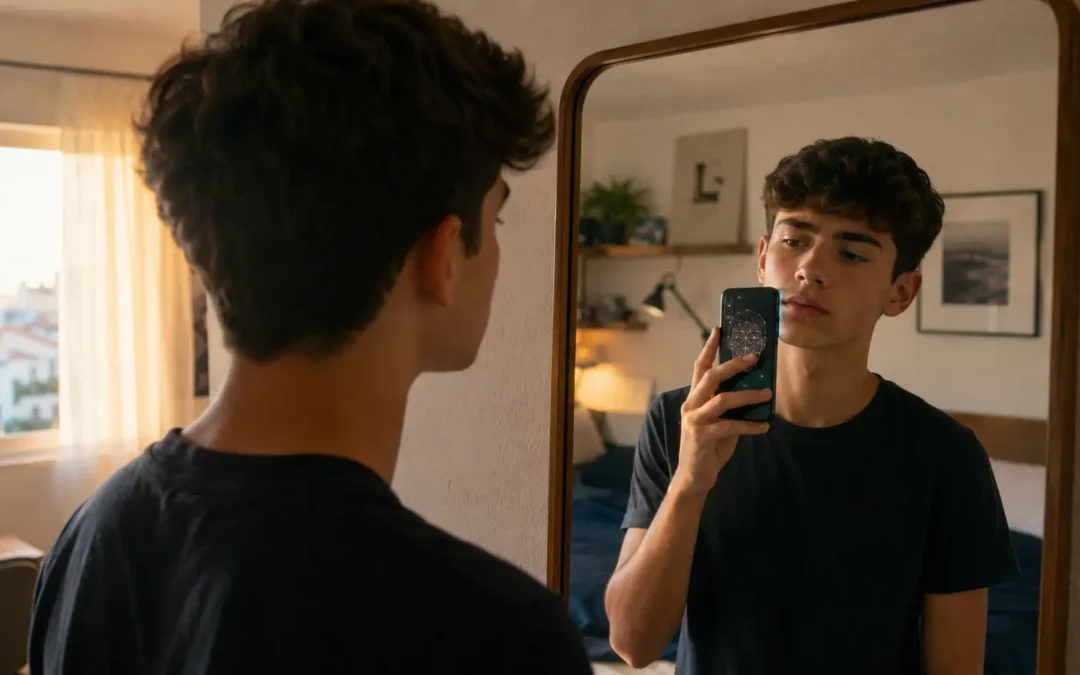

Looksmaxxing is not a diagnosis. It is an internet culture centred on “maximising” physical attractiveness. It can include ordinary self-care, but it becomes concerning when it brings rigidity, constant comparison, shame, isolation, extreme dieting, unregulated substances or physical harm. The important question is not how much someone cares for their appearance, but what that care costs them in health and everyday life.
Perhaps you have heard your child say mogging, mewing or hunter eyes. You may have seen videos that measure jawlines, compare side profiles or promise to change a face through a routine. The vocabulary sounds strange, but the needs beneath it are very human: to be liked, to belong and to feel worthwhile.
As a psychologist, I do not want to mock these words or turn every interest in appearance into a problem. I want to help you understand what looksmaxxing means, why it can be compelling and how to distinguish self-care from a harmful relationship with body image.
Looksmaxxing vocabulary explained simply
These expressions are not clinical psychology terms. They are labels created and spread through social media, forums and online communities. Their meanings vary, but they are generally used as follows:
Trying to take physical attractiveness to its supposed “maximum” through grooming, training, cosmetic changes or medical procedures. It can describe anything from getting a haircut to dangerous practices.
Non-invasive and generally reversible changes: hygiene, hair, clothing, skincare, sleep or exercise. The word soft does not mean that the routine cannot become rigid or obsessive.
Invasive, risky or difficult-to-reverse interventions, such as surgery, substances or home techniques intended to alter the body. Not every medical procedure is harmful; proper indication, safety and psychological wellbeing all matter.
Claiming that one person physically outclasses another because of their face, height, body, hair or style. It turns ordinary human differences into a competition with a winner and a loser.
Placing and pressing the tongue against the roof of the mouth with the promise of defining the jaw or changing facial structure. There is no robust evidence that it reshapes an adult face by itself.
An appearance ideal involving eyes described as deep-set, narrow and angled in a particular way. It is not a medical category and does not measure masculinity, health, personality or social value.
The angle between the inner and outer corners of the eye. It is a real anatomical feature, but looksmaxxing content often uses it to score faces and present preferences as universal rules.
The outline of the lower jaw. Online, it is often treated as proof of attractiveness or virility, although its appearance depends on genetics, age, body fat, posture, lighting, camera angle and natural variation.
Informal scales that assign a score to a face. They are not scientific tests. They reduce a person to measurements chosen by the community and vary according to whoever is doing the scoring.
Short for “sexual market value”. It is a cold, reductive way of describing relationships, as if affection and attraction worked according to a single fixed score.
A deterministic belief that genetics and appearance almost entirely decide romantic and social success. It can encourage hopelessness, misogyny, isolation and the idea that nothing meaningful can improve.
Hitting facial bones in the false hope that injury will make them more attractive. It can cause fractures, asymmetry and damage to the teeth, eyes or nerves.
Labels for “optimising” skin, hair, muscle or height. Some suggestions are ordinary self-care. Others promise impossible results, promote products, medicines or procedures and profit from the viewer's insecurity.
Knowing these words helps us have a conversation, but we should not adopt them as an objective way of describing people. A face is not a sum of angles, and a relationship is not decided by a score. A teenager using the words mewing or mogging also does not prove that they share every belief held in the communities where those terms arose.
What is looksmaxxing and why has it spread?
Concern about appearance did not begin with TikTok. Clothes, hair, exercise and the desire to be attractive are part of many cultures. What is new is the format: someone can now receive hundreds of edited faces, millimetre-by-millimetre analyses and commercial solutions every day, all presented as if they were objective.
The phenomenon has become particularly visible among teenage boys and young men. However, appearance pressure and looksmaxxing behaviours can affect people of any gender. Nor will every young person who watches this content develop a psychological difficulty.
Looksmaxxing offers an apparently clear system. First it identifies a “flaw”. Then it gives that feature a technical-sounding name, a rating and a promise of improvement. Finally, it displays idealised examples that the algorithm repeats. A vague insecurity can therefore become an endless project. For that reason, we need to assess looksmaxxing by its real effects, not simply by the label someone uses.
Research published in 2025 analysed more than 8,000 comments from a large looksmaxxing community. The researchers found detailed criticism of male bodies, recommendations for changing them and messages that could demoralise or facilitate harm. This does not mean everyone who sees one video belongs to those spaces. It does show that some of the vocabulary comes from communities where appearance is mixed with rigid hierarchies about masculinity, success and relationships.

Algorithms do not only show what you search for
Platforms learn from every pause, replay, comment and shared video. Pausing several times on jawline or height content may be enough for the subject to occupy more of the feed. The feed starts to feel like confirmation: “if this appears so often, it must be important”.
A 2025 US survey of 1,017 teenage boys found that 91% had encountered messages about changing their bodies. One in four had seen content about achieving a particular jawline or facial structure. Of those exposed to masculinity content, 68% said it had started appearing without them searching for it. These figures come from one particular context and are not universal, but they help explain why families often discover the phenomenon late. In looksmaxxing, repetition can make a minority ideal look normal and unavoidable.
How long someone spends online matters, but so do the content they see, what they do with it and how they feel afterwards. Ten minutes of intense comparison may affect someone more than an hour spent talking to friends.
The psychology of looksmaxxing: comparison, control and belonging
The problem rarely begins with a wish to cause harm. It often begins with a reasonable-sounding promise: “if I improve a little, I will feel more confident”. The initial relief reinforces the behaviour. But when confidence depends on checking appearance, it lasts only briefly. This cycle helps explain how looksmaxxing can move from curiosity to constant concern.
1. Comparison changes the reference point
When someone compares their face with thousands of selected, edited and carefully lit images, their idea of normal becomes narrower. They are no longer comparing themselves with the variety of people they see in everyday life. They are comparing themselves with the extremes that attract the most attention.
A systematic review and meta-analysis in Body Image found an association between social comparison on social media, body image concerns and eating-disorder symptoms. An association does not prove that one platform alone causes a disorder. Nevertheless, it supports a clinically relevant point: repeated comparison may be a risk mechanism.
2. Measuring creates a temporary sense of control
Angles, ratios and ratings appear to remove uncertainty. Someone may think that finding the right measurement will tell them exactly what to fix. Yet the scales change, new “flaws” appear and the target moves. The certainty that was promised never arrives.
3. Checking relieves worry and keeps it going
Looking in the mirror, retaking selfies, asking for ratings or comparing two photographs may bring a few minutes of relief. That relief teaches the brain to check again. Over time, the person trusts their own perception less and needs another photograph, another opinion or another measurement.

4. Appearance can become an identity
Adolescence and young adulthood are periods in which people build identity, autonomy and belonging. A community offering its own language, rules and shared goal can be appealing, especially when a young person feels lonely or insecure. Risk grows when the community teaches that respect, love or desirability depend almost entirely on the face, height or body.

5. Shame encourages hiding
If someone believes everyone will notice their supposed defect, they may avoid photographs, lessons, sport, dates or social plans. Avoidance reduces anxiety in the short term. In the long term, it prevents them from discovering that other people do not judge them as harshly as they imagine. Their life also becomes smaller.
Appearance can influence how we feel, but it cannot by itself explain friendship, desire, achievement or rejection.
Healthy self-care or obsession: where is the line?
We do not need to choose between “appearance does not matter at all” and “appearance decides everything”. We can look after our skin, exercise, wear clothes we enjoy or consult an appropriate health professional. Within looksmaxxing, the difference lies in the purpose a behaviour serves and the space it occupies.
My clinical rule of thumb is simple: self-care should help you live; it should not force you to postpone life until you have reached a supposedly perfect face or body.
Healthy self-care
It is flexible and compatible with rest, sufficient food, relationships and other goals. You can miss the routine without panic or self-contempt.
Warning zone
Time spent, comparison, photographs, guilt and the need to correct things all increase. Mood begins to depend on the mirror.
High risk
There is physical harm, unregulated substance use, extreme diets, isolation, hopelessness or an irreversible decision made during intense distress.

Four questions that help distinguish the two
- Flexibility: can I postpone or miss it without intense distress?
- Purpose: am I doing it to care for myself, or to neutralise a fear of rejection?
- Cost: is it harming my health, sleep, finances, education, work or relationships?
- Result: does it expand my life, or do I keep finding more things that must be corrected?

Mewing, hunter eyes and bone smashing: what you need to know
Mewing is not a substitute for a health assessment
The position of the tongue is involved in functions such as speaking and swallowing. That does not demonstrate that pressing it in a way learnt from a video will remodel an adult jaw. The American Association of Orthodontists states that current research does not support the claimed benefits and warns that incorrectly applied pressure may create problems involving the teeth, bite, jaw joint or speech.
If there is pain, difficulty chewing, concern about the bite or a question about tongue posture, the safe route is to consult an appropriate dentist, orthodontist, maxillofacial specialist or speech and language therapist. Do not use devices or force movements without professional supervision.
Hunter eyes are not a measure of health
Eye shape varies naturally. Lighting, expression, camera distance and the phone lens can radically alter a photograph. Treating one geometry as proof of male attractiveness presents a cultural preference as if it were a biological fact.
Hitting the face does not produce controlled improvement
Bone smashing misrepresents how bone responds to injury. A blow cannot control where or how tissue heals. It can cause fractures, bruising, nerve injury, dental or eye damage and deformity. Maxillofacial literature has identified the practice as a dangerous excess associated with online trends.
Seek medical assessment. Go to an emergency department for severe pain, bleeding, altered vision, numbness, difficulty opening the mouth, displaced teeth, fainting or new asymmetry. Do not wait for it to “sort itself out”.
Risks extend beyond the face
Some content recommends restrictive diets, dehydration, supplements, hormones, peptides, injectable products or unprotected sun exposure. Other posts present surgery as the automatic answer to a low rating. Calling something an appearance improvement does not make it safe.
Decisions about food, medicines or procedures should be based on an individual assessment, realistic information and qualified professionals. When there is intense distress about the body, addressing the psychological difficulty before making an irreversible decision is also important.
Warning signs associated with looksmaxxing
No single sign confirms a disorder. What matters is the overall pattern, frequency, distress and effect on functioning. Pay attention when several of the following changes occur:
- Spending a great deal of time measuring, photographing or searching for flaws in the face or body.
- Repeatedly asking whether they are ugly, whether their jaw is “wrong” or what rating they deserve.
- Mood changing sharply after seeing a photograph or receiving a comment.
- Avoiding socialising, education, sport, photographs or meeting people because of appearance.
- Deleting and retaking selfies many times, using filters to check features or asking strangers for ratings.
- Restricting food, exercising while injured, sleeping less or dehydrating to look different.
- Buying supplements, hormones, peptides or devices without proper health supervision.
- Talking about surgery as the only route to a relationship, respect or a worthwhile life.
- Using dehumanising language about themselves or other people.
- Hitting, cutting or otherwise injuring themselves, or expressing thoughts of death, hopelessness or worthlessness.
Looksmaxxing and body dysmorphic disorder are not the same
Body dysmorphic disorder involves intense concern about one or more perceived defects that are not observable or appear slight to other people. It is usually accompanied by repetitive behaviours such as mirror checking, comparison, camouflage or seeking reassurance. It also causes significant distress or interference with life.
Someone may consume looksmaxxing content without having body dysmorphic disorder. Equally, a person may have symptoms of body dysmorphia without knowing this vocabulary. We should therefore not diagnose anyone from a video or a checklist. When appearance concerns dominate the day, a professional assessment can clarify what is happening.
The pattern may also be linked with anxiety, depression, obsessive-compulsive symptoms, muscle dysmorphia or difficulties with food. Ocnos provides specialist psychological support for body image difficulties and eating disorders.
How to talk to your child about looksmaxxing without ridicule
If you begin with “that is just internet nonsense”, the conversation may end before it starts. Your child may hear: “you do not understand what worries me”. Understanding does not mean approving a dangerous practice. Discussing looksmaxxing calmly creates enough safety to find out what is really happening.

Ask what it means to them
Try: “I have heard that word, but I want to understand how you use it” or “Which videos feel useful and which leave you feeling worse?”
Validate the feeling, not the conclusion
You can acknowledge that feeling watched or insecure hurts without confirming that a defect exists. “I understand this is worrying you” is more helpful than “yes, you should change it” or “you have no reason to feel that way”.
Distinguish care from compulsion
Ask what would happen if they could not follow the routine for a week. Their answer can reveal whether there is genuine choice, fear, guilt or dependence on the ritual.
Discuss the algorithm, not only willpower
Look together at how one search changes the feed. The problem then shifts from “you are weak” to “this system learns how to hold your attention”.
Set clear boundaries where there is harm
Do not negotiate over hitting, non-prescribed substances, dangerous fasting or challenges that cause injury. Remove immediate access where necessary and seek appropriate healthcare.
Protect the relationship and other parts of identity
Encourage activities in which your child can experience competence, friendship and enjoyment without their body being evaluated. Avoid turning every meal, mirror or comment into an interrogation.
Phrases that open the conversation
- “I am not going to laugh. I want to understand what is really worrying you.”
- “How do you feel after seeing that content: helped, or more inadequate?”
- “We can check together whether that recommendation has a reliable health source.”
- “You do not have to prove how bad this feels before I help you.”
- “Your appearance matters because it matters to you, but I do not want it to become the centre of your life.”
Comments that tend to close the door
- “That is just internet nonsense.”
- “You are handsome, so I do not know what you are complaining about.”
- “You only need to put your phone away.”
- “At your age I had real problems.”
- Jokes about their jaw, height, weight, hair or relationships.

Tools for breaking the comparison cycle
These suggestions do not replace therapy when there is a clinical difficulty. They can, however, help someone observe the pattern and regain room to choose.
Exercise 1: map the cycle
For several days, note four things without judging yourself:
- Trigger: a video, photograph, comment, mirror or experience of rejection.
- Thought: “my profile is wrong” or “nobody will want me like this”.
- Response: measuring, checking, searching, restricting food or cancelling a plan.
- Effect: immediate relief and the cost a few hours later.
The aim is not to argue with every thought. First, you need to see how the complete cycle works.
Exercise 2: a seven-day experiment
- Mute accounts that rate bodies or promise extreme transformations.
- Choose “not interested” for content that triggers comparison.
- Avoid checking photographs during the first and final hour of the day.
- Choose two brief times to use a mirror for a specific practical purpose.
- Do not ask other people to rate your attractiveness during the week.
- Record anxiety, time recovered and urges to check again.
The goal is not perfect calm. It is to discover that an urge can rise and fall without always being obeyed.
Exercise 3: broaden identity
Write down five qualities or areas of life that do not depend on appearance. They might include caring for someone, learning, creating, using humour, keeping commitments or solving problems. Then choose one small action to strengthen one of these areas this week.
The aim is not to persuade yourself that appearance never matters. It is to prevent one dimension from deciding your entire worth.
How to check a health claim
- Is it explained by a qualified professional whose identity you can verify?
- Does the source distinguish evidence, opinion and personal experience?
- Does it explain risks, limits and who should not follow the advice?
- Does it promise to change bones, height or hormones quickly and for everyone?
- Does it first create insecurity and then sell the solution?
- Does it encourage secrecy from family members or health professionals?
When to seek professional help and what therapy can address
Consider seeking help when the concern takes up a great deal of time, causes distress or restricts life. You do not need to wait for an injury or a diagnosis. Early support can intervene before rituals, avoidance or eating behaviours become more firmly established.
A psychological assessment does not decide whether someone is attractive. It explores what worries them, when it began, what situations trigger it and which behaviours maintain it. Mood, anxiety, eating, exercise, sleep, relationships and risk should also be considered.
Depending on the person's needs, therapy may involve:
- understanding the comparison, checking and relief cycle;
- reducing mirror, photograph and reassurance-seeking rituals;
- gradually approaching situations that have been avoided;
- questioning rigid rules about attractiveness, masculinity and rejection;
- improving the relationship with the body, food and exercise;
- rebuilding relationships, interests and goals that do not depend on appearance;
- helping the family provide support without constant surveillance or reassurance.
For body dysmorphic disorder, NICE guidance recommends evidence-based psychological treatment such as adapted cognitive behavioural therapy, with family intervention for children and young people where appropriate. Treatment should be personalised and may require coordination with medical or other health professionals.
Stay with the person where it is safe to do so, reduce access to anything they could use to harm themselves and get urgent help. In Spain, call 112 in an emergency; the free, confidential 024 service is available 24 hours a day for people with suicidal thoughts or behaviour and their families. In Gibraltar, call 999. In the UK, call 999 if someone is in danger, or use NHS 111 for urgent mental health help; Samaritans can be reached free on 116 123 at any time. You can also read our guide for families supporting a teenager who self-harms.
We can help you understand what is happening
If looksmaxxing, comparison or rejection of the body is affecting you or your child, we can offer an initial assessment. We work in person in Palmones, in the Campo de Gibraltar, and online.
Frequently asked questions about looksmaxxing
Is looksmaxxing a mental disorder?
No. Looksmaxxing is an internet term, not a diagnosis. It may be a passing interest or be associated with difficulties such as body dysmorphia, anxiety, depression or disordered eating. Only a professional assessment can establish whether someone has a mental disorder.
Is all looksmaxxing harmful?
No. Hygiene, sleep, flexible exercise, clothing and skincare can all be healthy forms of self-care. Rigidity, distress, loss of time, interference with everyday life and practices that damage health are the features that should concern us.
What does mogging mean?
Mogging means presenting one person as physically superior to another because of their face, body, height or style. It is a hierarchical comparison used in some online communities, not a scientific measure of attractiveness or personal worth.
Does mewing really change your jaw?
There is no robust scientific evidence that placing or pressing the tongue against the roof of the mouth will by itself remodel an adult jaw. Forced pressure may affect the teeth or bite. Functional concerns should be assessed by an appropriately qualified oral health professional.
What are hunter eyes?
Hunter eyes is an appearance label for a particular eye shape, usually described as deep-set and narrow. It is not a medical category and cannot measure health, masculinity, personality or someone's ability to attract other people.
How can I tell whether self-care has become an obsession?
Warning signs include being unable to stop without distress, repeatedly checking appearance, avoiding plans, restricting food, exercising through pain or allowing photographs and ratings to determine your mood. The effect on your life matters more than any one routine.
Should I take my child's phone away?
Suddenly removing it will not usually solve the problem by itself and may close down communication. Learn what content they see, agree sensible boundaries and strengthen offline activities. If there is injury, purchase of dangerous substances or unsafe contact, safety requires immediate intervention.
When should I speak to a psychologist?
Seek advice when appearance concerns cause distress, occupy a great deal of time, alter eating or exercise, lead to isolation or result in dangerous practices. For self-harm, suicidal thoughts or a physical emergency, get urgent help rather than waiting for a routine appointment.
Scientific and institutional sources
- Halpin M, Gosse M, Yeo K, Handlovsky I, Maguire F. When Help Is Harm: Health, Lookism and Self-Improvement in the Manosphere. Sociology of Health & Illness. 2025.
- Bonfanti RC et al. The association between social comparison in social media, body image concerns and eating disorder symptoms: a systematic review and meta-analysis. Body Image. 2025.
- American Psychological Association. Health advisory on social media use in adolescence.
- Common Sense Media. Boys in the Digital Wild: Online Culture, Identity, and Well-Being. 2025.
- Blackburn MR, Hogg RC. #ForYou? The impact of pro-ana TikTok content on body image dissatisfaction and internalisation of societal beauty standards. PLOS ONE. 2024.
- American Association of Orthodontists. Does Mewing Actually Reshape Your Jaw?. Updated 2025.
- National Institute for Health and Care Excellence. Obsessive-compulsive disorder and body dysmorphic disorder: treatment.
- Spain's Ministry of Health. 024 support line for suicidal behaviour.
- HM Government of Gibraltar. Emergency services: 999.
- NHS. Where to get urgent help for mental health.
- Samaritans. Contact a Samaritan.
Clinical note: this article provides general information and does not replace a psychological, medical, dental or nutritional assessment. It cannot diagnose a disorder or determine whether a particular intervention is safe. In an immediate emergency, call the emergency service for your location.


