

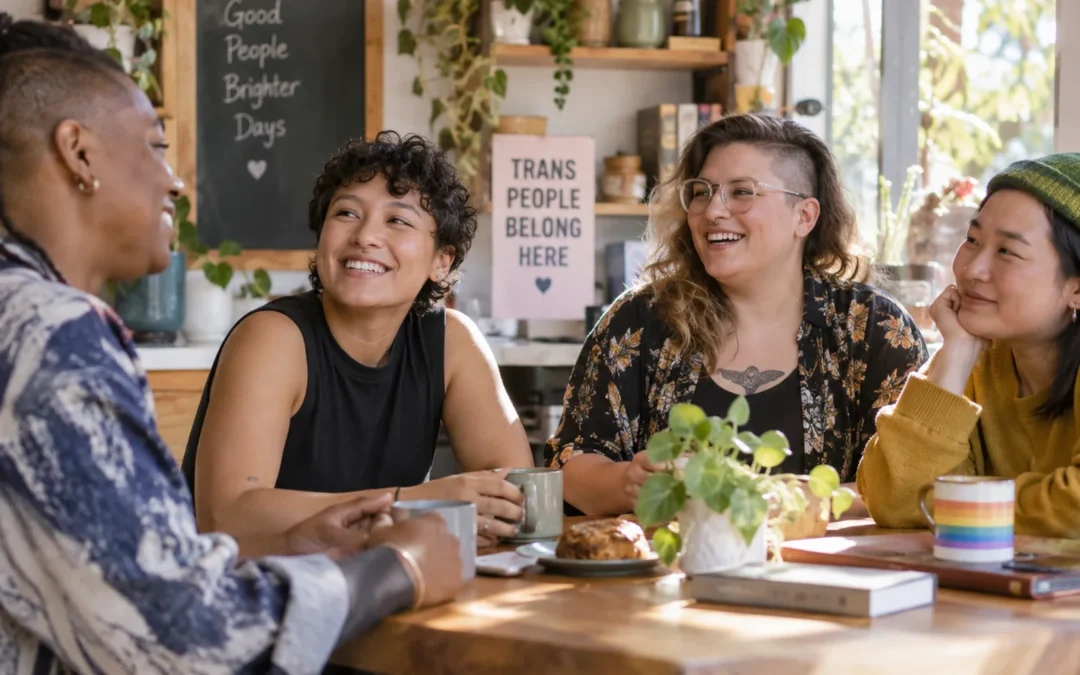

Feeling lonely does not always mean that you need more people in your life. What may be missing is emotional intimacy, understanding, reciprocity, safety, belonging or simply a relationship in which you do not have to monitor which parts of yourself are visible. Before adding more contacts, it can be more useful to work out what kind of connection you need now and which existing relationships already provide part of it.
In this article, you’ll find
You can spend most of the day around other people and still go home feeling as though nobody really knows you. You may have friends you laugh with, family members who ask how you are, pleasant colleagues and even a partner, yet still experience a distance that is difficult to name.
Perhaps your friends do not know that you are trans. Your family may not reject you, but conversations become awkward whenever gender comes up. You may have joined an LGBTQ+ space and been surprised to discover that you still felt like an outsider. Or perhaps people genuinely care about you, but you have become skilled at choosing your words, anticipating reactions and presenting the version of yourself that seems least likely to create difficulty.
In situations like these, “you need to socialise more” is not particularly useful advice. A better question is: what kind of connection is actually missing?
This guide sits alongside our wider resources for trans and non-binary people, but it does not assume that you need a trans-centred social life or that gender identity should be the main source of belonging in your relationships.
Not every form of loneliness means that you need more people
We often use one word — loneliness — for several quite different experiences. Separating them matters because they do not all call for the same response.
Objective social isolation
There is relatively little social contact: few conversations, few meetings or long periods without anybody to rely on. This is not automatically distressing; some people genuinely enjoy and need a great deal of time alone.
Subjective loneliness
People are present, but the contact available does not match the connection you need. A busy social calendar can coexist with considerable emotional loneliness.
Lack of emotional intimacy
You have relationships, but very few in which fear, shame, doubt, excitement or need can be expressed without feeling burdensome, exposed or obliged to explain yourself.
Lack of belonging
You participate in groups but still feel like a guest. Formal inclusion is present, yet the deeper sense that “there is a place for me here” is missing.
Company with self-censorship
You are not physically alone, but an important part of yourself remains carefully edited. The relationship may contain genuine affection whilst offering too little freedom to relax fully.
Chosen solitude
Time alone after demanding social experiences can be restorative. Needing quiet, privacy or a break from people is not automatically a problem that has to be corrected.
There is another possibility too: stepping away from people may originally have protected you, but over time the withdrawal may have become increasingly driven by fear, shame or an expectation of rejection. A strategy can make complete sense when it develops and still become costly later.

Before looking for more people, ask what kind of connection is missing
When loneliness hurts, it is understandable to think in numbers: “I need more friends”, “I should go out more”, “I ought to meet people”. Yet more contacts do not necessarily solve the difficulty you actually have.
Perhaps you already have people to go to the cinema with or meet for a drink, but nobody you would call when something hurts. What is missing may be emotional intimacy, not company.
You might have somebody with whom you can discuss gender for hours, yet long for a friendship where you can cook, play a game, complain about work or share a joke without your identity becoming the main subject. What is missing there may be ordinary companionship and mental rest.
In other situations, contact itself really is scarce. Moving home, working remotely, a relationship ending, living somewhere with few suitable social opportunities or gradually losing older friendships can leave very little day-to-day interaction.
A more precise question than “why am I so lonely?” can be: “If my social life felt slightly better tomorrow, what would actually be different?” Perhaps there would be somebody you could message, somebody with whom you could be vulnerable, a group built around an interest, or one relationship in which you did not have to justify who you are.
Being with somebody without feeling known by them
Relationships can be close in one area and distant in another. Somebody may know your family history, favourite films, work frustrations and sense of humour whilst knowing nothing about the fact that you are exploring your gender.
They may care about you deeply and still not know something that currently occupies a significant amount of emotional space. This can create a particular kind of loneliness: being attached to somebody whilst feeling that part of the relationship depends on certain information staying outside it.
These questions may help you understand the cost without forcing you to classify the relationship as simply good or bad:
- How much of myself can I show here?
- What parts of my story do I edit in order to keep this relationship?
- Can I relax, or am I presenting a particularly safe version of myself?
- Could I mention something related to gender without immediately fearing that I might lose this person?
- Can we talk about other things without every conversation being pulled back towards my gender?
One distinction is essential: privacy is not the same thing as forced concealment. Other people are not automatically entitled to know that you are trans. You may decide that a colleague, relative, casual friend or acquaintance does not need particular personal information and feel entirely comfortable with that choice.
Disclosure is not automatically therapeutic either. Safety, financial dependence, intimacy, culture, context and personal preference all matter. If you are specifically deciding whether, when or how to tell somebody, our separate guide on coming out as trans or non-binary looks at that decision in more depth.
Affirmative support is visible in behaviour, not only in the words “I support you”
Hearing somebody say that they accept or support you can matter. A sense of safety in a relationship, however, is often built through smaller actions that happen repeatedly.
- using the name and pronouns you have agreed;
- correcting a mistake without creating a scene in which you have to reassure them;
- protecting private information and not disclosing your trans identity to somebody else without consent;
- listening to a difficult experience without immediately changing the conversation into a debate about gender;
- respecting and, where appropriate, helping to uphold your boundaries with other people;
- not expecting you to provide an endless education about every trans-related subject;
- remaining interested in your work, interests, relationships, plans and the many parts of life that are not about gender;
- being available for concrete difficulties within their own realistic limits;
- respecting that sometimes you want to talk about gender and sometimes you do not.
This is not a checklist for identifying a flawless ally. People make mistakes, have limits and may need time to learn. A sufficiently safe relationship does not demand perfection; it usually allows people to repair mistakes, hear their impact and adapt what they do.
Someone may also know relatively little about trans identities whilst treating you consistently with care, respect and curiosity when learning is genuinely needed. The important people in your life do not all need the same level of specialist understanding.

Belonging is not quite the same as fitting in
Everybody adapts somewhat across different settings. We do not speak to a close friend in exactly the same way that we speak during a work meeting, and that does not necessarily mean that either version is false.
Fitting in becomes costly when it requires near-constant monitoring: how you speak, move, dress, what subjects you mention or which parts of your history need to stay hidden so that your place in the group feels secure.
Belonging usually contains something more. It includes a sense that you can remain recognisably yourself within the relationship. This does not mean that nobody ever disagrees with you, that everybody thinks alike or that complete disclosure is required. It means that keeping the relationship does not continually depend on erasing important aspects of yourself.
Being trans also does not have to be your main source of belonging. You may feel deeply connected through music, sport, gaming, a profession, faith, art, culture, study, neighbourhood life, activism, a shared interest or a friendship that has existed for years.
Meeting other trans people is very important to some people. For others, it is one small part of their social world. Some have little interest in identity-based spaces at all. None of those positions determines whether somebody is sufficiently trans or non-binary.
Community can be protective without having to become “your place”
Meeting people with similar experiences can be powerfully normalising. It may provide language for something that was previously difficult to explain, practical knowledge, different ways of living a trans life, friendships, and conversations that require less explanation.
Reviews of research on trans community connection describe potentially valuable links with several aspects of health and wellbeing. But the evidence is more nuanced than “more community is always better”.
A large 2024 meta-analysis across LGBTQ+ populations found that the psychological experience of belonging had more consistently favourable associations than simply taking part in community activities. It also found that relationships differed across age and the presence of other marginalised identities. Being in the room, therefore, is not the same as feeling that the room includes you.
Community may offer
- normalisation and recognition;
- practical knowledge from shared experience;
- different models of how gender can be lived;
- peer friendship and support;
- opportunities for participation and belonging.
Community spaces can also contain
- comparison and feeling that you are “behind” other people;
- implicit rules about the right way to be trans;
- political or generational conflict;
- racism, classism, ableism or other forms of exclusion;
- pressure to share personal information;
- the fear of not being “trans enough” to fit in.
If you try a particular group and do not feel comfortable there, that does not prove that something is wrong with you, nor does it necessarily mean that the group itself is bad. Sometimes there simply is not enough compatibility. No individual community has to become your home, and you do not owe any particular community that role.
Family of origin and chosen family do not have to compete
Chosen family generally describes relationships of care, commitment and mutual support that take on family-like significance without necessarily depending on biological or legal ties. The concept has particular importance in LGBTQ+ histories where conventional family structures have not always been able or willing to provide sufficient support.
That does not mean chosen family should automatically replace family of origin. Real relationships are rarely that tidy.
You might love your family and experience their support as incomplete. You may need firmer boundaries without ending contact. You might take distance for a period and later rebuild parts of the relationship. You may remain close to some relatives but not others. Friends may provide one kind of care whilst family provides another.
Equally, a supportive family of origin can remain central even when friendships or other relationships acquire a family-like meaning.
The aim is not to decide which relationships you ought to keep. It is to understand what support is actually present, what each relationship costs you, which boundaries you need and which choices are sufficiently safe for you.

Online support can be genuine support
For many trans people, the internet is not a second-rate form of social life. It may be the first place where they find language for their experience, see lives that differ from those available locally or speak to somebody who understands something they have never been able to explain face to face.
This can matter particularly when you live in a smaller area, suitable local resources are limited, travel is difficult or you do not currently want to share your identity within your offline environment.
Spending a great deal of time online, however, does not necessarily mean that you are receiving support. Several different experiences are worth separating:
Connection
There is exchange, recognition and some reciprocity. You can speak, listen, feel accompanied and gradually build continuity with particular people.
Information
Other people's experiences or reliable resources help you understand possibilities and put words to your own experience even when no personal relationship develops.
Comparison
You begin by looking for reference points and end up grading your body, transition, identity, relationships or life against a highly selected group of other people.
Overexposure
Online time keeps you immersed in arguments, hostile comments, transphobic content or distressing news that leaves you on alert long after you close the app.
The same platform can provide all four at different times. The useful question is not “is the internet good or bad?” but what is this particular use doing for me, and how do I feel afterwards?
Our separate guide to trans identity and social media looks more closely at comparison, algorithms, hostile content and ways of using social platforms with more intention.
A support network does not have to rest on one person
When you finally find somebody with whom vulnerability feels possible, it makes sense for that relationship to become very important. Without anybody intending it, however, one person can gradually begin carrying almost every support function.
A partner may become the only person with whom you discuss gender, the only person you see socially, the only person you ask for practical help and the only person who sees you when things are difficult. A close friendship can take on the same role.
That does not make the relationship unhealthy. It simply places a great deal of weight on one connection, so illness, conflict, distance or a breakup can leave several needs without an alternative at the same time.
A more distributed network might include:
- somebody you can talk to when you are low;
- somebody you can ask for a specific practical favour;
- a person with whom you can have fun and mentally switch off;
- somebody who understands particular trans experiences well;
- somebody who does not understand everything but consistently respects and listens;
- a relative, partner or friend;
- a meaningful online relationship;
- a healthcare or mental health professional;
- an association, activity group, cultural community or faith community that is sufficiently safe for you.
You do not need all of these. There is no ideal network to complete. The point is to move beyond the binary question “do I have support or not?” and recognise that different relationships can meet different needs.

Three Ocnos tools for understanding and caring for your network
These tools are not designed to score people or make automatic decisions about who should remain in your life. They are ways of seeing your relationships with a little more precision.
Map support by function
Rather than beginning with “who supports me?”, try answering several more specific questions:
Now look at the pattern. You may discover that you have more support than you had noticed because no single person provides all of it. Or you may see a specific gap: perhaps practical help and company are available but there is nobody with whom vulnerability feels possible.
You might also see concentration: the same person appears in every answer. That does not mean you should distance yourself from them. It may simply suggest that developing one or two alternatives would reduce the amount of emotional weight carried by a single relationship.
Circles of trust: different people can know different things
Trust does not need to exist in only two categories — “they know everything” or “they know nothing”. You can think in levels:
The aim is not to move everybody into the first circle. It is to have more choice about who knows what, rather than feeling that authenticity requires total disclosure or that safety requires hiding from everybody.
A connection compass and one small reconnection step
After an interaction that mattered to you, you might ask:
These questions are not a relationship test. A valuable conversation can be exhausting when the subject is painful, and an important person can have a bad day. Look for patterns rather than verdicts.
If you have been isolated for a long time, choose a deliberately small next step. It might be replying to a message, contacting somebody you once felt reasonably safe with, meeting for twenty minutes, attending an activity without having to speak, reading about a group before joining it, or going back to a shared hobby.
The aim is not to prove that you are brave. The step should create a little more opportunity for connection without requiring you to dismiss reasonable concerns about safety.
When previous rejection makes it hard to get close again
If somebody has rejected, mocked, exposed or treated you differently because you are trans, later caution is not irrational. Your history contains real information: some people and some settings can be harmful.
Difficulties may develop when a strategy that once protected you becomes generalised to almost every possible relationship.
- You experience rejection or loss of safety in earlier relationships.
- You begin expecting a new person to react in a similar way.
- You approach less, share very little, cancel plans or keep substantial distance.
- There are fewer opportunities to experience relationships that work differently.
- Loneliness increases.
- The loneliness itself seems to confirm the belief: “there really is nobody there”.
- Further withdrawal becomes more likely.
Changing this pattern does not require convincing yourself that everybody is safe. They are not. The aim is to make finer distinctions between situations: who has shown signs of trustworthiness, which risks are current, which precautions remain useful and where a small amount of closeness might be worth testing.
If expectation of rejection keeps you on alert even in settings that appear reasonably safe, our guide to hypervigilance and fear of rejection for trans people explores that process in more depth.
When psychological support may be useful
Loneliness is not a diagnosis. Having few friends, needing plenty of time alone, having no interest in LGBTQ+ groups or keeping your trans identity private are not mental disorders either.
Professional support may be useful when you feel stuck in a pattern that is difficult to change, for example when:
- you want connection but fear leads you to avoid almost every opportunity;
- relationships involve intense and persistent self-monitoring;
- loneliness has continued for a long period and causes substantial distress;
- almost every emotional need depends on one relationship;
- earlier rejection continues to shape present relationships that are meaningfully different;
- it is difficult to separate chosen privacy from concealment that is hurting you;
- isolation is occurring alongside depression, anxiety, hopelessness or other mental health difficulties.
If low mood or anxiety has also become prominent, our guide to anxiety and depression in trans people may help you understand some of the overlap.
Affirmative therapy should not require you to disclose your identity, join a trans community or rebuild relationships that are unsafe. The work may instead involve understanding why you became isolated, which forms of protection still matter and where there is space to build relationships with greater freedom.
If you are in Spain and experiencing suicidal thoughts or suicide risk, you can contact the Spanish Ministry of Health 024 service. It is national, free, confidential and available 24 hours a day. In an immediate emergency, call 112. These services do not replace ongoing healthcare when that is needed.
Frequently asked questions about loneliness and support networks
Is it normal to feel lonely even when I have friends?
Yes. Loneliness is not determined only by the number of people around you. You may have company whilst lacking intimacy, understanding, reciprocity, belonging or the freedom to show important parts of yourself. Asking what kind of connection is missing often tells you more than counting your friendships.
Do I need to know other trans people in order to be well?
Not necessarily. Meeting other trans people can provide valuable recognition, information and understanding for some people. For others it is not a central need. Belonging can grow through many parts of your life, and a meaningful support network does not have to be organised around gender identity.
What does “chosen family” mean?
Chosen family describes relationships that take on substantial roles of care, commitment or mutual support without necessarily being based on biological or legal family ties. It can exist alongside family of origin, complement it or become more important where family support is limited. The term does not imply that you have to end other family relationships.
Do I have to tell somebody that I am trans before we can be genuinely close?
No. Privacy is legitimate and no relationship is automatically entitled to your full history. It may be useful, however, to notice whether keeping something private feels like your own choice or requires such constant monitoring that emotional closeness becomes difficult.
Why is trusting people difficult after I have been rejected?
Previous experience may have taught you that closeness carries genuine risks, so caution can be protective. Sometimes that protection becomes generalised to new people and new settings. The aim is not indiscriminate trust, but learning to assess present-day signals of safety and allow different degrees of closeness where that is reasonable.
Can an online community be a real support network?
Yes. Online friendships and communities can provide genuine listening, continuity, information and belonging, particularly where geography or local resources create barriers. It is still worth noticing whether a particular space connects you with people or mainly increases comparison, conflict or exposure to harmful content.
What if I do not fit into LGBTQ+ or trans spaces?
Not feeling at home in a particular group says nothing definitive about your identity. Communities contain differences in age, values, politics, culture, class, disability, ethnicity and ways of understanding gender. You can try a different space or build belonging through parts of life that are not centred on identity.
Can one person be my entire support network?
One person may be your main source of support at a particular point in life. Difficulties can arise when every emotional and practical need depends on that single relationship, because conflict or unavailability can remove several forms of support at once. Where possible, developing a few alternative connections can add flexibility without diminishing the main relationship.
How can I start building support when I am very isolated?
Begin with something smaller than “make friends”. You might reply to one message, contact one reasonably safe person, research an activity, attend first as an observer or reconnect with an interest that involves other people. The step should open a possibility without demanding that you ignore safety or personal limits.
You do not need a perfect support network
Sometimes the first step is not meeting more people. It is understanding why you have become more distant, which existing relationships already support part of you and what sort of connection is missing now.
At Ocnos Psychology Clinic, affirmative psychological support does not assume that you should disclose your identity, reconcile with particular people or join a specific community. We offer face-to-face appointments in Palmones, in the Campo de Gibraltar, as well as online therapy.
Sources consulted
- Scarrone Bonhomme, L., Davies, S. and Beattie, M. (2023). Practicing Gender Affirming Therapy: What the Transgender and Non-Binary Client Can Teach Us. Open University Press. Publisher information.
- Pachankis, J. E., Harkness, A. R., Jackson, S. D. and Safren, S. A. (2022). Transdiagnostic LGBTQ-Affirmative Cognitive-Behavioral Therapy: Therapist Guide. Oxford University Press. Oxford Academic.
- Chaparro, R. A. and Abreu, R. L. (eds.) (2023). LGBTQ+ Affirmative Psychological Interventions: A Latine/x Perspective. Springer. Springer Nature.
- Dowers, E., White, C., Cook, K. and Kingsley, J. (2020). Trans, gender diverse and non-binary adult experiences of social support: a systematic quantitative literature review. International Journal of Transgender Health, 21(3), 242–257. DOI.
- Sherman, A. D. F. et al. (2020). Trans* Community Connection, Health, and Wellbeing: A Systematic Review. LGBT Health, 7(1), 1–14. DOI.
- Lefevor, G. T. et al. (2024). When connecting with LGBTQ+ communities helps and why it does: A meta-analysis of the relationship between connectedness and health-related outcomes. Psychological Bulletin, 150(11), 1261–1286. DOI.
- Puckett, J. A., Matsuno, E., Dyar, C., Mustanski, B. and Newcomb, M. E. (2019). Mental health and resilience in transgender individuals: What type of support makes a difference? Journal of Family Psychology, 33(8), 954–964. DOI.
- Cipolletta, S., Votadoro, R. and Faccio, E. (2017). Online support for transgender people: an analysis of forums and social networks. Health & Social Care in the Community, 25(5), 1542–1551. DOI.
- Jackson Levin, N., Kattari, S. K., Piellusch, E. K. and Watson, E. (2020). “We Just Take Care of Each Other”: Navigating ‘Chosen Family’ in the Context of Health, Illness, and the Mutual Provision of Care amongst Queer and Transgender Young Adults. International Journal of Environmental Research and Public Health, 17(19), 7346. DOI.
- Spanish Ministry of Health. 024 suicide prevention support service. Institutional information accessed September 2026.
Clinical note: much of the research on social support and community connection is observational, and a substantial proportion comes from North American samples. Associations between support, belonging and mental health do not establish that a particular kind of network will produce a specific psychological outcome for an individual. The value of a relationship also depends on its quality, context, safety and the person's needs.


