

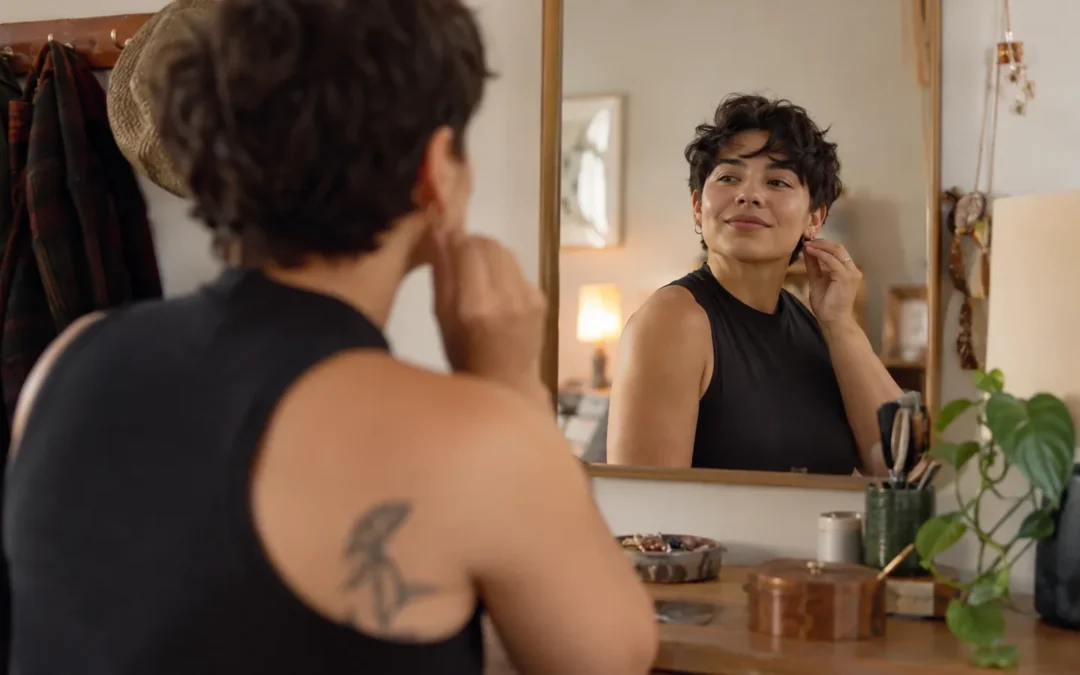

You can try a different way of expressing yourself without asking the experiment to tell you who you are. You may like a piece of clothing or dislike it. You can cut your hair and later prefer it longer. You can be curious about your voice and decide not to change it. Exploration can tell you something about preferences and wellbeing without becoming an identity test.
In this article, you’ll find
Sometimes a small question becomes much bigger than it needs to be. You see an item of clothing you would like to try and another thought immediately follows: “What will it mean if I like it?”
Perhaps you have been thinking about cutting your hair, growing it, wearing make-up, trying different accessories or experimenting with how your voice feels. Instead of simply finding out whether you enjoy something, each experiment begins to feel like evidence: “If this feels good, does that mean I'm trans?”, “if I dislike it, was I wrong?”, or “if I'm non-binary, shouldn't I look more androgynous?”.
That pressure can remove one of the most useful parts of exploration: being allowed not to know the outcome beforehand.
This article is about gender expression: clothing, hair, accessories, make-up, voice, movement and other ways of presenting yourself. We are not going to use any of them to determine your gender identity.
If your main question is still about understanding your identity itself, our guides to exploring gender identity and how to know whether you might be trans deal with that question more directly.
Gender identity and gender expression are not the same thing
Gender identity broadly concerns how somebody understands themselves in relation to gender.
Gender expression concerns ways in which somebody presents themselves or communicates socially through things that a particular culture may associate with gender: clothes, hair, make-up, gesture, voice, accessories, titles and other forms of presentation.
The two can relate to each other, but there is no compulsory correspondence.
A man can have a feminine expression
Enjoying clothing, accessories, gestures or styles that are culturally read as feminine does not automatically make him another gender.
A woman can have a masculine expression
She does not need to adopt a conventionally feminine presentation in order to prove that she is a woman.
A non-binary person does not have to look androgynous
Their expression can be feminine, masculine, androgynous, variable, conventional, striking or difficult to categorise.
Expression can change from day to day
Presenting differently tomorrow does not automatically require you to reinterpret your identity.
You may also have very little interest in aesthetics. For some people, clothing is an important form of self-expression. Others simply want something comfortable to wear whilst they get on with their day.
Either experience can exist alongside any gender identity.
There is no correct way to look trans or non-binary
Gender stereotypes can create a second set of rules just as somebody is beginning to question the first.
A trans woman may feel that she has to become especially feminine before other people will take her gender seriously. A trans man may wonder whether certain interests or styles make him insufficiently masculine. A non-binary person may start treating androgyny almost as a uniform.
Pressure can sound like:
- “If I'm a trans woman, I should want to wear make-up.”
- “If I'm a trans man, I shouldn't want to wear this.”
- “If I'm non-binary, people shouldn't be able to tell whether I'm a man or a woman.”
- “If I still enjoy something associated with my assigned gender, perhaps I'm not really trans.”
Those conclusions confuse identity with stereotype.
A trans woman can enjoy clothes other people consider masculine. A trans man can have a feminine expression. A non-binary person can feel entirely comfortable with a conventionally feminine or masculine presentation.
Expression can help you discover what you enjoy, what feels comfortable and how you prefer to present yourself. It does not have to produce a verdict about your identity.
Experimenting is not signing a contract
One useful way to reduce pressure is to make the question smaller.
Instead of: “Do I want to dress like this from now on?” you might ask: “Do I want to wear this for half an hour and see what I notice?”
Instead of: “Do I want short hair?” perhaps: “Am I curious about a different style or a smaller change first?”
Trying something does not create an obligation to keep it.
You can try a shirt and take it off. Wear make-up and find that it is not for you. Grow your hair and later cut it. Change an accessory. Explore a different communication style in private. Try a name or form of address with one trusted person and later prefer something else.
“I don't like this” is useful information too.
And “I don't know” does not mean that you must keep repeating the experiment until a clear answer appears.
“Reversible” does not mean “without consequences”
Many forms of expression are described as reversible. That can be useful shorthand, but it is worth being more precise.
Hair grows back, but it takes time. Clothes can be changed immediately, whereas an unpleasant social experience that happened whilst you were wearing them cannot be undone quite so quickly. A private photograph can be deleted from your phone, whereas an image shared with other people may be less controllable.
For that reason, terms such as low-commitment change, temporary experiment or easily modifiable change are sometimes more accurate.
The useful question is not only “can I undo it?” but: “what would trying this involve in this particular setting?”.

You can explore privately first
An experiment does not have to be public to count.
Some people need to experience a change around other people before they know how it feels. Others benefit from trying something without simultaneously dealing with questions, attention or other people's interpretations.
You might explore:
- at home;
- with one trusted person;
- for a few hours;
- through private photographs that you do not need to share;
- through a game character or avatar;
- in selected online settings;
- by trying something on in a shop without buying it;
- in therapy if talking about what you notice is useful.
Privacy can make an enormous question more manageable: “I'm going to try this and notice what happens.”
You do not have to announce the experiment or explain what it means.
Expression and safety sometimes need to be negotiated together
You may know exactly how you would like to dress and still decide not to do so in a particular setting.
Family, neighbourhood, school, employment, culture, faith, financial dependence and previous harassment can all affect how safe a visible form of expression feels.
“I'm not dressing the way I would ideally like” should not automatically be interpreted as irrational avoidance. Sometimes it is a realistic adaptation.
Affirmative psychological work should not require you to prove freedom through visibility. It can help you distinguish: what you would choose in a safer context, what you are adapting for concrete reasons and where there may be more room for choice than you currently feel.
Gendered meanings are not identical across cultures either. Clothing, hair, gesture and communication can carry different meanings according to age, period, culture, faith, profession and social class.
“Masculine”, “feminine” and “androgynous” are therefore not culturally fixed categories.
Clothes: explore preferences rather than categories
Clothing can be an accessible way to experiment because many changes are small and easily altered.
You do not have to begin by deciding whether an item is “men's” or “women's”. You may learn more by paying attention to your relationship with it.
- Which clothes make me curious?
- What would I wear even if nobody else were going to see me?
- What feels physically comfortable?
- What am I mainly avoiding because of what other people may assume?
- What am I wearing because I believe somebody of my gender ought to wear it?
- What changes when comfort, congruence or simple taste becomes the priority?
You may discover something that feels meaningfully connected with gender. You may simply discover that you like a particular pair of trousers.
Every aesthetic preference does not need an identity explanation.
Hair: experiment without demanding the perfect decision
Hair can carry considerable meaning because it is visible, because other people comment on it and because particular lengths and styles are culturally gendered.
It can also be just hair.
If regret worries you, it may help to think in degrees of commitment rather than two absolute options. You might first try a different hairstyle, tie your hair differently, use a wig or extensions temporarily, or make a gradual change before a larger one.
None of these steps is required. They illustrate a broader point: an experiment can be designed around the amount of uncertainty you are comfortable taking on.
If you make a larger change and then dislike it, the conclusion may simply be: “I prefer my hair another way.”
Regretting a haircut does not require a wholesale re-evaluation of your gender.

Voice: explore it if you want to, not because you have to
Voice can relate to identity, expression, communication, safety, dysphoria or personal preference.
It is highly important to some people. Others have no wish to change it. Some want to alter particular aspects of communication without seeking a voice that sounds clearly masculine or feminine.
Changing your voice is not a requirement for being trans or non-binary.
WPATH approaches voice and communication support through individual goals and explicitly recognises that not every trans or gender-diverse person wants professional voice support. Recent systematic review evidence is promising, although the evidence base remains comparatively small.
During informal exploration, you might simply notice aspects such as pace, intonation, volume, communication style or how familiar ranges of your own voice feel, without straining or forcing anything.
This article is not a technical voice-training guide. Some forms of voice modification require an understanding of vocal function and are better explored with suitably qualified professionals.
Voice exploration should not hurt. If you develop pain, hoarseness, vocal fatigue, persistent tension or loss of voice, stop practising and seek advice from a suitably qualified speech and language therapist or voice professional, ideally someone with specific competence in gender-affirming voice care.
A voice goal does not have to be “sound feminine enough” or “sound masculine enough” either. It may simply be a way of communicating that fits your own aims whilst remaining functional and vocally healthy.

The question is not “does this make me more trans?”
You try something and feel relief. Excitement. Embarrassment. Discomfort. Curiosity. Or nothing particularly significant.
It is understandable to wonder what the reaction means. Difficulties begin when one experience is expected to operate like a diagnostic test.
Feeling good in a particular outfit may simply mean that you like it. It may relate to how you prefer to express your gender. It may offer relief from expectations you have been carrying. Several meanings can coexist.
Feeling nothing in particular does not prove the opposite either.
A more useful observation may be: “this tells me something about this particular experience”, rather than: “this proves who I am”.
If you would like to understand experiences of gender-related comfort, distress, congruence or euphoria in more detail, see gender dysphoria, euphoria and wellbeing. None of these experiences functions as a standalone identity test.
Ocnos tool 1: a small gender-expression experiment
Try one thing and collect information rather than a verdict
The experiment can finish there. You do not need to add a compulsory sixth question asking what the experience proves about your identity. Sometimes the experiment is most informative when it is not required to answer anything larger.

Ocnos tool 2: want, “should” and safety
Three different influences can become mixed together inside one apparently simple choice.
Notice what is influencing the choice
All three can be present at once.
For example: “I want to wear earrings”, “I feel that I should wear make-up because I'm a trans woman”, and “at this workplace I prefer a more discreet presentation because I do not currently want to disclose my gender history” describe different influences.
The aim is not automatically to remove every “should” or ignore safety concerns. It is to know what is participating in the decision so that you have more room to choose.
Ocnos tool 3: think of a menu rather than a ladder
Gender expression does not need to progress in a sequence. There is no required route from clothes to hair to voice to make-up to public presentation.
Your expression menu can be inconsistent with stereotypes and still make sense
Consider each area independently and give it one of four responses: interested · perhaps · not interested · I don't know.
Your answers do not have to combine in a stereotypically coherent way. You might want long hair, masculine clothing, make-up, no voice changes and no interest in changing your name.
There is no final score.
When exploration starts becoming another demand
Exploration tends to provide useful information when some curiosity remains. It can become exhausting when every detail turns into repeated checking:
- “Do I look masculine enough?”
- “Does my voice sound feminine enough yet?”
- “Does this make me look non-binary?”
- “Why don't I look right yet?”
- “I need to check again whether these clothes make me look acceptable.”
At that point, the question has moved from “what do I like?” towards “am I passing the test?”.
If repeated evaluation of your body, photographs or mirror has become a significant part of the problem, our guide to body image and the mirror explores those processes in more depth.
If the main concern is how other people categorise your gender or pressure to look cis, see passing, visibility and fear of being identified as trans.
Social media can be inspiration without becoming a template
TikTok, Instagram, YouTube, Reddit and other platforms can provide something valuable: examples of clothes, hair, make-up and expression that may never have been available in your immediate environment.
They also show a selection. Certain bodies, outcomes, angles, styles and successful moments are much more visible than the ordinary, awkward or inconclusive experiments that happened along the way.
Transition timelines can be meaningful accounts of somebody else's experience. They are not schedules that your body, presentation or life must reproduce.
You can look at somebody and think “I'd like to try something similar” without changing that thought into “this is what I should eventually look like”.
If inspiration often becomes comparison or pressure, our guide to trans identity and social media looks at that process more closely.
Trying something and deciding against it is still exploration
You may buy an item of clothing you have imagined wearing for months and then dislike it once it is on.
You might try make-up and find it irritating. Or hear a recording of yourself using a different communication style and think: “That doesn't feel like me.”
It is easy to make the experience much larger: “So what does this say about my gender?”
Sometimes it simply means:
- I don't like that item of clothing;
- I prefer my hair another way;
- I do not want my voice to sound like that;
- make-up is not something I'm interested in;
- that particular form of expression is not for me.
Aesthetic preferences do not need an identity interpretation attached to each of them.
Your tastes are allowed to change too
Personal expression changes for many people with age, fashion, work, relationships, seasons, comfort, social setting or simple preference.
Being trans or non-binary does not remove that ordinary human variability.
You may enjoy a particular style for years and become bored with it. Wear a great deal of make-up for a while and later stop. Choose a particular hairstyle because it is convenient. Adapt to a work uniform. Have days when you enjoy making a statement and others when you barely want to think about presentation.
Not every change needs a deep reinterpretation of identity.
You can keep what is useful, leave behind what does not suit you and keep other questions open. Exploration has not failed when the answer is “this isn't for me”.
When discussing it in therapy may help
A psychologist should not decide what appearance belongs to your identity or design a presentation that makes you look more trans, more masculine, more feminine or more non-binary.
Therapy may be useful when:
- exploration creates so much anxiety that trying anything feels impossible;
- fear of judgement dominates many of your choices;
- it is difficult to separate personal preference from what you believe you ought to want;
- you avoid all exploration even in settings that are sufficiently safe;
- you demand a perfect presentation from yourself;
- every experiment becomes an identity test;
- particular preferences bring intense shame;
- family or relationship conflicts develop around how you present yourself;
- the issue overlaps with dysphoria, body image difficulties or hypervigilance;
- you need help deciding what pace and level of visibility are realistically safe in your circumstances.
Affirmative therapy does not prescribe an aesthetic. It can help create more space between “I'm curious about this” and “this has to prove something”, distinguish preference from pressure and take safety seriously without assuming that becoming increasingly visible is the only healthy outcome.
Frequently asked questions about gender expression
Does gender expression determine whether I am trans?
No. Identity and expression may relate to each other, but they are not equivalent. Clothes, hair, voice or aesthetics can provide information about your preferences without determining whether you are trans, cis, a man, a woman or non-binary.
Can I be non-binary without looking androgynous?
Yes. Non-binary identity does not require a neutral or androgynous appearance. A non-binary person may have a feminine, masculine, changing, conventional or difficult-to-categorise expression.
Does trying a different style of clothing mean that I am trans?
No. Trying a piece of clothing may tell you that you like it, find it comfortable, are curious about it or connect it with gender in some way. None of those reactions establishes an identity by itself.
What if I try something and then dislike it?
You have learnt something useful about that particular option. It does not automatically mean that your identity is false or that previous exploration was a mistake.
Do I have to change my voice if I am trans?
No. Some people want to explore or alter their voice and others do not. Voice change is not a requirement of trans identity. If practising voice changes causes pain, hoarseness, fatigue or persistent tension, stop and seek advice from a suitably qualified voice or speech and language professional.
Can I explore my expression only at home?
Yes. Private exploration can help you notice your own preferences without dealing with other people's reactions at the same time. You can also experiment with one trusted person, online or in any other setting that feels sufficiently comfortable and safe.
Is it normal to express myself differently in different settings?
Yes. Most people adapt aspects of their presentation according to work, family, culture, weather, comfort or safety. It can be useful to notice whether the adaptation feels chosen and manageable or is creating substantial psychological strain.
Does changing my expression mean that I am socially transitioning?
Not necessarily. You can experiment with clothing, hair or presentation without understanding it as a transition. If you want a fuller explanation of different transition decisions, see our guide to social, legal and medical transition.
Can a man have a feminine expression or a woman a masculine one?
Yes. Gender expression does not have to match stereotypes in order for somebody's identity to be valid. This applies to both cis and trans people.
How do I know whether I am choosing something because I like it or because I think I should?
The two influences cannot always be separated perfectly. You might ask what you would choose if nobody were evaluating your gender, which expectations you are trying to meet and which adaptations relate to genuine safety. The aim is not to find a perfectly pure motivation, but to understand what is shaping the choice.
You do not have to know in advance how you want to present yourself
You can be curious about some possibilities, rule out others and have no answer at all about the rest. An experiment does not need to become a permanent decision or evidence of who you are.
At Ocnos Psychology Clinic, we can help you separate personal preferences from external expectations, shame and safety concerns so that exploration contains more choice and less pressure to keep testing yourself. We offer face-to-face appointments in Palmones, Campo de Gibraltar, as well as online therapy.
Sources consulted
- Pachankis, J. E., Harkness, A. R., Jackson, S. D. and Safren, S. A. (2022). Transdiagnostic LGBTQ-Affirmative Cognitive-Behavioral Therapy: Therapist Guide. Oxford University Press. Oxford Academic.
- Martínez Guzmán, C. and Tomicic, A. (2023). ‘Psychotherapy and Affirmative Practices with Trans and Gender Non-conforming (TGNC) Patients in Chile’, in Chaparro, R. A. and Abreu, R. L. (eds.), LGBTQ+ Affirmative Psychological Interventions: A Latine/x Perspective. Springer. Springer Nature.
- Coleman, E. et al. (2022). Standards of Care for the Health of Transgender and Gender Diverse People, Version 8. World Professional Association for Transgender Health. Full text.
- Lorimer, G. and Rutter, B. (2025). The Efficacy of Gender-Affirming Voice and Communication Therapy: A Systematic Review. Journal of Voice. DOI.
Clinical note: this article does not use gender expression as a diagnostic tool or assume that one style of presentation improves wellbeing for every trans or non-binary person. Preferences, meanings and safety needs differ between people and settings. Evidence on gender-affirming voice interventions is promising but remains limited, so specialised voice work should be individualised and undertaken in a way that protects healthy vocal function.


