


Dyslexia today: far more than “reading badly”
Dyslexia is a specific learning difficulty that primarily affects reading and writing. However, its impact goes far beyond school grades. It is not related to intelligence, motivation or a child “not trying hard enough”, but rather to the way the brain processes written language.
In Campo de Gibraltar, many families live with dyslexia without realising it. Difficulties are often interpreted as “carelessness”, “laziness” or “lack of interest”, which can lead to misunderstandings and tension both at home and in school.
In clinical practice, we frequently see children, teenagers and adults who have carried years of silent distress linked to this difficulty: fear of reading aloud, embarrassment in class, or a persistent feeling of being “less capable” than others.
This article offers a clear, evidence-based and compassionate overview of dyslexia: what it is, how it is identified and how intervention is approached in professional practice in Campo de Gibraltar.
If you are looking for a detailed professional service, you can learn more about our dyslexia assessment and treatment service in Campo de Gibraltar .
What exactly is dyslexia (and what it is not)
Dyslexia is a neurodevelopmental condition that primarily affects reading accuracy, reading speed and comprehension, as well as writing and spelling. In practice, this means that a child may find it much harder to decode words, recognise them automatically and retain what they have read, even though they understand spoken explanations perfectly well and may show strong abilities in other areas. Dyslexia is not an illness or something unusual — it is a different way of processing written information, with a neurobiological basis and often a family component.

It is important to clarify what dyslexia is NOT. It is not a sign of low intelligence, laziness or lack of discipline. It does not “fix itself” with extra homework, punishment or repeating a school year. Many children with dyslexia in schools across Algeciras, La Línea or Los Barrios are creative, intuitive and strong in practical reasoning, art, sport or music. However, their academic performance may not reflect their true potential because the education system relies heavily on reading and writing. Understanding this difference between ability and the “instrument” (reading) is essential in order to avoid unfair labels.
It is also important to distinguish dyslexia from other difficulties that can lead to poor academic performance, such as attention problems, limited stimulation at home, emotional difficulties, or vision and hearing issues. Dyslexia can coexist with some of these factors, but it is not explained solely by them. For this reason, assessment should be thorough and consider the child’s cognitive and learning profile, emotional wellbeing, and family and school context. If you are looking for professional dyslexia assessment and treatment in Campo de Gibraltar , a specialist evaluation is the first step towards moving from blame to constructive support and making decisions that truly help.
Warning signs by age
Recognising early signs of dyslexia is essential in order to act promptly and prevent the difficulty from developing into low self-esteem, school avoidance or anxiety .
Early years (3–6 years)
During the early years (3–6), children may struggle to learn rhymes, remember sequences (days of the week, songs), pronounce certain words clearly, or learn the names of letters and their sounds. In many nursery and early primary school settings across Campo de Gibraltar (La Línea, Algeciras, San Roque, Los Barrios, Palmones, Tarifa, Jimena, Castellar), these signs may already be noticeable, but they are often mistaken for “late maturation”. When such difficulties persist, a psychological assessment may be advisable.
Primary school (6–12 years)
In primary school (6–12 years), dyslexia usually becomes more evident: very slow or fragmented reading, confusion between similar-looking letters, difficulty understanding what has been read, frequent spelling mistakes, and a noticeable gap between what the child understands orally and what they are able to express in writing.
Secondary school and adolescence
In secondary school and adolescence, the difficulty may be partially masked, but reading often remains effortful, spelling errors persist, and there is a common feeling that studying “takes three times as much effort”, often accompanied by frustration, fatigue and sometimes avoidance behaviours. Paying attention to how the child or teenager feels about reading aloud, sitting written exams or submitting assignments is just as important as observing their grades.
How dyslexia is diagnosed
Dyslexia should not be assumed based solely on school grades; it requires a structured professional assessment.
Dyslexia should not be assumed based solely on school performance; it requires a structured professional assessment . This assessment usually includes interviews with the family, the child or adolescent, and, when possible, the school. It also involves standardised tests of reading, writing, comprehension, verbal memory and other learning-related skills. The aim is not only to identify difficulties in reading and writing, but also to understand how these compare to the child’s age and overall intellectual level.
Different professionals may be involved in this process: a General Health Psychologist or Clinical Psychologist, an Educational Psychologist, a school counsellor, a Speech and Language Therapist, and teachers from the school. In Campo de Gibraltar, many families combine support from the education system with a more detailed private assessment in order to gain clarity and obtain a comprehensive report that can support school adaptations. At Ocnos Psychology Clinic in Palmones, the goal of assessment is not simply to label the difficulty, but to translate the results into a realistic intervention plan and practical guidance for both the family and the school — so that the diagnosis becomes a tool for support, not a limiting label.
Emotional and family impact
Dyslexia does not only affect reading and writing; it has a significant impact on how a child, teenager or adult perceives themselves. When someone makes a considerable effort and still struggles to achieve the expected results, thoughts such as “I’m stupid”, “I’m not good at studying” or “I always get it wrong” can easily emerge. This gap between effort and outcome is particularly painful in environments where comparison is constant, such as school.

At home, tension is also common: homework that takes hours, arguments about grades, punishments or labels such as “lazy” or “careless” that ultimately damage the relationship. Families often do not realise that dyslexia may be underlying these difficulties and may feel guilty, overwhelmed or confused. Understanding the root of the problem allows a shift in perspective: we move from thinking “they don’t want to” to recognising “they cannot (yet) keep up with the pace being demanded”.
When these difficulties begin to affect self-esteem, anxiety or family dynamics, seeking specialised support can be beneficial. A professional dyslexia assessment and treatment service in Campo de Gibraltar addresses not only reading and writing skills, but also emotional wellbeing and coordination with the school.
Understanding the origin of the difficulty allows families to move from blame to support, building healthier dynamics both at home and in school.
Treatment and intervention
- Specific intervention targeting reading and writing skills.
- Emotional support to protect self-esteem and motivation.
Targeted academic intervention
The treatment of dyslexia is based on two main pillars: structured intervention focused on reading and writing skills, and emotional support to reduce the impact on self-esteem and motivation. From an academic perspective, evidence-based re-education programmes are used to systematically train phonological awareness, decoding skills, reading fluency and spelling, adapted to the age and level of each individual. It is not simply about “doing more exercises”, but about working in a structured way, using appropriate materials and clearly defined objectives, so that effort leads to measurable progress.
Emotional support
The second pillar involves psychological support when difficulties are accompanied by anxiety , school refusal, exam-related blocks or a very negative self-image. Therapy helps the child, adolescent or adult understand their learning profile, challenge harmful labels and develop practical strategies to manage everyday challenges. Coordination with the school is essential: adjustments in exam timing, more flexible assessment formats, the use of assistive technology and a supportive attitude from teaching staff. At a psychology clinic in Campo de Gibraltar such as Ocnos Psychology Clinic in Palmones, the ideal approach involves the family, the individual and, whenever possible, the school, so that everyone works together and dyslexia becomes not a barrier, but a manageable challenge.
Dyslexia in the classroom: a guide for teachers
The classroom can either become a place of significant distress or a strong protective environment for a student with dyslexia, depending on how their needs are understood and addressed. From a neuropsychological perspective, understanding the student’s cognitive profile helps guide appropriate adaptations. When teachers interpret reading difficulties as a lack of effort or “poor handwriting”, the student often feels exposed, compared and sometimes humiliated in front of peers. By contrast, when dyslexia is recognised as a different way of learning, the classroom becomes a space where mistakes are allowed, questions are welcomed and progress can occur at an individual pace. This applies equally to both primary and secondary education.
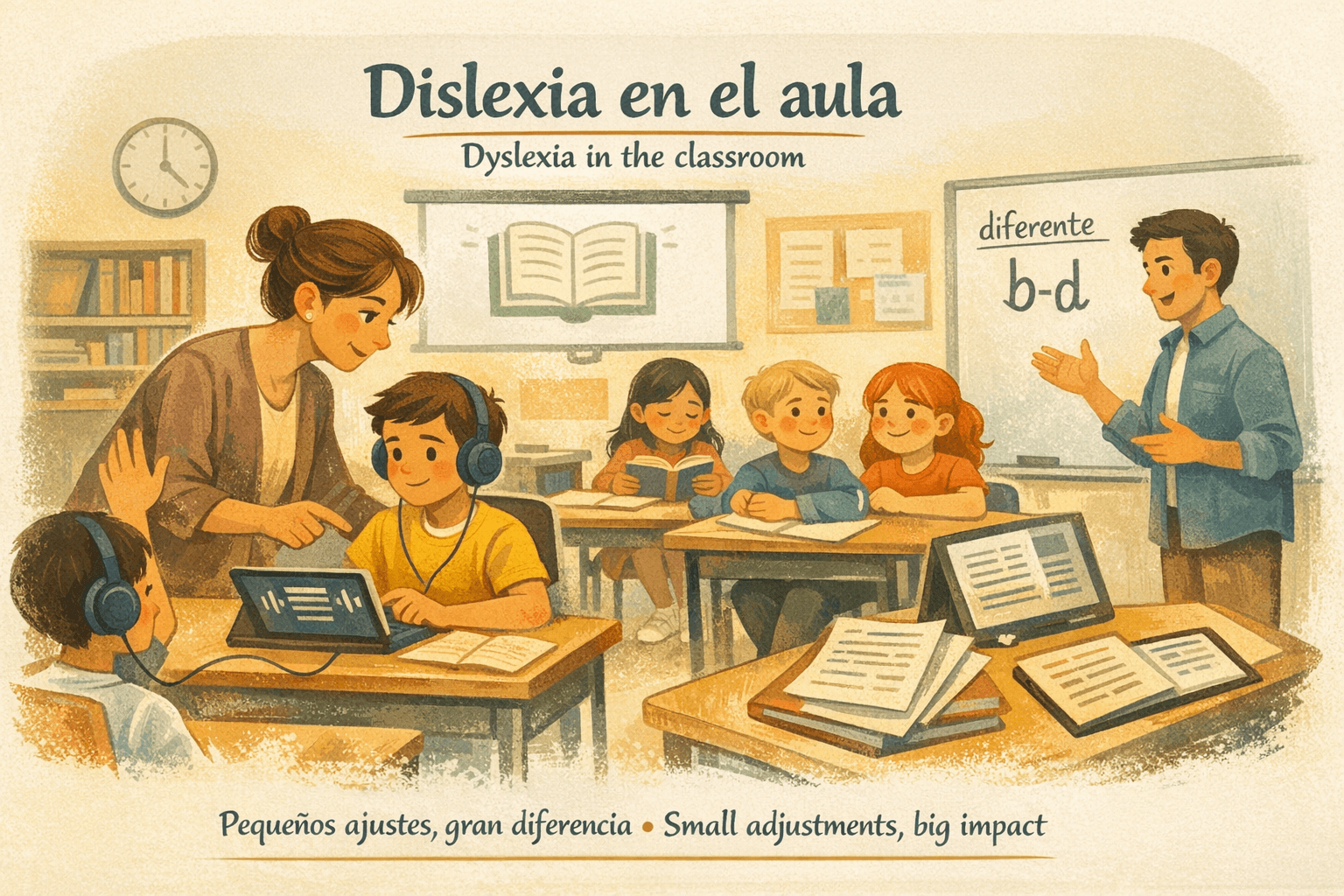
Some simple measures can make a significant difference: allowing extra time in exams and reading tasks; avoiding unexpected requests to read aloud; providing printed or digital notes so the student does not rely solely on copying from the board; focusing more on content than spelling in certain assignments; and permitting supportive tools such as reading rulers, audiobooks or more legible fonts. It is also helpful to explain to the class, in age-appropriate language, what dyslexia is and how to support a peer who has it, fostering empathy rather than ridicule. When teachers across Campo de Gibraltar engage in these small but meaningful adaptations, the positive impact on both academic performance and emotional wellbeing can be substantial.
Dyslexia in Campo de Gibraltar: local context and available resources
A context that may increase demands
Campo de Gibraltar has specific characteristics that influence how dyslexia is experienced and identified. The area is often characterised by bilingualism or exposure to multiple languages (Spanish and English), labour mobility among families and a wide cultural diversity. There may also be differences in resources between educational centres.
In practice, a child with dyslexia may face a higher linguistic demand. For example, a student living in La Línea de la Concepción and studying in Algeciras, or using materials in more than one language, may be required to perform academically under increased reading and writing expectations. Understanding this context allows families and professionals to adjust expectations and design more realistic and effective support strategies.
Local resources and ongoing follow-up
Access to specialised resources within the region avoids long journeys and enables closer follow-up. In Palmones, families can access dyslexia assessment and treatment in Campo de Gibraltar , with active coordination with primary and secondary schools.
Intervention goes beyond diagnosis. It includes guidance for families, specific recommendations for schools and a structured work plan tailored to each individual case.
The goal is not only to improve reading and writing skills. It is to ensure that every child, adolescent or adult with dyslexia can develop academically and personally without their context or educational situation becoming an additional barrier.
Practical advice for families
First step: observe and seek support
If you suspect that your child may have dyslexia, the first step is to observe without judgement. Take note of specific examples: slow reading, repeated errors such as confusing “b” and “d”, difficulty following written instructions, or excessive fatigue when reading.
Speak with their class teacher or school counsellor. Request a formal meeting at the school, whether in La Línea, Algeciras, San Roque, Los Barrios, Palmones, Tarifa, Jimena or Castellar. You can ask for an initial educational assessment.
If you need a more in-depth evaluation, a neuropsychological assessment allows a more detailed analysis of the cognitive and learning profile. It also provides a clear report that can help request appropriate adjustments at school.
How to support at home without creating conflict
Try to avoid turning homework into a battleground. Divide tasks into short blocks of 15–20 minutes. Introduce small breaks to reduce fatigue.
Use colours to organise information. Read aloud content that is difficult to follow in writing. Celebrate every improvement, even if it seems small.
Praise effort, perseverance and creativity — not only the final grade. Communicate with the school respectfully and in writing when necessary. Suggest practical solutions, such as extra time in exams or adapted materials.
And do not forget something important: take care of your own wellbeing. When adults manage their frustration more effectively, children feel safer and better supported.
Dyslexia in adults
Dyslexia does not disappear with age. Many adults seek support after years of masking their difficulties: unsuccessful professional exams, challenges writing workplace reports, slow reading of contracts or emails, or even avoiding promotions due to fear of written tasks. During childhood, family or school may have compensated without a formal diagnosis, but in adulthood the pace of work and personal responsibility can make the effort unsustainable and impact self-esteem.

Seeking assessment in adulthood is entirely valid and often very helpful. Through dyslexia assessment and treatment , it is possible to confirm the diagnosis, understand why certain challenges persist and develop practical strategies such as assistive software, audiobooks or techniques to improve reading fluency. Therapy also supports the restructuring of long-standing negative beliefs such as “I’m not capable”, helping individuals optimise performance without exhausting themselves on basic tasks.
Understanding dyslexia in adulthood allows individuals to let go of past guilt and build on their genuine strengths.
Costs of dyslexia assessment and report at Ocnos Psychology Clinic
If you are looking for a clear price for a dyslexia report or a private assessment in Campo de Gibraltar (La Línea, Algeciras, San Roque, Los Barrios, Palmones, Tarifa, Jimena or Castellar), here is full transparency.
€70 per session (50–60 minutes). Payment is made at the end of each session (Bizum, card or bank transfer).
How is an official dyslexia report prepared?
The report is developed through a structured assessment process. It includes interviews, observation and standardised tests. The aim is to describe the reading and writing profile and translate findings into practical recommendations.
| Stage | What it includes | Cost |
|---|---|---|
| Assessment 4–5 sessions |
Reading tests, phonological awareness, spelling, memory and other related skills.
Includes interviews and analysis of school or workplace context.
|
€280–€350 €70 x 4–5 sessions |
| Report writing and delivery Written report |
Integration of results, conclusions, personalised recommendations and intervention plan.
Delivered as a signed PDF.
|
€150 |
| Estimated total | Payment is made progressively. There is no formal financing or full payment required in advance. A flexible system so you can plan calmly. | €430–€500 |
- Free brief initial consultation (15 minutes) to guide the case and answer questions.
- Coordination with the school or college when helpful (with consent).
- Follow-up and clear guidance for families and educational centres after the report.
You can also explore our services in neuropsychology and psychological assessment.
Note: fees are indicative, as the number of sessions may vary depending on age and individual needs. The priority is that the report is genuinely useful and applicable — not a rushed formality.
Frequently Asked Questions (FAQ)
What is dyslexia? Can you give an example?
Dyslexia is a neurodevelopmental condition with a neurobiological basis. It mainly affects reading accuracy and fluency, and it can also influence writing and spelling. It is not related to intelligence.
Example: an 8-year-old child may read the word “was” as “saw”, omit word endings, or take a long time to decode a short paragraph. However, they may fully understand stories when they are told aloud.
How can dyslexia be identified?
Dyslexia is identified through a professional assessment. This usually includes reading tests, phonological awareness tasks, spelling and comprehension measures. The general cognitive profile and school context are also reviewed.
Many families notice early signs such as letter confusion (b/d, p/q) or significantly slow reading. In such cases, it is advisable to request an initial school assessment and, if necessary, seek a more detailed private evaluation.
Is dyslexia a type of ADHD?
No. They are different conditions. Dyslexia affects written language processing. ADHD is mainly related to attention, impulsivity and self-regulation.
In some cases, they can coexist. That is why a comprehensive assessment is important to tailor support appropriately and avoid confusion between different needs.
What is often confused with dyslexia?
Dyslexia is sometimes mistaken for lack of effort, visual or hearing problems, ADHD, general low academic performance or emotional difficulties. It may also be confused with teaching methods that are not sufficiently adapted.
The key is to assess specific skills carefully. This avoids unfair labelling and reduces unnecessary frustration.
Do people with dyslexia need glasses?
Dyslexia is not a visual problem. Glasses correct issues such as short-sightedness or astigmatism, but they do not “cure” dyslexia. However, if blurred vision is suspected, it is sensible to rule out additional contributing factors.
What causes dyslexia?
There is usually no single “trigger”. Dyslexia has a predominantly genetic and neurobiological origin. It typically becomes noticeable when formal reading instruction begins.
It is not caused by trauma or “poor parenting”. The important thing is early identification and appropriate support.
How do people with dyslexia write?
Persistent spelling and writing errors may occur, such as omissions, phonetic substitutions, letter reversals or slow written expression. Oral expression may be strong, but transferring ideas to paper can be more challenging.
In exams and assignments, this may affect grades even when ideas are sound. That is why reasonable adjustments can be very helpful.
How do people with dyslexia experience reading?
They do not “see” the world in a distorted way. Rather, reading often requires significant cognitive effort. They may tire more quickly, lose their place easily and need more time to process written information.
Many individuals with dyslexia show strengths in creative or visuospatial areas. The difficulty lies not in ability, but in the mental load required for reading and writing.
Do you suspect dyslexia?
If you have concerns about your child — or about yourself — a professional consultation can help you understand the situation clearly and without premature labels.
At Ocnos Psychology Clinic, we offer a free brief initial consultation (15 minutes) to explore your case and explain the next steps transparently.
Sources and references
- Mayo Clinic. “Dyslexia: symptoms and causes”. View source
- DisFAM – National Dyslexia Plan (Spain). Official framework for detection and intervention. View source
- DisFAM – Definition of dyslexia. View source
- Plataforma Dislexia España. Prevalence data and educational context. View source


